Azure foundation resources
Use this reference to review the v1 Azure foundation defined in infra/bicep/main.bicep. Bicep is Azure's declarative infrastructure language; AKS means Azure Kubernetes Service. The template defines a dedicated network and cluster, Entra-only PostgreSQL, and Key Vault, Blob Storage, and Azure Monitor resources. PostgreSQL, Key Vault, and Blob use private networking; Azure Monitor uses a private query path and an explicit ingestion path. Blob creates private platform-artifacts and session-material containers.
These definitions do not show that anyone deployed the resources, that private DNS resolves, or that a service has live access.
For the Broker, initial schema bootstrap is separate from runtime table access. The migration Job applies the canonical table grants as the migration owner, and read-only bootstrap verification checks those grants after migration. See Broker database permissions. These steps do not change the resource topology shown below.
The Orchestrator and Events & Sessions migrations use the separate P1 migration identity. The Events & Sessions Job repeats its Sessions and Messaging settings from the runtime map because the host validates them before --migrate.
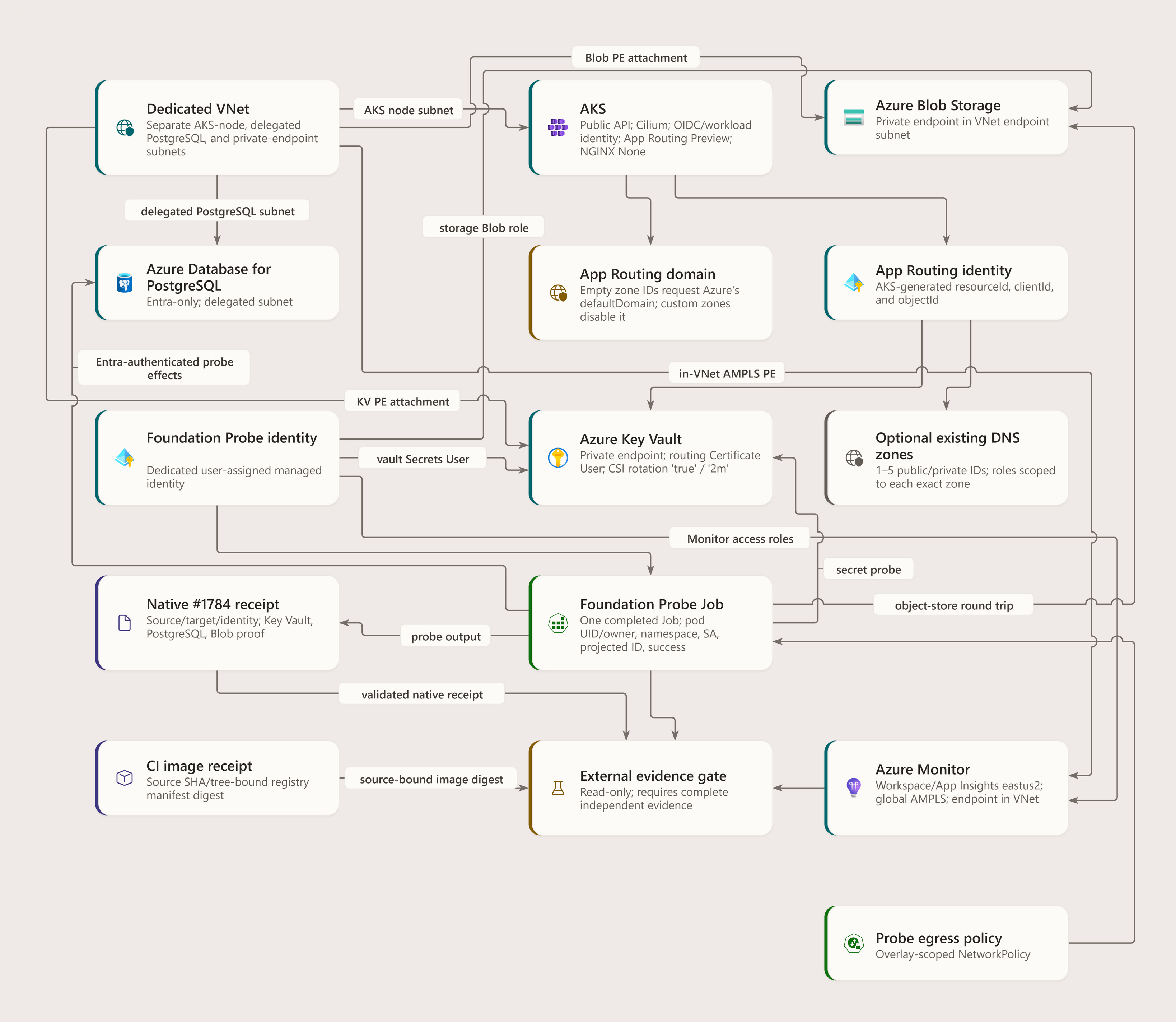
Open full-size PNG · Open editable draw.io source
The following sequence shows the verifier's time-ordered, read-only checks after the probe Job completes. It does not launch the Job or deploy resources. The P1 PostgreSQL migration Jobs are separate; the Events & Sessions Job validates its provider settings before migration.
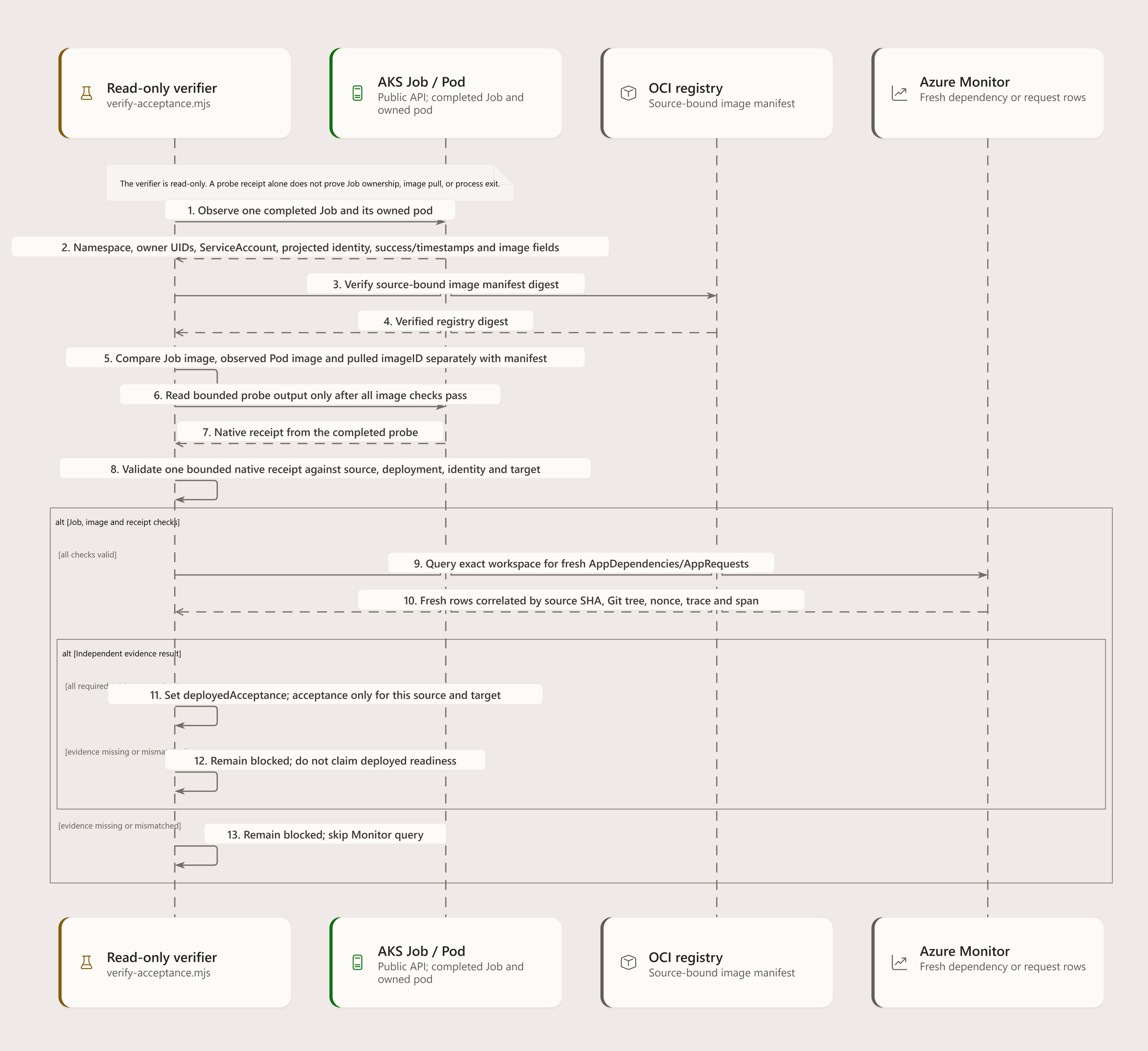
deployedAcceptance; the result does not claim broader P0 readiness.Open full-size PNG · Open editable draw.io source
Region placement
The intended v1 P0 placement is:
| Resource | Region | Notes |
|---|---|---|
| AKS, private VNet and subnets, PostgreSQL Flexible Server, Key Vault, Blob Storage, and Private Endpoints | eastus2euap | PostgreSQL is Entra-only and uses Standard_B2s. |
| Log Analytics workspace and Application Insights | eastus2 | Provider metadata advertises these Monitor resources in East US 2, not East US 2 EUAP. |
| Azure Monitor Private Link Scope (AMPLS) | global | Monitor resources can link to the global AMPLS. |
| AMPLS Private Endpoint | eastus2euap | It is in the EUAP VNet/subnet; the endpoint region follows its VNet. |
The root Bicep parameters bind that placement and the Entra administrator:
| Input | Requirement |
|---|---|
location | Set to eastus2euap for the VNet and core resources. The Bicep default is the resource-group location; reviewed P0 parameters must select the intended region. |
monitorLocation | Required; set to eastus2 for Log Analytics and Application Insights. |
postgresEntraAdminObjectId | Required directory object ID for the PostgreSQL Entra administrator. |
postgresEntraAdminPrincipalName | Required directory principal name for that administrator. |
postgresEntraAdminPrincipalType | Required; User, Group, or ServicePrincipal. Unknown is rejected, and a group is not required. |
Supply real administrator values only through reviewed operator parameters; documentation and checked-in examples keep placeholders.
Provider metadata advertises AKS, including API version 2026-07-02-preview, Key Vault, Storage, VNets, Private Endpoints, and PostgreSQL Standard_B2s in eastus2euap. East US 2 EUAP has no Retail Prices API meters, so this page makes no EUAP cost quote. Standard eastus2 rates are only a planning proxy. This region map is not deployment evidence and adds no 0.x product scope.
Blob containers and data access
The storage module creates private platform-artifacts and session-material containers. Both disable public access. The Foundation Probe identity keeps its account-scoped Storage Blob Data Contributor role for acceptance checks. The Events & Sessions identity receives Storage Blob Data Contributor on the session-material container only; it has no account-scoped Blob data role. These are source-defined scopes, not evidence of live containers or grants.
AKS and Application Routing preview
The full-foundation Bicep source uses Microsoft.ContainerService/managedClusters@2026-07-02-preview. It explicitly enables Kubernetes RBAC, separately from Azure RBAC, and configures native webAppRouting with nginx.defaultIngressControllerType set to 'None'. This source does not select an NGINX controller or create an application route.
The template configures the native managed Gateway API installation and Application Routing implementation. Its Gateway class is approuting-istio. The class name describes Azure's internal implementation, not a service-mesh addon or an Istio API requirement. The root Kustomize bundle supplies the exact-host Portal Web HTTPRoute, which references the shared https listener but does not create the Gateway or listener. The separate default-off routing installer uses native managed certificates, one v1 HTTPS listener for the wildcard managed domain, the Broker/Web/Gateway API/MCP HTTPRoutes, and verified backend HTTPS. It requires explicit approved Gateway namespace and security-policy inputs. The product namespace remains restricted. All four routes attach to that listener, while each HTTPRoute retains its exact Broker or Portal hostname and its existing paths and backend. This keeps both hosts' routes available when HTTP/2 connection coalescing reuses a connection across the certificate-covered origins; unknown hostnames still have no matching route. The shared listener routes / to Web, /api/v1 plus exact /openapi/v1.json to Gateway, and exact /mcp plus the MCP protected-resource metadata path to MCP. Gateway and MCP use operator-owned TLS Secrets with service-DNS certificates signed by the public CA in the service-backend-ca ConfigMap. These source routes do not prove live traffic. The issuer comes from the admitted route hostname. Public callback changes default to read-only append/no-op plans. An append requires separate explicit registration and exact-URI confirmation. The installer fresh-reads the selected application and preserves all other properties. Only the optional ordinary-DNS and trusted-HTTPS health checks prove Broker readiness. See the operator interface.
Separate default-off installer operations create initial Broker signing material, retained key-ring storage, and explicit public acceptance-client configuration. Existing state remains unchanged. The installer can align only the existing route hostname fields without changing Gateway placement or namespace policy. An intended route-derived issuer does not prove DNS, trusted TLS, or health. The Probe installer derives the existing identity, federation, and Monitor configuration without creating credentials or broader roles.
When appRoutingDnsZoneResourceIds is empty, the full-foundation template requests AKS's managed default domain. The appRoutingDomain output reports managedDefaultRequested: true and reads domainName from aks.properties.ingressProfile.webAppRouting.defaultDomain.domainName. The source does not construct a hostname. The preview API describes an autogenerated domain with a signed TLS certificate; offline validation does not prove preview registration, regional support, or HTTPS serving.
When the array contains custom zone IDs, the full-foundation template disables the managed default domain. It accepts one to five unique existing public or private DNS zone IDs in the exact authorized subscription. The guard rejects malformed, cross-subscription, and PrivateLink zone IDs. Public zones can be in one resource group and private zones in another; all zones of each kind must share one resource group.
For an existing P0 foundation, aks-redeploy.bicep reads the AKS-managed domain and issuer through an existing resource reference. It does not deploy Microsoft.ContainerService/managedClusters, so the generated domain name and Kubernetes RBAC setting are not removed by a partial AKS update. This AKS-only path does not change routing DNS configuration; use the full-foundation template only for its documented initial-deployment scope. If custom DNS means AKS omits defaultDomain, the output reports false and null rather than failing.
AKS supplies a separate appRoutingIdentity with resourceId, clientId, and objectId. Bicep scopes Key Vault Certificate User to the existing vault. It grants each configured DNS zone only its matching public or private DNS Zone Contributor role at that exact zone. The Bicep source defines these role assignments; they are not live role grants. The routing identity is separate from the Foundation Probe identity.
The template configures the Key Vault CSI provider and secret rotation with enableSecretRotation: 'true' and rotationPollInterval: '2m'. These values are template settings; the addon is not active in Azure.
Limited runtime identity setup
infra/bicep/p1-runtime-identities.bicep is separate from the P0 foundation topology. It uses the existing resource group location and the existing AKS OIDC issuer. The resource group and cluster locations must match before deployment. Its fixed service list is Projects & Config, Environment, Knowledge, Events & Sessions, and Orchestrator. Each identity trusts only its named ServiceAccount in agentweaver.
The template grants the Events & Sessions identity Storage Blob Data Contributor on the exact session-material container. It creates no database grant, migration identity, certificate, storage account, server, cluster, or node pool. It does not reuse or change Broker and Probe privileges. The output provides observed runtime client and principal IDs for workload configuration. Identity creation and federation do not prove database access or service readiness. The operator guide describes the separate approval boundary.
For an existing resource group that already has the Events & Sessions identity but lacks its configured container and grant, the focused infra/bicep/p1-session-material-access.bicep template creates only the private container and its container-scoped role assignment. The operator command and approval boundary are documented in the Azure operator guide.
The P1 PostgreSQL initializer is an explicit operator action, not part of an infrastructure deployment. scripts/azure/bootstrap-p1-postgres.mjs checks the fixed target, current PostgreSQL administrator, and all five live P1 principal IDs before it starts the temporary tunnel. It runs the Identity Broker and P1 database stages through the same loopback-only tunnel and removes only its run-owned transport resources. The command creates no Azure role assignment and deploys no product workload. Its receipt proves operator initialization only, not runtime identity or deployment success. The initializer rejects incompatible existing privileges without changing them. Before grants commit, it validates planned row-lock mutation guards and reads back each installed trigger/function against the exact table, trigger type, function source/owner, and runtime EXECUTE restriction. Its role stage checks all five mappings before commit. Its grant checks preserve existing ownership and permit only exact runtime grants. The source checks functions by owner and effective EXECUTE privileges, not counts alone. Its source catalog includes 34 Core migration versions (1 through 16, 18 through 33, and 35-36), with version 17 excluded and reserved version 34 skipped, ten Events versions, and 11 Environment versions. The initializer compares that catalog with each migrator's compiled version list. The reviewed offline plan hash is 2d23dae8dd58c37671fd196a13550907c244694c5a54b0ec51c1ffcde47ff1a1. It retains 115 tables, nine row-lock columns, and 33 exact function signatures. Events migration 010 adds session_object_inventory with exactly SELECT, INSERT, UPDATE runtime access. The Environment runtime bootstrap profile replacement store requires a separate SELECT, INSERT grant on environment.runtime_bootstrap_profile_replacements. Its planned access is exactly SELECT, INSERT; it adds no UPDATE, DELETE, or default privileges. Only casting authority can receive direct runtime EXECUTE. Restricted-role behavior and actual PostgreSQL catalog behavior still require separate database proof; source tests do not execute the initializer. For an initialized database, --inspect reads roles, schemas, migration history, and grants without writing. --apply-pending-migrations applies only missing Core and Events versions up to explicit maximum versions, then the exact plan grants. It fails closed if the source catalog extends past those maximums. --apply-projects-config-grants applies only the planned Projects & Config runtime grants after that service's migration Job; the migration runner calls it automatically. It checks the live history and objects against the source first, and commits only an exact grant readback. The separate continuation mode admits only the exact Projects-only prefix, checks ordered EF migration histories and every service's migration inventory, and migrates the other schemas without runtime object grants. Its pre-grant checks allow only owner ACLs or the known default PUBLIC EXECUTE on planned non-runtime functions while service schemas remain unavailable to runtime roles. It rejects unplanned views and materialized views, and checks their relation and column ACLs. The final grant transaction removes those public function grants and applies only the planned casting-function grant. These source changes do not change the P0 Azure topology. See the operator initialization procedure, the initializer source limits and the source-test boundary.
P1 migration identity
infra/bicep/p1-postgres-migration-identity.bicep defines one more identity, agentweaver-id-p1-postgres-migration, federated only to the p1-postgres-migration ServiceAccount in agentweaver. It has no Azure resource role. After a one-time ownership handover it owns the orchestrator and events_sessions schemas, so migration Jobs run in the cluster under their own egress policy instead of through an operator tunnel. The database maintenance runner deploys this template, applies the ServiceAccount and egress policy, performs the handover once, and runs the migration Jobs.
infra/bicep/db-maintenance-ci-identity.bicep defines the identity that the database maintenance workflow uses, agentweaver-id-db-maintenance. GitHub Actions signs in as it only from the v1-db-maintenance environment. It can read the resource group, get cluster credentials, and manage the maintenance Kubernetes objects in the agentweaver namespace. It cannot deploy Azure resources or assign roles, so it uses the migration identity as it is and never runs the handover. npm run db:maintenance:setup, run once by the PostgreSQL Entra administrator, creates both identities, runs the handover, and configures the GitHub environment.
Network and acceptance checks
The canonical Identity PostgreSQL grant definition includes the four runtime grant tables. The existing runtime role can read and insert audit rows and can update grant heads through CAS. It cannot delete these records, update audit rows, write migration history, or create schema objects. The verifier checks all 14 exact tables and their migration-role ownership. Tests use disposable restricted PostgreSQL principals for this source definition. It creates no new Azure identity or live role grant and does not run the operator bootstrap.
AKS exposes a public API endpoint protected by managed Entra authentication and Azure RBAC; local accounts are disabled. The cluster keeps Azure Linux nodes, Cilium networking, OIDC/workload identity, and ACNS security with observability disabled. The source leaves kubernetesVersion empty. Runtime acceptance requires Kubernetes 1.29 or later.
The base NetworkPolicy denies traffic by default. The Foundation Probe overlay grants its own egress. The base does not provide telemetry exporter egress.
The base Cilium policies allow internal owner calls by exact service DNS name on the service HTTPS port. The shared Broker-issuer policy also allows its selected workloads to reach the identity-broker Gateway Pods on TCP 443. Cilium kube-proxy replacement maps the public issuer address to those Pods inside the cluster, so an FQDN-only rule cannot authorize that hairpin path. Events & Sessions and Projects & Config have separate endpoint rules for the same Gateway. Identity Broker has exact DNS and endpoint rules for its Projects, Orchestrator, and Environment owner calls. Orchestrator and Environment also allow Broker ingress on TCP 8443 for those requests.
The separate Identity Broker migration Job uses its own Cilium policy. Its Kustomize overlay resolves both the DNS rule and PostgreSQL TCP 5432 rule to agentweaver-pg.postgres.database.azure.com, matching the root runtime policy. This source binding does not prove that the live policy is accepted or that the database is reachable.
The Foundation Probe Job has a dedicated workload identity. It exercises Key Vault, Blob, PostgreSQL, and telemetry without redeeming through the Identity broker. A separate read-only consumer checks the completed Job and pod. It verifies the exact registry image and validates the native receipt. After the Job completes, the consumer queries Azure Monitor for matching stored telemetry. Configuration observations remain separate from runtime evidence.
These definitions and diagrams are not deployment evidence. Live role grants, addon activation, DNS zones, certificates, controllers, routes, and HTTPS serving are not verified by this page. The consumer has only been validated with local fixtures; it has not run against Azure or AKS. See Azure acceptance for the evidence boundary and deployment approval requirements.