Providers and models
Use this reference to understand how Agentweaver models provider choices and binds them to runtime resources. A provider seam is a contract boundary for one capability, such as Memory or Storage. An adapter implements that contract for a technology. The Agentweaver.Abstractions source currently defines 15 seams; a seam does not prove that its adapter or service is running. For configuration steps, see the planned provider configuration guide and runtime configuration reference.
The platform design now plans 16 seams. Canvas is new P2 work, not a current enum member or implemented resolver path. It separates A2UI and GitHub Canvas compatibility from Application Hosting.
ProviderDescriptor records the seam, provider ID, adapter version, options-schema version, hosting pattern, and advertised capabilities. It contains no option values or credentials.
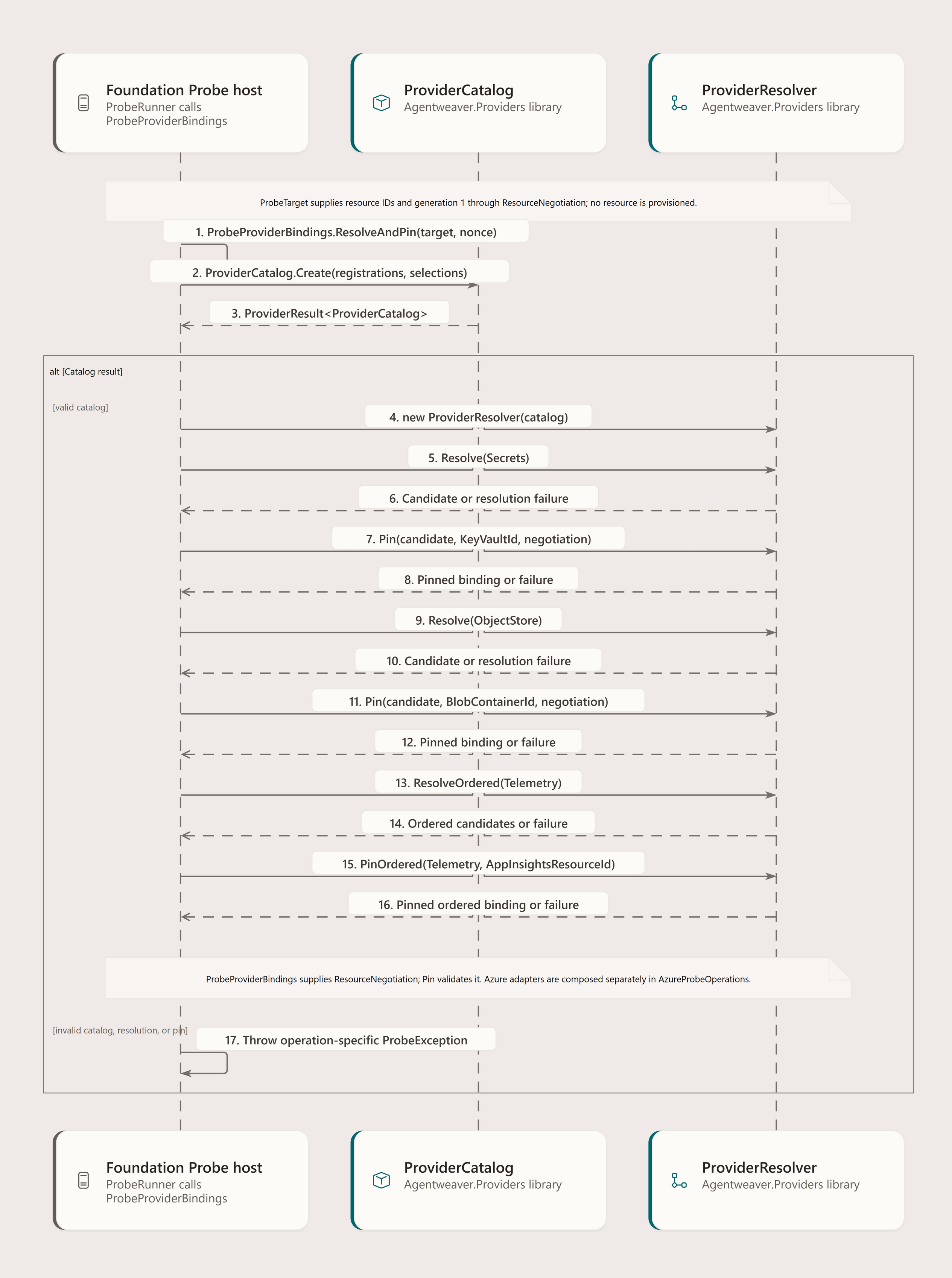
ProviderCatalog.Create validates registrations, defaults, allowed overrides, ordered sets, network-policy layers, and meter-keyed Cost selections. ProviderResolver checks cardinality, versions, options schemas, and capabilities.
Open full-size PNG · Open editable draw.io source
| Cardinality | Seams | Resolver status |
|---|---|---|
| Exclusive | Sessions, Snapshots, Sandbox, Storage, Memory, Source Control | Resolve and Pin support this form. Snapshots can resolve to explicit None. |
| Platform singleton | Policy, Secrets, Messaging, Object Store | Resolve and Pin support this form. Projects cannot replace the provider. |
| Ordered composite | Guardrails, Telemetry | ResolveOrdered and PinOrdered preserve the selected order. |
| Layered | Network Policy | ResolveNetworkPolicy and PinNetworkPolicy support required L3/L4 and optional L7 layers. Pinning requires a matching applied intent generation. |
| Keyed by meter source | Cost | ResolveCost selects one enabled provider per explicit source. PinCost and VerifyCost validate immutable Cost bindings. Projects persists candidates only. |
| Per application | Application Hosting | Not implemented. |
| Per canvas | Canvas (planned P2) | Not implemented in the current enum or resolver. |
Pinning records provider identity, adapter version, options revision, resource generation, and negotiated capabilities. It does not provision a resource or enforce policy.
The current Events & Sessions host resolves the exclusive native PostgreSQL Sessions provider through this catalog/resolver, negotiates the configured database, then pins the effective binding when a run's first session is created. It stores the exact provider ID, adapter version, options schema and revision, resource ID and generation, and capabilities against the project/run. Later append, replay, and live-subscription requests verify that exact binding; a changed or missing provider fails closed instead of falling back to a new default. The service emits bounded pin evidence through the existing telemetry helper without recording option values, credentials, or raw resource IDs. See the journal service reference.
The provider-neutral Sessions capability names, such as sessions.events.replay and sessions.events.fork, are in SessionsCapabilities in Agentweaver.Abstractions, so any Sessions provider can advertise them. The optional agentsessions.records provider in Agentweaver.Providers.Sessions.AgentSessions is a second Sessions implementation. It offers read-only replay of verified AgentSessions record exports. The host doesn't register or reference it. See Agent primitives proof of concept.
The authenticated Events run-binding route returns this actual consumer pin under existing exact-run read authority. Environment's current placement also exposes its successful consumer pin without option values or recovery metadata. Neither response converts accepted candidates into provisioned resources. The native SDK supplies its effective modelId separately from the immutable accepted modelSelectionReference and acceptedSelectionHash.
The shared, SDK-independent resolver reads AgentHost:ModelBindings and AgentHost:ModelBindingsRevision in AgentHost and the enabled Events native consumer. It resolves an exact accepted reference to an enabled concrete model and source mode. Its pin includes the configuration revision and canonical map hash. An optional positive PromptCapacityTokens is part of that canonical map. Omitted capacity preserves the historical null hash. Hosted prompt limits require the concrete native catalog capacity; an optional lower server limit can narrow it. BYOK prompt limits require the concrete server-owned capacity and explicit SDK provider configuration. AgentHost uses the narrowest accepted and available capacity, then pins the effective value for resume. The pinned native SDK uses this setting as a prompt-compaction threshold. It compacts removable conversation history; an irreducible latest turn can still be sent to the provider during that compaction attempt and then end with the SDK's capacity-attributed query error. This is not a hard admission check for every internal provider request or a guarantee that no request occurs. The runtime does not silently truncate input. These are not cumulative token budgets or internal model-call counters. For configured hosted credit limits, Events prices that concrete model before root acceptance or backlog claim, without creating SDK or usage facts. The Host later checks the accepted pin before SDK startup and verifies actual native model policy. The model ID must match the accepted model. Any provider ID returned by the SDK or context metadata must match the accepted BYOK provider; when the SDK omits provider attribution, it remains unknown rather than being treated as a mismatch. BYOK token pricing cannot substitute for hosted Copilot credit admission.
Explicit-event forks require the pinned provider's sessions.events.fork capability and a committed source event matched to its session-bound cursor. Events rechecks the Orchestrator's admission receipt inside the fork transaction, then atomically persists the target session and lineage with the provider-binding hash. Exact retries return the stored lineage; reusing an idempotency key for a different fork conflicts. The Orchestrator adds the lineage to its session tree only after its final owner-state recheck, so an unregistered target is not a usable child. Session tree and status routes report durable owner state; they do not imply a running AgentHost.
Event version 2 defines a typed PolicyEvaluation payload. The native journal advertises sessions.policy.evaluations for new run pins. Generic run-scoped callers cannot append these events because actor equality does not prove Orchestrator Core writer provenance. Each run keeps its exact persisted capability set across provider upgrades. Older pins remain usable for ordinary append, replay, subscribe, and additional session registration. The new receipt route returns 409 for a pin without this capability and does not advance the journal. New runs negotiate the expanded set.
The receipt route accepts only an immutable Orchestrator receipt ID. Owner writes and Events admission require current Core writer authority, accepted selection, and a matching active owner session/run, actor, and fence; each rechecks authority after owner-row lock waits, including duplicate attempts. Allow also requires its exact active grant. Deny and Error can reference an issued inactive grant, but remain non-authorizing facts.
The Orchestrator Core also contains the source-only agt.dotnet-yaml Policy provider. It requires a deny-by-default platform policy, rejects unsupported AGT actions, and requires every document in the platform and project sets to allow. It uses the existing platform-singleton catalog/resolver/pinning path; this adapter does not authorize a protected action or imply that runtime call sites are wired.
Knowledge uses the same exclusive Memory seam. Its run-selection request must contain exactly one Memory candidate. The service resolves that candidate through ProviderCatalog and ProviderResolver. It negotiates the live database identity, then persists an immutable project/run binding with the project, configuration, and context revisions. A missing adapter, capability mismatch, or different later binding fails closed without falling back to another provider. The current postgres.native-memory adapter implements the read, write, search, revision, proposal-promotion, and context-composition capabilities. The optional cosmos.memory source candidate implements those operations and accepted-effect delivery with a project-partitioned Cosmos container when registered and configured. See Knowledge and Memory for the service and its integration limits.
Project-wide search uses the same selected Memory provider through existing run-provider bindings. The provider query filters by project and searches all agents; discovery does not create or change a run binding.
Native PostgreSQL remains the default. Cosmos negotiation validates the existing container identity, /projectId partition key, required search composite index, and non-expiring default TTL; it does not provision resources. The redis.memory source candidate requires TLS and negotiates standalone-primary, AOF-always, noeviction, no-replica/no-cluster, and non-expiring-data constraints. Neither candidate provisions resources. These are Memory backends, not replacements for the PostgreSQL Sessions journal.
Application Hosting currently plans only the built-in AKS web runtime. Canvas owns A2UI and GitHub Canvas compatibility work. Elastic SAN is outside P2; Container Apps Sandboxes is a later Sandbox evaluation, not an application host.
GitHub Canvas research boundary
The GitHub Canvas research inspected the experimental public SDK at commit 2023ed29af3cae890b26f9e2a269a04d8ac7ba60 and permitted local declarations. The source snapshot reports SDK 0.0.0-dev, CLI 1.0.93-3, and global wire protocol 3; observed app discovery used runtime 1.0.93-1. These are evidence baselines, not Canvas-format versions or a tested interoperable pair.
The bounded target is declaration/action/lifecycle compatibility with trusted owned assets in Agentweaver's retained panel. No portable GitHub content format, rendering catalog, or generic browser bridge was established. No interoperability was executed; the historical reverse-engineering artifact is unavailable.
Core retains current actor authorization, operation identity, workflow gates, and artifact ownership. An instance or URL is not an artifact or grant. Reconnect must preserve its binding and obtain a fresh location; successful close does not prove cleanup. The detailed evidence, unknowns, and subset and planned acceptance cases inform a separate GitHub Canvas adapter. Canvas remains unimplemented in the current source enum and resolver. The research does not implement that adapter or establish deployment or publication acceptance.
Existing model and provider integrations
The host also registers postgres.native-messaging as the platform-singleton Messaging provider, with no project override. It negotiates the configured PostgreSQL resource and persists an immutable Messaging provider binding per run. The Orchestrator uses the internal addressed-message routes to validate durable owner outbox records and request delivery at explicit turn boundaries. There is no background delivery relay or automatic AgentHost scheduler. These are source-host integrations, not a deployed cross-service messaging endpoint.
The Foundation Probe registers azure-key-vault, azure-blob, and azure-monitor descriptors for its checks. These registrations do not form a product provider catalog.
Model is not a provider seam. The unpublished AgentHost executable uses the runtime library, not a new general model resolver. The library maps accepted references to actual SDK models through a registered connection and SDK catalog. This source does not declare deployed model-vendor support.
Platform defaults route planning, review, design, security, creative writing, and complex work to gpt-6.1-sol at High effort. They route code-writing and straightforward work to gpt-6-luna at High effort. Platform and project configuration can override the model reference and reasoning effort by task, role, or agent. An explicit project model selection pins every route for that project, preserving the 0.x run-pin behavior. The accepted run stores the resolved task/role/agent routes and each distinct model/effort selection. Every reference must be present in the immutable run context; an unavailable reference fails run acceptance instead of falling back. Platform configurations that omit task defaults get the built-in routes. Unless a project pins one model, a platform that doesn't offer both default models must replace or clear those routes; see Projects configuration.
The accepted reasoning effort is passed to the native Copilot SDK session and is recorded in the runtime binding and durable session material. An accepted ModelBindingPin, when present, must match that effort. AgentHost also resolves a separate server-owned pin for the exact reference, source mode, and effort; resume and usage evidence must match it. Before session creation or resume, AgentHost checks the requested effort against the selected model's capabilities. BYOK model bindings must list supported efforts explicitly. Unsupported or unknown effort fails closed; the runtime does not downgrade effort.
GitHub Copilot and BYOK remain distinct SDK modes. A selected SecretRef is not proof of the credential's format, current ownership, refresh, or SDK purpose. Copilot requires its supported GitHub credential path; BYOK requires an explicit SDK Provider configuration. A provider key, credential envelope, or GitHub App installation token must not be passed as an interchangeable Copilot GitHubToken.
The source repair adds an explicit SourceMode to platform/project model settings. Hosted mode selects a stable Identity-owned ConnectionId; BYOK selects an exact CredentialReference. Empty or unknown modes, invalid connection references, and mixed hosted/BYOK settings fail with standard errors. The Identity-owned connection lifecycle implements these contracts in source, not in a deployed service.
The accepted hosted selection and its hash remain immutable during normal token rotation. Each ModelSession receipt pins the current connection revision, exact secret version, grant revision, and credential kind. Identity and the current Core binding authorize use; a submitted connection ID alone gives no authority. Consumption rechecks current proof after remote waits and before SDK use. Stale receipts fail closed. Changes to the connection's owner, kind, scope, or GitHub identity require an authorized new binding or selection, not silent reassignment of the same ID.
Legacy omitted or null fields, stored JSON, and accepted hashes must remain unchanged. An accepted secret-pinned hosted selection cannot become a connection reference through a compatibility default or automatic migration. It returns an explicit migration-required or unavailable result until a new selection is authorized. BYOK retains its exact secret reference and SDK Provider configuration, without hosted fallback.
An accepted BYOK selection also stores the common ModelBindingPin from the server-owned model map. The pin includes the provider type, model ID, configuration revision, and configuration hash. The Host compares the pin before SDK use and records the actual effective model in SdkSessionFacts.ByokProvider. Core binds token measurements to these facts, the producer registration, and the dispatch ID. Events reads the immutable Core receipt by reference. It does not accept caller-supplied provider authority. Unknown pricing remains Unpriced.
Identity owns the Copilot connection and refresh lifecycle. Repository GitHub App credentials are a separate Identity connection. AgentHost mode selection remains a separate path. Platform/project model selection remains the documented scope. GitHub-user account linking can authenticate a deliberately selected Copilot binding; it does not add personal BYOK settings or personal model-provider preference or fallback. Controlled SDK catalog and usage fixtures do not prove live user entitlement.
A Cost source key and an opaque model-selection reference are not trusted SDK provenance. The native Projects run-selection routes retain the source key, adapter/options versions, options revision and capabilities without claiming SDK producer authority or admitting usage writes.
The copilot.usage-cost source adapter prices reported input, cached-input, cache-write, and output tokens directly in AI credits (AIC) using a provider-owned immutable rate-card snapshot. The operator supplies the versioned JSON document through EventsAndSessions:Cost:Copilot:RateCard:Json; startup validates its strict schema and hashes the exact document. The cost binding, snapshots, and accounting receipts retain the card version and content hash, so changing the ConfigMap does not reprice earlier usage. The default card cites GitHub's official Copilot model-pricing documentation, retrieved 2026-10-17. It contains the 33 models and published token categories listed below. Complete token measurements can be priced when the SDK omits Nano AIU. Copilot configuration does not supply scalar multipliers, and prices are not inferred from legacy multipliers. Missing token measurements, unsupported sources, unavailable context tiers, and unknown model rates return an explicit Unpriced result with a reason, never a zero price. A valid Unpriced quote does not itself block run admission or dispatch; its recorded usage remains visible but does not count toward credit limits, while priced usage continues to count. Malformed or tampered receipts still fail closed.
GitHub publishes the following USD rates per 1 million tokens. Values use the order input / cached input / cache write / output. A dash means the source marks the rate or long-context tier as not applicable; it is not a zero price. Long-context rates apply only above the listed input-token threshold.
| Model ID | Default rates | Long-context threshold | Long-context rates |
|---|---|---|---|
gpt-5-mini | $0.25 / $0.025 / — / $2.00 | — | — |
gpt-5.3-codex | $1.75 / $0.175 / — / $14.00 | — | — |
gpt-5.4 | $2.50 / $0.25 / — / $15.00 | 272K | $5.00 / $0.50 / — / $22.50 |
gpt-5.4-mini | $0.75 / $0.075 / — / $4.50 | — | — |
gpt-5.4-nano | $0.20 / $0.02 / — / $1.25 | — | — |
gpt-5.5 | $5.00 / $0.50 / — / $30.00 | 272K | $10.00 / $1.00 / — / $45.00 |
gpt-5.6-luna | $0.20 / $0.02 / $0.25 / $1.20 | 200K | $0.40 / $0.04 / $0.50 / $1.80 |
gpt-5.6-sol | $4.00 / $0.40 / $5.00 / $20.00 | 272K | $8.00 / $0.80 / $10.00 / $30.00 |
gpt-5.6-terra | $2.00 / $0.20 / $2.50 / $12.00 | 272K | $4.00 / $0.40 / $5.00 / $18.00 |
gpt-6-astra | $10.00 / $1.00 / $12.50 / $50.00 | 272K | $20.00 / $2.00 / $25.00 / $75.00 |
gpt-6-luna | $0.10 / $0.01 / $0.125 / $0.50 | 272K | $0.20 / $0.02 / $0.25 / $0.75 |
gpt-6-sol | $2.00 / $0.20 / $2.50 / $10.00 | 272K | $4.00 / $0.40 / $5.00 / $15.00 |
gpt-6.1-sol | $2.00 / $0.10 / $2.50 / $10.00 | 272K | $4.00 / $0.20 / $5.00 / $15.00 |
claude-haiku-4.5 | $1.00 / $0.10 / $1.25 / $5.00 | — | — |
claude-haiku-5.5 | $0.10 / $0.01 / $0.125 / $0.50 | 100K | $0.50 / $0.05 / $0.625 / $2.50 |
claude-sonnet-4 | $3.00 / $0.30 / $3.75 / $15.00 | — | — |
claude-sonnet-4.6 | $3.00 / $0.30 / $3.75 / $15.00 | — | — |
claude-opus-4.8 | $5.00 / $0.50 / $6.25 / $25.00 | — | — |
claude-opus-5 | $5.00 / $0.50 / $6.25 / $25.00 | — | — |
claude-opus-5.5 | $4.00 / $0.20 / $5.00 / $20.00 | — | — |
claude-sonnet-5 | $2.00 / $0.20 / $2.50 / $10.00 | — | — |
claude-sonnet-5.5 | $2.00 / $0.10 / $2.50 / $10.00 | — | — |
claude-opus-4.8-fast | $10.00 / $1.00 / $12.50 / $50.00 | — | — |
claude-fable-5 | $10.00 / $1.00 / $12.50 / $50.00 | — | — |
claude-fable-5.1 | $10.00 / $0.25 / $12.50 / $50.00 | — | — |
gemini-3.7-flash | $0.75 / $0.075 / — / $3.75 | — | — |
gemini-3.8-flash | $0.75 / $0.075 / — / $3.75 | — | — |
gemini-4-argon | $2.00 / $0.10 / — / $10.00 | — | — |
mai-code-1.1-flash | $0.20 / $0.02 / — / $1.20 | — | — |
grok-4.5 | $2.00 / $0.50 / — / $6.00 | 200K | $4.00 / $1.00 / — / $12.00 |
grok-4.6 | $2.00 / $0.50 / — / $6.00 | 200K | $4.00 / $1.00 / — / $12.00 |
grok-4.7 | $2.00 / $0.50 / — / $6.00 | 200K | $4.00 / $1.00 / — / $12.00 |
kimi-k3 | $3.00 / $0.30 / — / $15.00 | — | — |
The model IDs above are the rate-card keys. Pricing applies only when a key exactly matches the model ID returned by the Copilot SDK. The source defines one AI credit as $0.01 USD. The snapshot records the source URL and retrieval date so earlier usage is not repriced when GitHub changes rates. Keep the adapter options revision aligned with the provider catalog; the rate-card version identifies each pricing snapshot. The adapter and PostgreSQL ledger do not establish SDK producer authority. The separate runtime pipeline requires a current registration, original validated bearer, and purpose-bound observe credential before it commits actual SDK measurements. Events accepts only the resulting immutable source receipt reference.