
PostgreSQL and Blob Storage
Use this reference to understand how Agentweaver separates durable event delivery from large-object storage. Agentweaver.Persistence.Postgres stores outbox events and consumer inbox receipts in a service-owned schema. An outbox records work with the producer's database change; an inbox records a consumer's admission of that work. The library does not create domain tables or start a relay service. For provider selection, see the planned provider configuration guide.
The separate Agentweaver.EventsAndSessions service owns its events_sessions schema by default, including the journal, session/provider bindings, and object-reference retention records. Its explicit migration composes the outbox/inbox schema with those domain tables; ordinary service startup verifies the schema and does not migrate it. The journal reference describes append, replay, live cursors, and the migration boundary in detail.
Open full-size PNG · Open editable draw.io source
Open full-size PNG · Open editable draw.io source
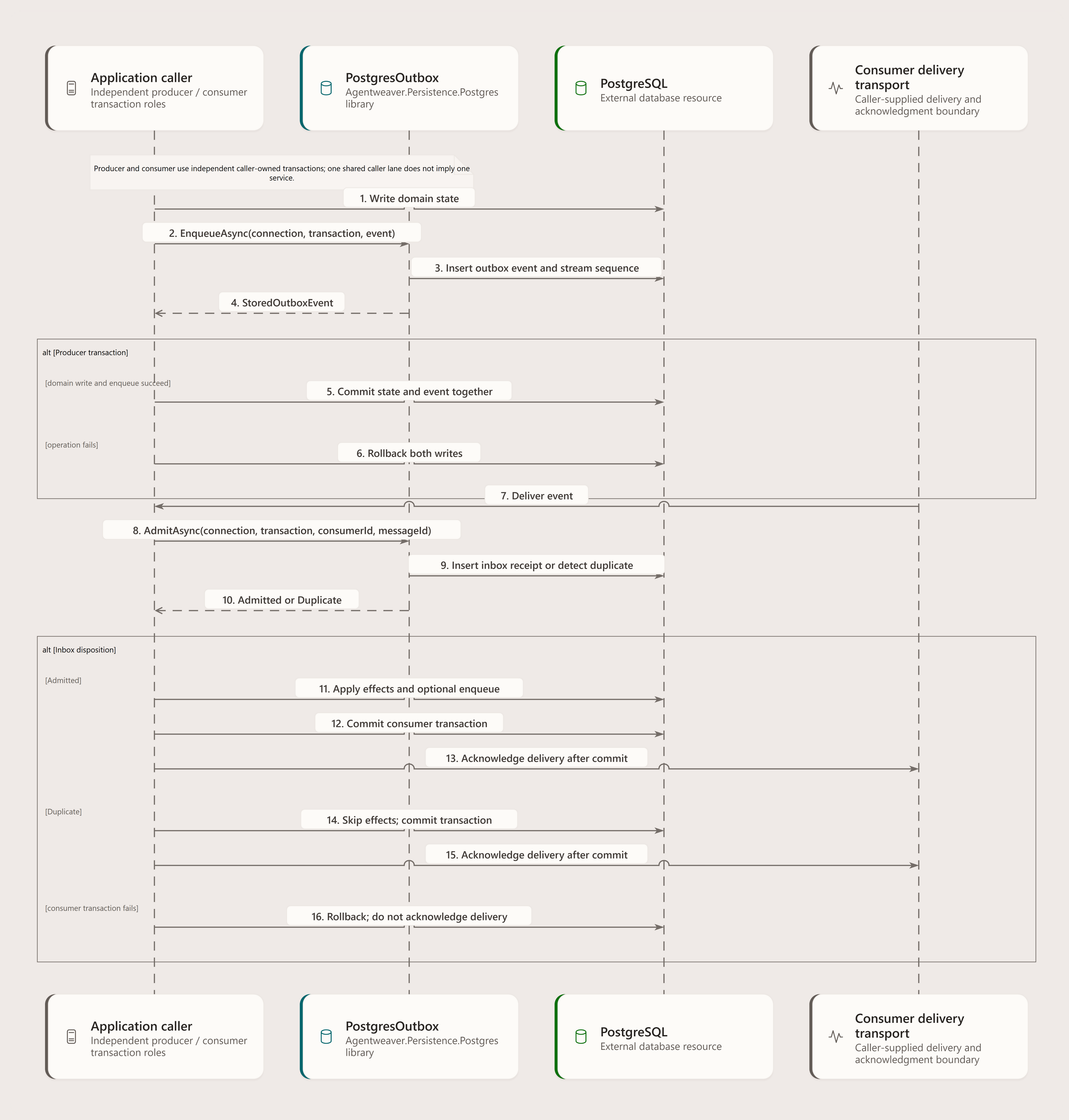
Call EnqueueAsync with the same open connection and transaction as the domain state change. PostgreSQL assigns stream sequence numbers and enforces stable event IDs and idempotency keys.
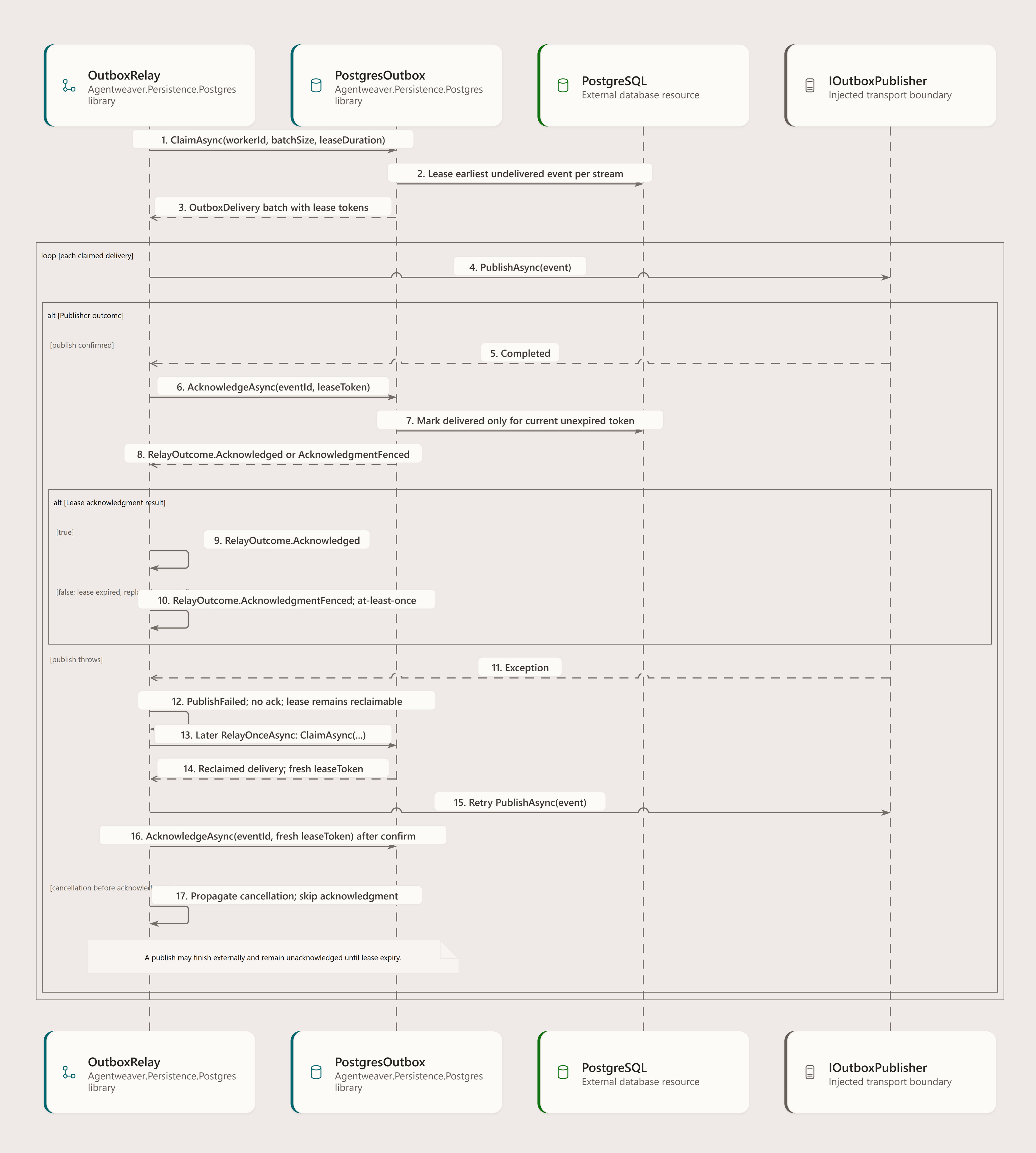
ClaimAsync leases the earliest undelivered event per stream. ClaimOneAsync leases a requested event only when it is next in its stream and its prior lease is absent or expired; it returns null when the event cannot be claimed. Both return a lease token, and AcknowledgeAsync accepts only a current, unexpired token. The Orchestrator uses the single-event claim for synchronous admission of its selected owner-outbox message; it does not add a background relay.
OutboxRelay publishes through an injected IOutboxPublisher, then acknowledges only confirmed publishes with the current lease token. A failed, cancelled, or fenced publish remains unacknowledged and can be reclaimed; the transport can finish a publish externally before a failure. The host calls RelayOnceAsync. The library does not start a daemon or provide exactly-once delivery.
Call AdmitAsync with the same transaction as consumer state and any new outbox event. Apply effects only for InboxAdmission.Admitted. Skip effects for InboxAdmission.Duplicate. Acknowledge delivery after commit.
Delivery remains at least once. The inbox prevents duplicate committed local effects when the consumer gates all effects on the receipt and transaction.
Agentweaver.ObjectStore.AzureBlob implements IObjectStore for opaque platform objects. It does not provide agent workspace storage, create a container, authorize callers, or fall back to disk. The container must exist before the adapter is used. Blob writes do not commit PostgreSQL references.
The Events & Sessions host composes the adapter with its typed session-material owner when an explicit HTTPS container is configured. The host's workload identity receives Blob access for that container; AgentHost and runtime clients use the owner's authenticated routes and do not receive Blob credentials or direct container access. The foundation Bicep creates the private session-material container and assigns its role at container scope. These source definitions do not prove that the container or role assignment has been deployed.
Session event payloads store typed opaque ObjectKey references with purpose and optional byte length. PostgreSQL stores the ordered event, reference, and retention metadata; Blob stores only the referenced bytes. The trusted Events owner controls authorization and access to those bytes. See Events & Sessions.
Events and Blob have different jobs
Events & Sessions is the journal service. Azure Blob is the large-object backend. They are not competing event stores.
| Location | Stores | Authority |
|---|---|---|
| Events PostgreSQL schema | Ordered events, session identity, usage, object keys, purpose, length, and retention references | Events owns journal order and run artifact references. |
Azure Blob through IObjectStore | Opaque conversation caches, large logs, and run artifacts | Blob stores bytes. The trusted owner controls access and lifetime. |
| Orchestrator PostgreSQL schema | MAF checkpoint identity, workflow position, and optional cache references | Orchestrator owns workflow recovery, not the Events journal. |
| Azure Files through Storage | Agent-visible repository and workspace files | Environment owns volume bindings. These workspace files are not platform object blobs. |
For example, a journal entry can record that a turn completed and refer to an object containing its large output. PostgreSQL answers what happened and in which order. Blob supplies the referenced bytes when an authorized caller requests them. A normal small event does not require a Blob object.
Production session-material composition
The existing foundations are the PostgreSQL journal and reference records, the IObjectStore contract, and the create-only Azure Blob adapter. The Events & Sessions host composes them through its typed owner when the explicit container setting is present. This is source composition, not evidence of a deployed route or Azure resource.
The general runtime material route accepts only typed TurnContent and SdkCache bytes with bound event, session, runtime revision, and execution-fence identities. Events generates the object key and records the kind, digest, length, revisions, and SDK/model binding. A caller-supplied key is never proof that bytes were stored or that the caller may read them. Other protected material routes remain separate owner contracts; this boundary does not authorize a generic raw-content or Azure proxy API.
Writes require current authenticated project/run authority and the Orchestrator's current runtime registration, source receipt, and writer fence. Events checks that authority before storage, again after storage, and before the journal transaction commits. An Observe-purpose credential is insufficient. An identical retry returns the original acknowledgment; changed material for the same event conflicts.
The write order is deliberate: Events first creates the immutable Blob object, then commits the ordered event, object reference, and retention metadata in PostgreSQL. The caller receives a success acknowledgment only after the journal commit. A Blob failure is returned explicitly and creates no journal reference. A journal failure is also returned explicitly, but a Blob object may remain unreferenced. PostgreSQL and Blob do not share an atomic transaction, and an uncertain commit must not be treated as proof that no reference exists.
sequenceDiagram
    participant Runtime as AgentHost or runtime client
    participant Events as Events & Sessions owner
    participant Projects as Projects owner
    participant Core as Orchestrator owner
    participant Objects as IObjectStore
    participant Blob as Azure Blob
    participant PG as Events PostgreSQL
    Runtime->>Events: Typed bytes with event, session, and fence
    Events->>Projects: Check current actor and project/run authority
    Events->>Core: Check current registration, source, and writer fence
    Events->>Objects: Create immutable object with owner-generated key
    Objects->>Blob: Write opaque bytes to configured container
    alt Blob write fails
        Blob-->>Objects: Storage error
        Objects-->>Events: Write failure
        Events-->>Runtime: Explicit failure; no journal reference
    else Blob write succeeds
        Blob-->>Objects: Write completed
        Objects-->>Events: Stored object
        Events->>Projects: Recheck current authority after storage
        Events->>Core: Recheck registration and fence
        Events->>PG: Commit ordered event, reference, and retention
        alt Journal commit fails
            PG-->>Events: Commit failure or uncertain outcome
            Events-->>Runtime: Explicit failure; no success acknowledgment
            Note over Events,Blob: Bytes may remain; no cross-store rollback
        else Journal commit succeeds
            PG-->>Events: Committed position and reference
            Events-->>Runtime: Typed acknowledgment; no Blob credential
        end
    end
    Runtime->>Events: Read by session, event, and kind
    Events->>Projects: Check current read authority
    Events->>PG: Verify pinned provider; resolve reference and retention owner
    Events->>Objects: Read exact owner-recorded key
    Objects->>Blob: Read opaque bytes
    Blob-->>Objects: Bytes
    Objects-->>Events: Bytes and length
    Events->>Events: Verify digest and length; recheck authority
    Events-->>Runtime: Authorized material bytes
Reads resolve committed material by session, event, and kind. The caller cannot choose an object key, path, URL, or container. Events checks current read authority and the pinned Sessions provider, retrieves the exact reference, verifies its length and digest, and checks authority again before returning bytes. Historical turn reads and execution-bound cache reads use their respective current authority rules. Cache restore also requires compatible runtime and model bindings.
PostgreSQL owns each reference's retention owner and expiry. The current source records that metadata but does not run Blob retention deletion. Any later cleanup must re-read the current Events-owned reference and retention state, confirm the object is no longer retained or referenced, and delete only that exact key under the owner boundary. Blob does not choose which run data to delete.
The current source also has no durable inventory or enumeration path for unreferenced uploads. IObjectStore can create, read, and delete a known key, but it cannot list candidate objects; Events has no persistent orphan-reconciliation record. Therefore the service cannot discover every orphan after restart. Do not sweep the container or delete a key based on caller input. Reconciliation must remain Events-owned and must prove, from current PostgreSQL state, that an exact candidate has no committed reference before deletion. This limitation is unresolved in the current contract; it does not authorize a new public API or broader Blob access.
A cache must come from actual SDK-supported serialization through the runtime's custom filesystem. Do not rewrite an opaque SDK payload to fabricate safety or claim portable restore without SDK support. Missing, incompatible, or unpersistable cache requires actual journal-context rebuilding, without model or external-effect replay. A missing required artifact is an explicit failure, not an empty successful read.