
Foundation architecture
Use this concept to map the main Agentweaver v1 source components and the boundaries between contracts, adapters, and service candidates. A provider contract describes a capability; an adapter implements that contract for a technology; a service owns the data and authorization for its domain. Several services described here are unpublished source candidates, not deployed services. Environment owns lifecycle, egress intent, workspace-volume orchestration, and Sandbox leases. Its Azure Files CSI adapter provisions or releases generation-pinned claims, while the selected Sandbox provider mounts the exact attached volume. The native journal can store typed, redacted PolicyEvaluation evidence, but it rejects generic writes without trusted Orchestrator Core provenance. Evidence is not an action grant. The action guard checks current grants and waits for a durable receipt before a protected effect; downstream effect-call-site wiring is not claimed.
Environment uses a separate EnvironmentMigration connection for EF Core migrations. The P1 maintenance runner starts its migration Job with the reviewed runtime grant plan; normal startup checks migration history and fails while a migration is pending.
The Identity Broker is the host for caller authentication and secret-redemption authorization. It constructs the Key Vault backend and the authorization wrapper; it is a service host in source, not a claim that a service is deployed.
Its separate migration Job applies the canonical explicit runtime table grants after migration. The runtime checks migration history with read-only access; it does not migrate or grant itself permissions.
The Foundation Probe resolves provider descriptors and pins binding evidence for acceptance checks. The IDs azure-blob, azure-key-vault, and azure-monitor identify catalog entries; they do not instantiate adapters. AzureProbeOperations separately constructs the Key Vault and Blob classes, while Program registers telemetry composition. The probe is not an agent runtime.
Projects & Config loads the catalog owner's meter-source selections and uses the existing resolver to persist Cost candidates through its native run-selection routes. Selection alone does not authorize an SDK producer. The runtime pipeline separately binds actual SDK facts to a current registration and purpose-bound Identity credential. Orchestrator commits immutable source receipts before Events fetches and prices them. Events uses the existing keyed Cost resolver and append-only PostgreSQL accounting.
The runtime library now creates an auth-first native SDK session from a delivered configure nonce and a current registration. The registration source compares the confirmed work item and active turn with the current Environment lease and registered profile. The canonical Environment manager retains its lease transaction during the internal profile callback. Public write gates still reject run-bound tokens. The separate read-only path uses current ReadRunSelection without new roles or claims. The local combined harness exercises SDK source persistence and reference-only accounting. It does not prove deployed AgentHost scheduling or paid model execution.
Environment's BuildTest path resolves Core's immutable accepted checkpoint and persists one stable operation in existing owner-effects state. It uses gated offline command Pods and a separate read-only output-collector Pod. The optional server profile pins capability, images, executable allow list, resource limits, and collector mode. Core retains MAF checkpoint and run-state ownership. Source checks do not prove live provider effects or complete native accounting.
Component overview
Open full-size PNG · Open editable draw.io source
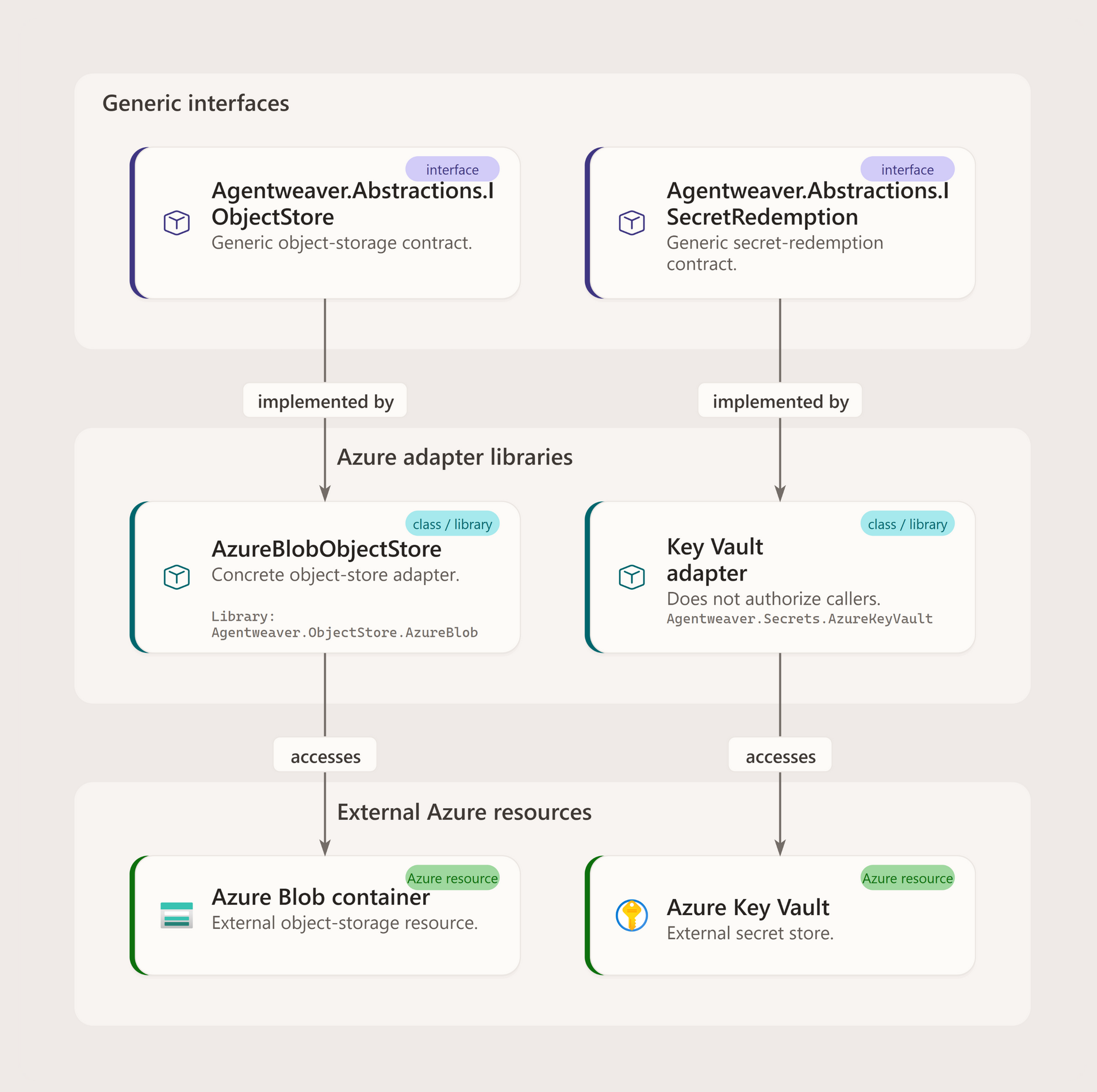
The figure is a structural component view, not runtime request order or deployment topology. Agentweaver.EventsAndSessions references the shared contracts, provider catalog/resolver, PostgreSQL outbox/inbox library, and telemetry helper. Agentweaver.Environment references the shared contracts, provider catalog/resolver, Azure Files Storage provider, and Agent Sandbox provider. Its egress flow and evidence boundary are described in Environment egress. Its Sandbox lease contract is described in Environment Sandbox. AzureFilesCsiWorkspaceVolumeProvider implements IWorkspaceVolumeProvider and calls the Kubernetes API; it does not itself mount the volume into a Sandbox or prove data erasure. Environment reserves and releases the exact Workspace generation around Sandbox provider use. AzureBlobObjectStore implements IObjectStore in the Agentweaver.ObjectStore.AzureBlob library. AzureKeyVaultSecretRedemption implements ISecretRedemption in the Agentweaver.Secrets.AzureKeyVault library. The table names the concrete types and their external boundaries.
| Interface | Concrete class | Library | External boundary and edge semantics |
|---|---|---|---|
ISecretRedemption (Agentweaver.Abstractions) | AuthorizedSecretRedemption | Agentweaver.Identity | Implements the contract; checks the exact grant and delegates backend redemption through ISecretRedemption. |
ISecretRedemption (Agentweaver.Abstractions) | AzureKeyVaultSecretRedemption | Agentweaver.Secrets.AzureKeyVault | Implements the backend contract; reads the exact version from Azure Key Vault. |
IObjectStore (Agentweaver.Abstractions) | AzureBlobObjectStore | Agentweaver.ObjectStore.AzureBlob | Implements the contract; reads or writes opaque objects in Azure Blob Storage. |
Host composition and Foundation Probe registration IDs
| Host or ID | Composition or registration | Meaning |
|---|---|---|
| Identity Broker | Constructs AzureKeyVaultSecretRedemption as an ISecretRedemption backend, AuthorizedSecretRedemption with the grant authority and backend, and the Identity-owned GitHub App connection and token-mint routes. | The wrapper checks actor, project, run, purpose, and exact-version grants before backend redemption. GitHub App private-key redemption and repository-token minting remain inside Identity. |
| Foundation Probe | ProbeProviderBindings.ResolveAndPin records provider IDs in pin evidence. Separately, AzureProbeOperations constructs AzureBlobObjectStore and AzureKeyVaultSecretRedemption; Program registers telemetry composition. | ID-based pinning does not construct adapters; the probe is an acceptance executable, not an application service host. |
azure-blob | ObjectStore provider ID recorded in Foundation Probe binding evidence. | Registration ID, not the AzureBlobObjectStore class, library, or constructor. |
azure-key-vault | SecretRedemption provider ID recorded in Foundation Probe binding evidence. | Registration ID, not the AzureKeyVaultSecretRedemption class, library, or constructor. |
azure-monitor | Telemetry provider ID recorded in Foundation Probe binding evidence. | Registration ID, not an exporter class, library, or model vendor. |
Component boundaries and project references
| Component | Current boundary | Direct project references |
|---|---|---|
Agentweaver.Abstractions | Provider, journal, addressed-message, accepted-effect, secret, object-store, environment/network-policy, authorization-context, run-selection, and Memory contracts. | — |
Agentweaver.Providers | In-memory provider catalog and resolver. | Agentweaver.Abstractions |
Agentweaver.Providers.Sessions.AgentSessions | Optional, read-only AgentSessions Sessions provider and record verifier. No service references it. | Agentweaver.Abstractions, Agentweaver.Providers, Google.Protobuf |
Agentweaver.Orchestrator.Core | Workflow validation and the platform-singleton AGT YAML Policy adapter. | Agentweaver.Abstractions, Agentweaver.Providers, Microsoft.AgentGovernance |
Agentweaver.Identity | Trusted actor, exact secret grants, separate runtime nonce contracts, and fixed owner HTTP transport. | Agentweaver.Abstractions |
Agentweaver.AgentRuntime | Authenticated bootstrap, guarded native turns/tools, actual turn content, accounting acknowledgment, and compatible SDK-cache or journal recovery. | Agentweaver.Abstractions, Agentweaver.Identity, GitHub.Copilot.SDK |
Agentweaver.AgentHost | Unpublished HTTPS runtime executable, exact image/native-runtime verification, priority at idle boundaries, measured readiness, and trusted BuildTest repository preparation/full-output collection. No automatic scheduler. | Agentweaver.AgentRuntime, Agentweaver.Telemetry, Agentweaver.SourceControl |
Agentweaver.Secrets.AzureKeyVault | Exact-version Azure Key Vault adapter. | Agentweaver.Abstractions |
Agentweaver.Persistence.Postgres | Service-schema outbox, consumer inbox, and relay library. | — |
Agentweaver.ObjectStore.AzureBlob | Opaque-object Azure Blob adapter. | Agentweaver.Abstractions |
Agentweaver.Telemetry | In-process OpenTelemetry traces, metrics, and logs. | — |
Agentweaver.Telemetry.AzureMonitor | Opt-in Azure Monitor exporters. | Agentweaver.Telemetry |
Agentweaver.Identity.Broker | OAuth, secret-redemption, and Identity-owned GitHub App connection/token-mint host; caller-authentication boundary. | Agentweaver.Identity, Agentweaver.Secrets.AzureKeyVault, Agentweaver.SourceControl |
Agentweaver.EventsAndSessions | Native journal, addressed messages, reference-only SDK usage admission, immutable Cost pricing, and exact usage totals. Unpublished host candidate. | Agentweaver.Abstractions, Agentweaver.Identity, Agentweaver.Providers, Agentweaver.Persistence.Postgres, Agentweaver.Telemetry |
Agentweaver.Knowledge | Project-wide discovery plus run/agent-scoped Memory API, context compiler, native PostgreSQL default, and optional Cosmos and Redis adapter candidates. | Agentweaver.Abstractions, Agentweaver.Providers, Agentweaver.Persistence.Postgres, Agentweaver.Telemetry |
Agentweaver.Environment | Environment-owned egress, workspace volumes, Sandbox leases, registered runtime profiles, and authenticated nonce delivery; not deployed. | Agentweaver.Abstractions, Agentweaver.Identity, Agentweaver.Providers, Agentweaver.Providers.Storage.AzureFiles, Agentweaver.Providers.Sandbox.AgentSandbox |
Agentweaver.Orchestrator | HTTP owner for session trees, forks, recovery, turn boundaries, runtime registration, immutable SDK source receipts, message outbox, and parent notifications. It checks current Projects authority. | Agentweaver.Abstractions, Agentweaver.Identity, Agentweaver.Orchestrator.Core, Agentweaver.Providers, Agentweaver.Persistence.Postgres |
Agentweaver.FoundationProbe | Acceptance-only infrastructure probe executable. | Agentweaver.Abstractions, Agentweaver.Providers, Agentweaver.Persistence.Postgres, Agentweaver.Secrets.AzureKeyVault, Agentweaver.ObjectStore.AzureBlob, Agentweaver.Telemetry.AzureMonitor |
The Events & Sessions project owns the native PostgreSQL journal and addressed-message delivery store. The Orchestrator validates owner outbox messages and session bindings before admission, presentation, and acknowledgment. Mapped spawn validates the latest confirmed root decision under the owner lock; runtime-owner-context returns mapped agent/model/turn metadata only while the child row, decision, and current Projects authority are unchanged. These source candidates have no deployment, background delivery relay, or automatic AgentHost scheduler. Their contracts are described in the journal service reference.
Workspace-volume lifecycle
Environment owns each volume's status and separate transition, resource, and data generations. Azure Files claims are scoped by Environment identity and resource generation; the owner pins the adapter/options snapshot, Kubernetes target identity, and exact claim/PV release descriptor. Replace pins the verified target and records cleanup for the exact old resource in one owner transaction. A current-fence lease retries that cleanup with the original binding. Retained resources and shared Delete work without an authoritative reference registry remain blocked; a Released receipt requires the exact claim and saved PV to be absent. This confirms Kubernetes control-plane removal, not Azure Files data erasure. Release is rejected while the volume is bound or attached. Known preflight rejections leave the owner record safely retryable; uncertain provider effects remain reconcilable. Azure Files does not claim Sandbox mounting or durable flush.
The AgentHost source candidate includes a pinned image definition and authenticated runtime routes. Its local fixtures and CI image receipt do not prove deployed scheduling or paid model execution. The repository does not contain a published platform image, AgentHost scheduler, or product MCP server. It also includes an unpublished v1 browser client over the Gateway/BFF and Identity Broker; that source does not establish a deployed application or automatic work scheduling. See the v1 web client guide.
The Knowledge source candidate supports project-wide discovery through existing, authorized run-provider bindings. Its native Memory boundary and provider rules are described in the Knowledge and Memory reference.
The proposed platform architecture remains a Proposed source document.