
AgentHost runtime architecture
AgentHost executes work; it does not decide which work is authorized. Environment owns its Sandbox placement, Orchestrator owns the current execution binding, and Identity owns purpose-bound credential access. AgentHost checks that those bindings still agree before native model turns and tools.
This page explains the source contracts behind readiness, execution and recovery. It does not report a live deployment or paid model acceptance. AgentHost has no automatic scheduler. Environment can resolve a bootstrap source without a per-run static profile when its global Environment:RuntimeBootstrap:DefaultSourceProfileId is configured. It derives the source only from the authorized Sandbox lease, the observed receiver configure URL, and its Orchestrator observation URL. Static sources remain supported. Registration and readiness recheck the same source hash, actor, accepted selection, exact resource, endpoint, fences, and lease expiry. Resume can change Pod IP and UID without changing that source hash when the logical receiver is unchanged. This source resolution neither selects a new registration caller nor carries credential material. The source pins GitHub.Copilot.SDK 1.0.18 to native runtime 1.0.97. Microsoft Agent Framework remains an Orchestrator dependency, not an AgentHost runtime. For host settings, see the runtime configuration reference.
Deployment profile
The optional agenthost-runtime-v1 ConfigMap supplies the AgentHost settings for Environment Sandboxes. It does not create a shared AgentHost Deployment. The local Kustomize installer binds the same AgentHost digest, linux/amd64 platform, and compressed image byte count into this ConfigMap and the Environment Sandbox options. A selected image is resolved and measured from GHCR; an omitted image keeps the validated live tuple. A missing or conflicting live tuple fails before Kubernetes writes.
The operator supplies the agenthost-tls Secret. Before writes, the installer checks its Kubernetes TLS Secret type, the other required Secrets, and the effective Environment ServiceAccount permissions needed by the Sandbox provider. It does not inspect certificate or key data, create the Secret, or apply RBAC. The proposed Agent Sandbox permissions are kept outside the active Kustomize bundle. The profile retains MaximumPendingTurns: 4; this setup does not change queue semantics or select a new limit.
The current native SDK path consumes either a hosted access token or a bring-your-own-key (BYOK) credential inside the selected Sandbox. This is legacy credential delivery, not credential-less guest execution, even when subprocess environment variables contain no secrets. The credential-less sandbox proposal requires trusted-side request authentication or a supported model-runtime adapter outside the guest, with the same guards, native results and accounting contracts. Two containers sharing a Kata guest and private host directories alone do not prove that separation. This proposal does not change the executable or its current readiness contract; unsupported modes must not claim compliance.
Authentication and immutable bindings
AgentHost requires an explicit HTTPS issuer, audience, owner addresses, image identity, and registered model bindings. OpenIddict validates the bearer before a runtime route reads owner state. The request host and scheme must match the exact configure audience. The host never treats a caller-supplied actor, model, credential, or placement as authority.
Orchestrator supplies the current registration and immutable accepted-selection reference. Environment supplies the exact retained lease, provider resource, image, and runtime profile. Identity supplies separate configure and observe grants, plus current model-credential proof. The host compares actor, tenant, project, run, session, purpose, grant revision, execution fence, and placement. It repeats current authority checks after remote waits and before protected effects. An authenticated per-session registration read uses GET /internal/projects/{projectId}/runs/{runId}/coordination/sessions/{sessionId}/runtime-registrations. Orchestrator checks the current session owner before and after finding the exact registration. Missing, ambiguous, expired, or changed registrations do not produce a current result. Fixed-work sessions use their retained execution-checkpoint association instead of an open WorkPlan item. The association must match the parent, child, workflow, plan, agent, model, selection hash, fence, and decision version. Accepted numeric and credit limits propagate without changing legacy null configuration. Workflow-bound MaxModelTurns, MaxToolCalls, and configured Hosted Copilot hard credit limits use owner-controlled admission. The Orchestrator preserves an accepted MaxPromptTokens value in RuntimeOwnerContext and the runtime binding. AgentHost resolves the effective per-prompt/context capacity against the concrete model and any narrower server limit, then passes it to the native SDK. The SDK compacts removable conversation history and fails the turn if system context, tool definitions, and the latest input still cannot fit; it does not silently truncate input. This is not a cumulative token budget or a count of the SDK's internal model API calls. For a zero Hosted Copilot hard limit with a priceable source and fully priced existing usage, startup remains allowed, but the host denies model-turn dispatch and never calls the SDK's native Send. Before it returns the budget error, it reads the native event log and requires a complete empty range, then the owner stores a guard receipt and linked no-send evidence. The receipt binds the message hash and current Observe grant, not the prompt text. An incomplete range or failed owner write fails closed. Orchestrator also stores a stage-specific receipt before denying a model-turn action at its authorization or verification boundary.
Coordinator-root MaxModelTurns denials use a separate, narrower path in AuthorizedRuntimeSession.SendTurnAsync. After the Host persists the user's message and before root action authorization, it captures the native SDK cursor under the existing execution gate and uses that persisted message ID as both the action EventId and DispatchId. Only the exact stored model-turn denial can start the proof path. Orchestrator returns the denial as a no-store HTTP 403; the owner transport preserves its code only from a bounded, single-field JSON error envelope on the action-authorization routes. Other or malformed 403 responses remain generic runtime_owner_denied errors. The Host then requires current authority and an unchanged source, reads a complete empty native-event range with the same cursor before and after, and posts a typed companion to Orchestrator. Orchestrator validates the original denial, root admission, source, authority, and owner send state before appending the companion to the existing immutable evidence ledger. The original denial is not changed. The Host returns the original denial only after the companion is stored; missing, stale, incomplete, or conflicting proof fails closed and never reaches SDK Send.
This companion proves only the no-send interval for that persisted root attempt. Child pre-dispatch numeric denials and tool-call denials inside an admitted turn remain owner-only; they do not have this empty-range evidence. This slice does not establish restart recovery or duplicate-send prevention.
Before native session creation, AgentHost reads skills through the current runtime registration. Orchestrator checks the accepted run selection and current read permission; Projects returns only imported revisions assigned to the active agent. AgentHost checks the registration binding and content digests, exposes those instructions through the SDK skill provider, and places the exact resource bytes in the native session filesystem. The configured working directory maps only to the virtual /workspace root; it is not read from the host filesystem. AgentHost initializes that root for fresh and restored sessions while other missing virtual paths remain absent. It repeats the content read during current authority checks. Missing, changed, revoked, unassigned, or legacy unpinned content denies session creation or continued use.
sequenceDiagram
    participant H as AgentHost
    participant O as Orchestrator
    participant P as Projects & Config
    participant B as Blob storage
    participant S as Copilot SDK
    H->>O: Read skills by runtime registration ID
    O->>P: Check accepted selection and current permission
    P->>B: Read the accepted agent's pinned revisions
    B-->>P: Return verified instructions and resource bytes
    P-->>O: Return ordered skills for the active agent
    O->>P: Check current permission again
    O-->>H: Return content bound to this registration
    H->>H: Check content and resource digests
    H->>S: Start with accepted skills and resource files
Note over H,O: Repeat the registration and content checks before protected runtime work.| Route | Source contract |
|---|---|
POST /runtime/v1/configure | Authenticated delivery of the pending, purpose-bound configure nonce. No model session starts on delivery alone. |
POST /runtime/v1/configure/activate | Contract version 1, exact registration, consume/exchange operation IDs, and the delivered configuration bytes. Exact replay returns the existing session. Changed bytes or bindings deny. |
POST /runtime/v1/refresh | Exact session proof and an operation ID. Rotation rechecks current Identity and owner authority. Exact replay does not rotate again. |
POST /runtime/v1/turns/numeric-limit-denials/read | Reads an existing Orchestrator numeric-limit denial by attempt ID. The owner receipt binds the current registration, source grant, accepted limit, checkpoint/dispatch (when present), and equal persisted before/after send-state hashes; an absent receipt is 404. This is not a generic no-send or recovery receipt. |
GET /runtime/v1/projects/{projectId}/hosted-model-reasoning-catalog | Reads live supported reasoning levels for the project's enabled hosted model references. Identity checks the caller's connection and project read authority; the hosted token is returned only to AgentHost. The response is keyed by model reference and includes the project and binding revisions plus explicit unavailable states. |
GET /runtime/v1/readiness | Returns the existing noncredential RuntimeHostReadinessReceipt after the host revalidates the caller, registration, session, Observe grant, and readiness evidence. Ordinary configuration includes the source-derived recovery mode and its bound cache or journal evidence. It does not configure the SDK or send a turn. |
GET /runtime/v1/readiness/evidence | Independently revalidates current Host readiness and registration, reads the authenticated Environment /pod-observation twice, requires the downward-API AGENTWEAVER_HOST_POD_UID to equal the observed Pod UID, and reads Linux /proc/self/mountinfo plus statx for the opened workspace directory. It returns a redacted mount identity and hashes, not the mount source. Missing/mismatched identity, an absent exact mountpoint, a root-filesystem fallback, or a changed Pod UID/resourceVersion fails closed. This proves neither invocation ownership nor PVC data isolation. |
POST /runtime/v1/a2a/message:send | One user message with one text part, a GUID message ID, native context ID, exact runtime proof, and immediate or enqueue delivery. |
GET /runtime/v1/readiness | Authenticated current readiness receipt. Checks the caller, exact HTTPS configure audience, registration, source authority, and current placement. Does not start a turn or rotate a grant. |
GET /health/live | Process liveness only. |
GET /health/ready | Current registration, source authority, lease, isolation, workspace, egress, configuration, and startup budgets. A lost prerequisite returns 503. |
For opt-in checkpoint recovery at a pending gate, Orchestrator retires the old placement through Environment and registers a replacement at the next execution fence. The replacement uses the existing authenticated native-cache or journal recovery path. Orchestrator accepts readiness only when the Host reports one of those recovery modes; a fresh session does not satisfy recovery. The recovery operation ID also scopes the Host's registration, skill, source, and configuration calls while the replacement starts. The Host does not answer the gate or send a model turn during this continuation.
For a saved child join, Orchestrator restores the root and required children while dispatchHeld remains true. It does not send a child message during recovery. When a pending child has a prepared native dispatch, Orchestrator checks the immutable origin and its no-send proof. In the final ready transaction, it appends a native-child-rebind receipt for the replacement registration and releases the hold. The original dispatch row remains unchanged. ready means the Host restored the saved boundary; it does not mean that a child task or the run is complete. After the hold is released, ordinary dispatch uses the same saved message through the verified effective binding.
The Broker saves the bootstrap receipt before Environment activates the Host. After a transport or timeout failure, the same recovery operation can continue; an exact Broker replay returns the existing session. If activation instead returns runtime_delivery_unavailable, runtime_receiver_unavailable, runtime_source_credential_unavailable, runtime_configuration_conflict, or runtime_operation_conflict, Orchestrator marks the operation blocked with checkpoint_recovery_host_bootstrap_spent. The credential is not replayed. A new recovery operation pins the failed runtime ID and registration revision, advances the fence once, retires the failed placement, and uses new operation IDs. Authority does not roll back.
sequenceDiagram
    participant C as Authenticated caller
    participant H as AgentHost
    participant O as Orchestrator
    participant I as Identity
    participant E as Environment
    Note over H: Permit workflow-bound and admitted coordinator-root MaxModelTurns and MaxToolCalls; configure native SDK MaxPromptTokens.
    C->>H: GET /runtime/v1/readiness with Broker bearer
    H->>O: Revalidate current registration
    O-->>H: Current registration or denial
    H->>I: Revalidate current Observe and model grants
    I-->>H: Noncredential grant receipts
    H->>E: Read current placement and readiness evidence
    E-->>H: Current lease and startup observations
    H-->>C: RuntimeHostReadinessReceipt with ordinary recovery evidence (no-store)
    opt Read the current durable run credit guard
        C->>O: POST /internal/runtime/credit-guards/read with Observe proof and exact run intent
        O-->>C: Owner snapshot or unavailable/denied (no-store)
    end
    Note over H: No SDK start or turn send
    Note over C,H: Unbound positive hard-capped Hosted activation is rejected; workflow and coordinator-root turns use owner admission.
Runtime responses use Cache-Control: no-store. Authentication rejection returns 401. Current-authority rejection returns 403 with the exact code. Invalid input returns 400; owner, execution, or startup failure returns 503. When a zero-credit denial is stored, the 403 response also includes fixedCreditGuard with the typed guard receipt and no-send evidence. If the guard is stored but evidence writing fails, the 503 response includes the stored guard receipt with no evidence. An incomplete native event range or failed guard write does not return stored receipts, and neither path writes turn content or sends a model request. The authenticated readiness route does not reuse the configured actor as permission for a different caller. The health route remains a process probe, not caller authorization.
The separate readiness evidence route is an observation, not an invocation receipt. Environment's Pod observation supplies Kubernetes Pod and configured workspace-attachment identity; the Host independently binds its downward-API Pod UID and opened workspace directory to the exact mount ID/device reported by the kernel. It intentionally does not expose a mount source string or treat configured PVC attachment as proof of the mounted filesystem's storage owner. Projects/Environment invocation issuance is not part of this route. The route cannot prove invocation ownership, replacement lineage, or generic no-send/recovery behavior. Only numeric-limit denials have the Orchestrator's current persisted send-state receipt; the replacement-comparison API remains explicitly blocked until its missing provenance is supplied.
Hosted Copilot and BYOK remain distinct modes. Hosted selection names an Identity-owned connection, not a secret version or personal-provider fallback. Identity returns only the current GitHub user access token and typed proof. Refresh tokens and OAuth client secrets stay inside Identity and its protected store. BYOK uses the exact selected SecretRef and explicit native SDK Provider configuration without Copilot authentication or catalog lookup. Neither a cache nor a submitted connection ID grants permission. For settings, the caller-authorized AgentHost catalog read checks current Projects & Config model choices and binding revisions before reading the live SDK model list. It obtains the short-lived user token from Identity only over the pinned AgentHost-to-Identity mTLS channel, holds the token inside AgentHost for the SDK read, and invalidates it afterward. The token is never returned by the AgentHost or Gateway catalog response. If the dedicated Identity channel is not configured, the catalog reports hosted levels as unavailable.
The pinned SDK does not prove which A2A send owns a native usage callback. Workflow-bound Hosted Copilot with a positive hard credit limit uses the owner-prepared dispatch and begin path, which checks current whole-run priced usage before each new native send. An unbound positive hard limit still fails activation with runtime_usage_affinity_unavailable; the prepared session is cleaned up and the host does not become ready. An omitted limit keeps legacy startup, zero still permits startup but blocks dispatch, and BYOK remains token-metered.
The immutable Projects selection's maxModelTurns, maxToolCalls, and optional maxPromptTokens values flow through RuntimeOwnerContext into the registered RuntimeBinding. maxModelTurns and maxToolCalls are supported for workflow-bound registrations and for the coordinator root used by casting generation. Native child sends require the prepared-dispatch, action-grant, and native-begin admission path before SDK send. Coordinator-root turns require an append-only admission bound to the accepted request ID, prompt digest, selection, fence, and decision version. Both paths reserve against the same run-wide model-turn count under the execution lock; exact retries exclude their existing reservation and attempts beyond the limit are denied. Each native tool invocation reserves one owner-side slot before approval; exact retries reuse the reservation and attempts beyond the run limit are denied. Other unbound registrations with maxModelTurns or maxToolCalls fail activation with runtime_numeric_limits_unsupported, before SDK session creation, readiness, or model/tool invocation. A configured maxPromptTokens is supported when its concrete capacity can be resolved; otherwise activation fails with runtime_model_prompt_capacity_unavailable. The resolved value is passed to the native SDK as its prompt-compaction threshold. Coordinator-root model turns use the same spend budget admission as child dispatches. When the pinned run or agent budgets, or the current project budgets, apply to the turn, the RuntimeAction owner reads Events evidence and reserves exposure in the grant transaction. It issues no grant when the budget denies the turn. The reservation uses the turn ID. It retires after the root-turn completion is recorded and Events shows the usage events of that completion. Absent values preserve the legacy path. The RuntimeAction owner also rejects unsupported numeric bindings before issuing an action grant. Positive workflow-bound Hosted Copilot hard limits use the same prepared dispatch and begin checks against observed whole-run priced usage. The source path can record durable hard-limit denial and bounded no-send receipts, but it does not establish live boundary acceptance. The hard-limit dispatch acceptance check remains blocked until permitted live owner receipts prove the limit boundary, soft-warning deduplication, later floor advancement, and no-send result.
AgentHost and the enabled Events native consumer load the same server-owned AgentHost:ModelBindings map and required AgentHost:ModelBindingsRevision. The shared resolver lives in Identity without an SDK dependency. It resolves the accepted reference to its concrete model ID; a reference is not a model ID. Lookup is ordinal and exact: a binding under an alias does not satisfy a task default that references the concrete model ID. It snapshots the map and hashes its canonical model, provider, header, enabled-state, and BYOK reasoning-capability values. The accepted ModelBindingPin retains that revision, hash, reference, model ID, source mode, and requested reasoning effort when the accepted selection carries that pin. The runtime binding also carries the independently selected effort (default high) so a routed child selection can preserve its effort without borrowing the primary model's pin. AgentHost always resolves a server-owned pin for the exact selected reference, source mode, and effort; it keeps that pin distinct from any accepted pin. A supplied accepted pin must agree with the selected effort, and BYOK still requires that accepted pin. AgentHost rejects a changed accepted pin before it starts the SDK client. The resolver also has a per-run path for a trusted ModelProviderBindingRevision carried with an accepted BYOK selection. It requires the provider revision and configuration hash, provider type, deployment/model ID, and reasoning effort to match the run pin. It also requires the provider's credential version to match the exact SecretRef in the selection. This path builds the provider binding from that revision and does not fall back to the deployment map or redeem a credential. A mismatch fails closed. The path uses the supplied selection for each call, so it does not require a host restart. The active selection writer does not yet supply runtime provider revisions; this consumer does not enable runtime provider selection by itself. Existing deploy-time bindings remain supported. Disabled bindings and source-mode mismatches deny; BYOK cannot become hosted through a fallback. Before session creation or resume, the host verifies the selected effort against the exact hosted catalog capability and supported-effort list. BYOK requires an explicit supported-effort list in the server-owned model binding; an unknown or unsupported effort fails closed. The requested effort is passed to both native create and resume and checked against the SDK's effective session model. The host never silently substitutes a model default or lower effort. After reading the hosted SDK model catalog, AgentHost may publish its verified reasoning levels to Projects & Config. The request includes the opaque model reference, selected connection, model-binding revision, verification time, and supported levels; it does not include the hosted credential or model ID. Projects & Config stores the values for the same actor, project, connection, and binding revision, returns them for at most 24 hours, and rejects an older verification that arrives after a newer one. Publication is best-effort: failure does not block session creation, and every run still uses AgentHost's live SDK check as the authority. The write uses the caller's bearer for current project authority and AgentHost's pinned client certificate for service identity; an ordinary project reader cannot publish catalog values.
Project Settings reads current model choices from Projects & Config. That response can include recent AgentHost-published hosted levels for the caller, project, connection, and binding revision. If no recent publication is available, Settings shows no generic hosted levels. Opening Settings does not ask Identity for a hosted credential or call the Copilot SDK. AgentHost still checks each selected effort against its live catalog when a run starts.
An explicit caller can still request the live catalog endpoint. AgentHost reads the current project configuration and model choices, then asks Identity for the caller-owned connection credential. Identity checks current project read authority, tenant scope, connection ownership, and connection freshness. AgentHost passes the short-lived token only to the pinned Copilot SDK client; it is not returned through Gateway, Projects & Config, or the browser. The result maps exact SDK model IDs back to enabled model references, includes the project configuration and model-binding revisions, and marks a missing connection, unavailable SDK list, or missing model as unavailable. AgentHost rereads the project configuration and choices after the SDK call so stale revisions do not produce selectable levels. The Gateway response is Cache-Control: no-store.
sequenceDiagram
    participant C as Explicit live API caller
    participant G as Gateway
    participant H as AgentHost
    participant P as Projects & Config
    participant I as Identity
    participant S as Copilot SDK
    C->>G: GET hosted reasoning catalog with user bearer and tenant selector
    G->>H: Forward bearer and selector; no-store
    H->>P: Read project configuration and model choices
    H->>I: Read caller-owned hosted connection credential
    I-->>H: Short-lived user access token
    H->>S: Read the live SDK model list
    S-->>H: Model IDs and supported reasoning levels
    H->>P: Recheck project configuration and model-binding revisions
    H-->>G: Reference-keyed levels or explicit unavailable states
G-->>C: No-store catalog response; no credentialsequenceDiagram
participant W as Project Settings
participant G as Gateway
participant P as Projects & Config
W->>G: GET project configuration choices
G->>P: Forward bearer and tenant selector
P->>P: Read recent hosted catalog publications in caller and binding scope
P-->>G: Choices with published levels or verifiedAtRunStart
G-->>W: No-store choices; no hosted credentialLegacy unpinned factory callers retain their existing API; they do not provide versioned admission proof. For configured hosted credit limits, coordination root acceptance and backlog claim now require a real Events run-admission receipt before their transaction writes the root. The receipt binds the trusted Projects selection, selected connection, shared model pin, and Cost identity. An explicit Unpriced quote does not itself block admission or dispatch; only known priced usage counts toward credit limits. A model missing from the Copilot SDK catalog still cannot start a session, and malformed or tampered admission receipts fail closed. The durable admission pin propagates through current owner context into the Host registration. These source paths still need live PostgreSQL and whole-producer acceptance.
sequenceDiagram
    participant Core as Orchestrator
    participant Projects
    participant Events
    participant Host as AgentHost
    Core->>Events: Accepted-selection hash only
    Events->>Projects: Read current selection and authority
    Events->>Events: Resolve shared model map and real Cost quote
    Events->>Projects: Recheck selection and authority before Cost commit
    Events-->>Core: Concrete model, connection, configuration, and Cost pin
    Core->>Projects: Recheck after waits and before root commit
    Core->>Core: Commit root and typed admission outbox receipt together
    Core-->>Host: Current registration with accepted model pin
    Host->>Host: Match shared map before native SDK startup
Turns, tools, and durability
The native SDK supplies the effective model, session ID, runtime version, usage, and idle boundary. The runtime disables ambient authentication, configuration discovery, native session persistence, and built-in tools. Only registered guarded tools can run. Each model turn and protected tool effect requires current AGT authorization and a committed Policy receipt before the effect.
The host serializes turns. Prompt text preserves line breaks, tabs, and fenced code without trimming or changing its bytes. Unsupported control characters, such as NUL, deny before dispatch. immediate work takes priority over pending enqueue work at the next native idle boundary. It does not interrupt an active native turn.
Hosted Copilot runs with no configured credit limit retain legacy startup without cost admission. A soft-only limit can retain an Unpriced quote; its unknown amount remains visible but does not enter the priced subtotal. A fully priced run may start at the exact hard limit, but the owner denies the next model dispatch at the turn boundary. A zero hard limit permits startup only after run admission confirms a priceable source and fully priced existing usage; it then denies model-turn dispatch. Before returning the budget error, the host must record a complete-empty-range no-send proof; it never calls the SDK's native Send. A positive hard limit uses workflow-bound dispatch admission against observed whole-run usage; an unbound positive hard limit is rejected before readiness. BYOK remains token-metered and does not use the Copilot nano-AIU price preflight. An exact message replay shares the original completion; changed content under the same ID denies. Completed responses remain available for the configured host lifetime, independent of the pending-turn limit. The configured pending-turn limit rejects excess work explicitly.
Numeric budget boundaries
For workflow-bound registrations, MaxModelTurns bounds owner-admitted native sends across the whole run. For coordinator-root casting generation, it also counts root model-turn grants and workflow dispatches together, so a root generation turn cannot be followed by another run turn after using the last reservation. Preparation reserves one slot in the existing immutable MAF dispatch table before a new send. The root owner lock serializes reservations across child runtimes. Exact prepared replay uses the same slot. Completed, failed, or uncertain sends do not refund that slot after restart or fence changes. A sending or uncertain dispatch cannot be resent. The model action grant must match the prepared dispatch, current registration, and exact prompt hash. The SDK exposes no pre-model admission hook; this limit does not count internal model API calls.
MaxToolCalls is supported only for workflow-bound registrations. The Orchestrator reserves a run-wide invocation slot before approving a native tool call, with replays reusing the original reservation. The next invocation after the configured limit is denied. Unbound registrations with this limit fail before SDK setup.
When configured, MaxPromptTokens is preserved in RuntimeOwnerContext and the runtime binding; it is not silently discarded or reclassified as a Knowledge retrieval budget. The effective value is the narrowest of the accepted limit, the actual hosted model capacity, and any lower server limit; BYOK uses its server-owned capacity. The pinned native SDK uses this value as a prompt-compaction threshold and compacts removable conversation history. For an irreducible latest turn, the SDK may send a provider request during compaction and then report a capacity-attributed query error. This is not a hard admission check for every internal provider request or a no-send guarantee, and input is not silently truncated. This is not an owner-side raw-request token counter or a cumulative token budget. Native and hosted deployment evidence is still required.
Read runtime limit evidence
The Gateway's readRuntimeObservationV2 operation reads the Orchestrator's durable runtime-limit facts. The owner checks current project/run authority, the accepted selection, and the root or child session binding before and after the read. A root read can include child facts; a child read filters facts to that child, while totals remain run-wide. The read does not require an active Host registration.
History pages use a fixed high-water mark, so later facts appear only in a new read. A missing coverage marker reports incomplete legacy or uninstrumented history. The response keeps native-send, consumption, and tool execution proof unavailable unless matching owner evidence exists. For a tool-call limit denial, AgentRuntime can record a separate rejection decision after Orchestrator confirms the exact denial and active MAF dispatch. This record does not confirm that the SDK received the decision or that the tool did not run. A reservation does not prove a native action. See the runtime observation contract for the public fields and evidence limits.
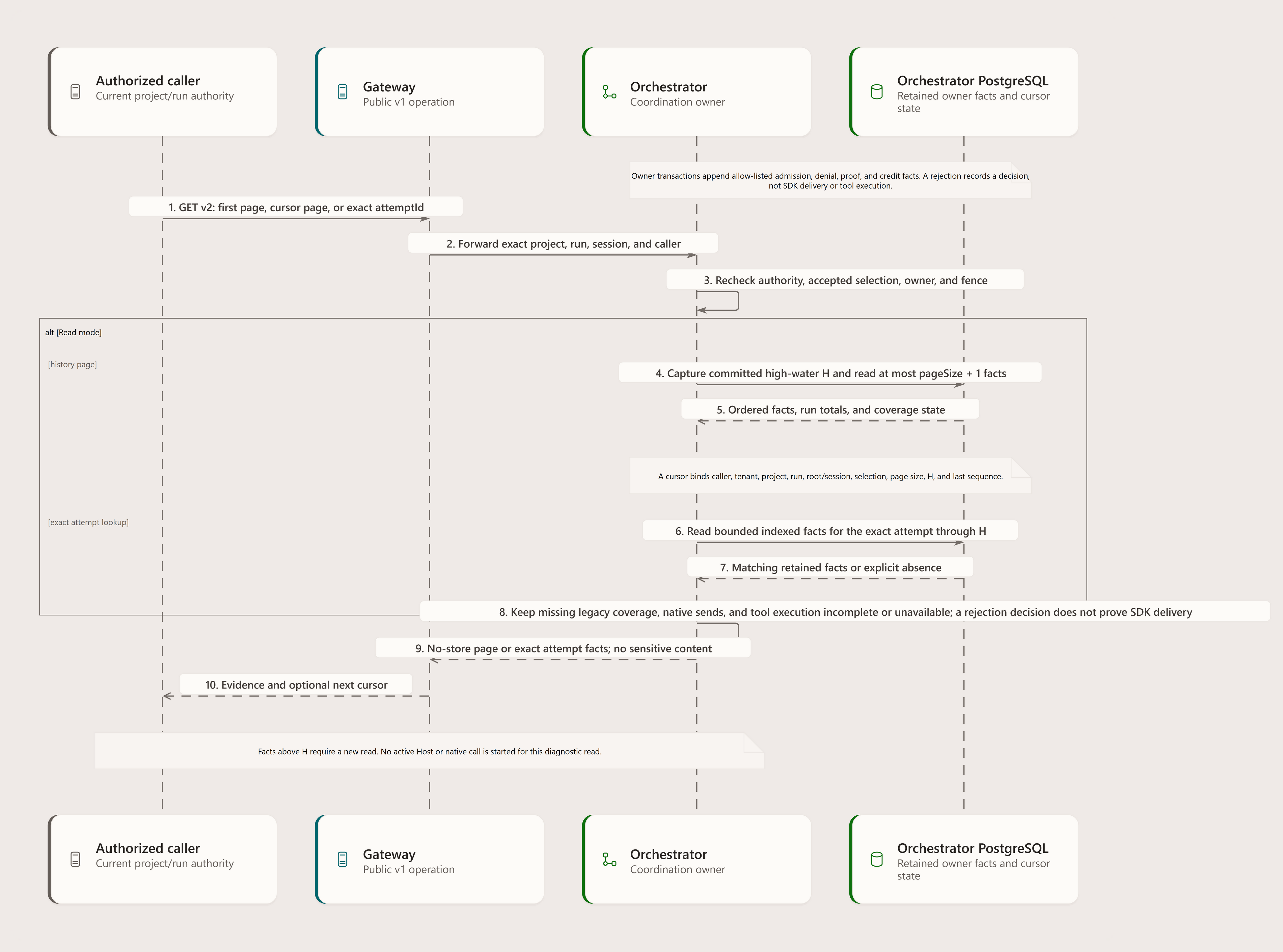
Open full-size PNG · Open editable draw.io source
Each built-in tool approval checks current owner authority and Policy again. The pre-tool callback checks Policy without reserving a tool slot. The native call ID binds invocation and secondary permission checks to the current runtime registration and A2A turn. Repeated callbacks retain their request IDs for reservation deduplication, but never reuse a cached approval. Cancellation, a changed turn, or revoked authority prevents approval after an earlier successful check. Secondary permissions also require a fresh Policy check for their exact input. These checks do not enable the remote MCP tool hook.
Events stores actual user and assistant content as typed TurnContent through the existing Object Store. The journal retains authenticated content references, Policy receipts, tool events, and compatible cache references. Orchestrator commits native SDK source receipts. The pinned SDK does not expose a proven usage-event-to-A2A-send binding. AgentHost leaves usage observations uncorrelated rather than copy the active message ID or infer ownership from event timestamps. Events therefore withholds cost-turn release for an unbound callback, including one delivered after a later send begins. Events fetches each receipt and commits immutable usage accounting before AgentHost acknowledges the turn. For a bounded cost turn, Events requires the source receipt's A2A ID to equal the CostTurnId; a later send in the same session cannot release an earlier turn's cost slot. Already-weighted nano-AIU is not multiplied again. Unknown cost remains Unpriced, never zero. Before readiness, AgentHost asks Events to verify that the current SDK source can be checked against the run's immutable Cost binding. A valid Unpriced result does not prevent readiness; unavailable or malformed receipts still fail closed.
At a confirmed idle boundary, the runtime captures opaque SDK cache bytes through its custom filesystem. Durable cache material records both the optional accepted pin and the server-resolved model-binding pin, plus the selected reasoning effort, alongside session scope, accepted selection, model reference, model ID, prompt-capacity pin, SDK version, and runtime version. A changed or unprovable model/effort binding rejects recovery; the host does not convert an unprovable binding into a journal rebuild. Other missing, incompatible, or corrupt caches rebuild conversation context from authenticated journal content. The saved source-session replay supplies visibility, including Events-approved parent history. Each recovered TURN must match its own journal payload, single stored object reference, and authenticated material acknowledgment. Events rechecks the current reader's authority before it returns material bytes. The Host checks event identity, position, tenant, byte length, and content digest. Historical runtime, revision, fence, selection, SDK/runtime, model, and capacity facts belong to each TURN, not the latest cache. Recovery does not replay model turns, tools, or external effects. Cancellation waits for the native abort idle event; a failed abort prevents another turn or cache capture.
The private native-receipt bridge records the SDK's durable cursor before sending. After idle, it reads bounded, persisted events through the SDK event-log API, continuing each page from the cursor returned by the preceding page. The collected range must have unique event IDs; a duplicate across pages fails closed rather than being counted twice. It binds the actual native send message ID to the user event, turn start, turn end, and completion receipt. The receipt's event range must match those native IDs. The captured assistant bytes must match the returned answer. Only the complete observation is recorded through the existing authenticated POST /internal/runtime/turns/observations route. An idle event alone cannot produce this proof.
When present, a native usage checkpoint retains its reported nano-AIU and source sequence watermarks. This observed amount is not proof that all usage has settled. Missing accounting stays unavailable. Native output evidence alone does not authorize a protected send or prove financial completeness.
The source bridge now uses a typed RuntimeNativeTurnObservation. It retains the actual root usage-event IDs found inside the native completion range. Those IDs describe observed membership, not a complete accounting-source set.
Orchestrator exposes authenticated native-turn and denial-evidence routes under the existing observe grant. Before sending, the MAF source path prepares the immutable dispatch row under the current registration, root owner, decision, and checkpoint locks. It pins the platform intent, complete request hash, source hash, model, and execution fence. Exact prepared retries retain that row. A changed binding or an already-sending row denies. For configured hosted credit limits, preparation verifies the Events cost-preflight receipt before it commits the dispatch. An explicit Unpriced quote does not block readiness or dispatch; an unavailable or malformed receipt still fails closed. Begin repeats financial admission before any native work. POST /internal/runtime/turns/begin requires a previously prepared MAF dispatch. It checks the current registration, SDK source, model, request bytes, pending checkpoint, and decision version before it changes prepared to sending. It returns either an admission or a typed hard-limit denial; the denial leaves the dispatch prepared at its existing owner revision. The admission receipt contains the stable platform message ID, not predicted native IDs. A repeated begin cannot resend a dispatch that has already entered sending. For configured hosted credit limits, begin reads the existing Events pricing snapshot. It validates the pinned zero-work quote and observed Copilot totals. An explicit Unpriced quote is accepted; only the known priced subtotal counts toward the limit, and missing amounts remain visible instead of being treated as zero. The root owner lock serializes admission and its durable observed-credit guard. When a valid whole-run pricing snapshot first reaches or exceeds the configured soft-credit limit, the guard queues one durable warning event through the existing outbox. Replays, concurrent admissions, and later snapshots do not duplicate that warning; later priced totals still advance the observed-credit floor and ledger-event count. These admission-time observations are not immediate per-call settlement: Events can price those costs after they become visible. At or above the hard limit, it records exhaustion and denies new dispatch. The currently executing turn can report usage above the limit; the next dispatch cannot start. Another sending or accounting-pending dispatch blocks hard-capped admission. These checks do not claim an all-future accounting-source barrier. POST /internal/runtime/credit-guards/read provides a separate read-only Orchestrator observation of this durable state. Its Observe proof is checked against the current registration and source grant, and its request must match the current tenant, project, run, root session, accepted-selection hash, execution fence, and configured limits. The typed response includes the owner registration hash, cost identity and unit/scope, observed-credit floor, ledger-event count and digest, guard revision, warning/exhaustion flags, and update time. The guard row is read under a shared transaction lock; no row returns 404, and the response is never cached. The source owner stores the typed denial receipt in its existing outbox with the credit-guard update. For a hard-capped Hosted Copilot turn, AgentHost captures the native cursor before begin. After a denial it accepts only a complete bounded event-log range with zero events and the same before/after cursor, then stores a source-owned no-send receipt through POST /internal/runtime/turns/no-send. The Host returns the budget error only after that receipt is stored. An event, incomplete range, or changed cursor fails closed, and native Send is not called. The no-send receipt proves only the bounded no-send interval, not later accounting finality. AgentHost exposes authenticated read routes at POST /runtime/v1/turns/fixed-credit-denials/read and POST /runtime/v1/turns/denials/read. Each request contains the current session proof and the stable record selector. The Host checks the proof against the current registration before and after the source read, then returns the source-owned receipt/evidence or receipt/noSend pair directly. A stored fixed-credit guard can have null evidence while its no-send write is incomplete; a native read with no stored denial returns a null receipt and null noSend. Source-owner unavailability returns 503. Both routes use no-store responses. The separate POST /runtime/v1/turns/fixed-credit-denials/select-current accepts only a runtimeInstanceId locator. The Host binds it to its authenticated current session and rechecks that session before and after selection; callers cannot supply a request ID or hash. Orchestrator verifies the current registration, actor, Observe grant, and source receipt, then selects against the exact registration revision, run/session, execution fence, grant, and source hash in its existing outbox. It returns a pair only when exactly one complete stored guard/no-send pair matches; zero or multiple matches return a null pair. Selection is not a list and never chooses the latest record. The original explicit read route and its request-ID/hash semantics are unchanged. The pair proves only that the fixed-zero guard followed a complete empty native event range with an unchanged cursor. It does not prove a live CLI turn, generic dispatch no-send, cursor continuation, completion acknowledgment, child effects, or external-effect deduplication. POST /internal/runtime/turns/observations attaches the actual native range and output hash to that same dispatch. Exact retries retain the stored observation. The resulting state is terminal_pending_accounting, with a partial source report. It is not a source-completion manifest. These routes reuse migration 015; they add no financial ledger or migration.
POST /internal/runtime/turns/accounting completes the observed dispatch. It requires the recorded native range and exactly its observed usage-event references. Events joins every reference to its immutable source receipt and actual ledger row. The registration, SDK source, platform message, accounting hash, and price must match. Raw SDK usage can have no platform message ID. Events accepts this only after an authenticated Core read confirms the persisted turn and its exact observed event set. A wrong non-null message ID or an event after native completion still fails. Events repeats the Core read after releasing its Cost transaction. Core releases its owner locks before requesting the Events snapshot. Its final owner transaction rechecks the source grant, checkpoint, report, and revision before storing references and changing the dispatch to completed. Report writes and final completion reject event reuse by another dispatch of the same SDK source. This join does not call Source GET or create a source-completion manifest. Accounting remains explicitly priced or unpriced; unknown cost does not become zero. The source report stays partial, and hard_cap_serialized stays false. Neither source-completion nor strict retirement fields are populated.
The Host uses this path for a registration with an accepted workflow step. The legacy string-turn method rejects that registration, so it cannot bypass admission. The Host begins the dispatch before it writes user content or sends native work. After native completion, it persists the partial observation, assistant content, and cache. It retains actual Events acknowledgments and completes the durable observed join before returning the answer. No observed usage means no synthetic usage event is required. An accounting failure prevents an answer and makes the Host unavailable. Exact message retries retain the result or failure and do not resend native work. Unbound legacy sessions retain their existing turn behavior. MAF prepares through the current source owner before sending. After the Host responds, MAF rereads the completed dispatch and matches the actual output hash. Only then can the workflow retain the result. An explicit unpriced receipt does not block an uncapped answer. Later usage still enters the ledger and affects the next capped admission. These source paths do not prove live PostgreSQL or whole-producer acceptance.
The source owner also exposes an authenticated, read-only completion-proof route: GET /internal/projects/{projectId}/runs/{runId}/coordination/sessions/{sessionId}/usage-dispatch-completions/{dispatchId}. It reads only an owner-persisted hosted-Copilot source-completion manifest with matching dispatch scope and digest. The retained SDK source supplies the actual meter mode, including for an empty receipt set. An absent or unproven manifest returns 404 with Cache-Control: no-store. The host exposes no caller-facing manifest writer. The current native observation path writes only partial reports, so it cannot supply this proof. SDK 1.0.18 and runtime 1.0.97 expose no supported accounting-source finality guarantee. Their output completion receipt, usage status, idle event, and watermarks do not prove that every accounting source is final or that no late usage remains. That missing guarantee does not block ordinary answer acknowledgment. Observed pricing and accounting-source finality are separate facts.
flowchart LR
    N["Current source and MAF intent"] --> Z{"Hosted Copilot hard limit is zero?"}
    Z -->|"Yes"| ZeroCursor["Host reads native event log before queueing"]
    ZeroCursor --> EmptyRange{"Complete empty range?"}
    EmptyRange -->|"No"| ZeroFail["Fail closed; do not record no-send proof"]
    EmptyRange -->|"Yes"| ZeroProof["Owner stores fixed-zero guard and linked no-send proof"]
    ZeroProof --> BudgetError
    Z -->|"No"| Q{"Whole-run model slot available?"}
    Q -->|"No"| R["Deny new send; retain existing reservations"]
    Q -->|"Yes or exact replay"| A["Prepared immutable MAF intent and reserved slot"]
    A --> P["Current Policy grant matches dispatch and prompt"]
    P --> B{"Begin: credit admission"}
    B -->|"Allowed"| C["Host captures native cursor when hard-capped; SDK send"]
    B -->|"Hard limit reached"| Denial["Persist denial; keep dispatch prepared"]
    Denial --> EmptyRange{"Complete empty native event range?"}
    EmptyRange -->|"No"| NoSendFail["Fail closed; do not send or report no-send"]
    EmptyRange -->|"Yes"| NoSendReceipt["Persist source-owned no-send receipt"]
    NoSendReceipt --> BudgetError["Return budget exhausted; no SDK send"]
    C --> Observed["Observed native IDs and bounded durable range"]
    Observed --> ValidProof{"Range and output bytes match?"}
    ValidProof -->|"No"| RejectProof["Reject native proof; never resend blindly"]
    ValidProof -->|"Yes"| Partial["Persist partial native observation"]
    Partial --> Content["Persist assistant content and native cache"]
    Content --> Ack["Events acknowledges observed usage receipts"]
    Ack --> Join["Events joins immutable source and ledger references"]
    Join --> Complete["Owner completes observed dispatch; source remains partial"]
    Complete --> Answer["Return actual answer; retain exact replay"]
    C --> T{"Registered pre-tool invocation"}
    T --> U["Current Policy allow and exact tool event"]
    U --> V{"Whole-run tool slot available?"}
    V -->|"No"| W["Deny invocation"]
    V -->|"Yes or exact HTTP replay"| X["Reserve once; then execute guarded tool"]
Reviewed remote tool result recovery
The source-only Orchestrator reviewed-tool agent checks for a committed result after native action admission and before serializing or sending a remote call. A matching saved result returns only after current grant, registration, selection, and tool snapshot checks. It must match the complete call proof, event, runtime binding, byte length, and digest. Only the result content class can come from the recorded result rather than the read template. Missing material permits a new guarded dispatch; invalid or changed material does not. New results also require durable Events acknowledgment and a final current-authority check.
The trusted private result client belongs to Orchestrator, not AgentHost. The ordinary runtime material client remains disabled for remote results. See the private result TLS boundary. These source paths do not enable the native remote-tool hook or prove a real remote call.
Startup evidence and image
Environment reports actual scheduled, imageReady, and started timestamps from Sandbox observations. An exact Pod UID and image digest Pulled event also proves availability when the image is already cached. Its timestamp is actual availability evidence; compressed pull bytes describe the pinned image, not new network traffic. AgentHost records configured after authenticated native session creation and ready after current prerequisite checks. The readiness receipt combines all five observations with the exact image and current source grant. That Observe grant targets the registration's observation endpoint, not its configure endpoint. Orchestrator requires that exact audience for workflow dispatch, casting generation, and resume; configure-endpoint and foreign audiences remain invalid. Readiness does not infer completion from a Kubernetes Ready condition. Before spawning or delivering child work, Orchestrator verifies placement egress separately from Host execution readiness. The AgentSandbox placement can still be Pending, but must carry all three placement phases, the exact pinned image digest and compressed size, verified isolation and workspace attachment, a verified network generation, and no startup failure. When the exact owned Pod has no IP, an endpoint-required observation retries the complete observation for up to five seconds. Each retry checks the Sandbox, Pod, and Service again. If the IP remains unavailable, endpoint resolution fails. Invalid or replaced resources still fail validation; an assigned IP must pass the normal endpoint checks. Environment then rereads the exact lifecycle fence, accepted selection, and Cilium generation. Only AgentHost supplies configured and ready; child execution still requires its genuine readiness receipt. A confirmed dispatchable plan keeps the existing root registration current, but does not grant arbitrary root model or tool operations. Ordinary configuration also reports whether the SDK used a fresh session, a restored native cache, or journal-rebuilt context. Native-cache evidence carries the Events acknowledgment for the source cache and is bound to the replacement Host instance, registration revision, fence, and returned SDK session facts. Journal-rebuild evidence carries the last read event position and a digest over the ordered authenticated journal entries and turn-material digests, bound to the same replacement instance. A fresh start carries neither source proof; none of these modes alone proves that an external effect was not repeated. Resume-only receipts remain separate.
The host enforces configured per-phase and total startup-time ceilings. Exact ceiling values pass; values beyond the ceiling fail. Missing, future, out-of-order, or differently bound observations fail. The readiness owner read retains the exact lease during fresh egress and Sandbox observations. Competing retirement waits for that lease lock. The read uses the retained selection snapshot, not a recursive accepted-selection lookup.
The Dockerfile pins the build and runtime base digests and verifies the native archive SHA-512. The final image runs as UID/GID 1654:1654 on linux/amd64. It uses explicit HTTPS certificate configuration and a read-only root filesystem. Private state and temporary files are separate from the attached workspace. The image verifies the pinned CLI executable, then runs its non-authenticated --version command during the build to materialize the matching distribution under image-owned /app/native. It includes the launcher, application modules, and native addon; it does not extract executable packages into private session state at runtime. The host starts that image-owned executable through the SDK's stdio connection and sets COPILOT_CLI_DIST_DIR to /app/native, never a caller-selected path. Startup checks the Linux x86-64 ELF header, executable checksum, required distribution files, SDK/runtime versions, and pinned archive digest. Private state and temporary mounts need no executable permission. Opaque SDK session caches remain private and use the existing authenticated recovery path. No registry credential or runtime model credential enters the image.
The selected agent-sandbox options can include the typed trusted AgentHost launch profile. It contains only ConfigurationMapName and TlsSecretName. Environment binds this optional subsection before it validates the selected Sandbox options. The provider mounts the named appsettings.json read-only and the named TLS Secret read-only. It supplies fixed private /state and /tmp volumes, UID/GID/fsGroup 1000, HTTPS 8443, and health probes. The explicit Pod identity matches the admitted Azure Files workspace owner and its 0755 directories and 0644 files. The image default remains UID/GID 1654 for standalone use. This profile does not change Storage mount options or use a privileged initializer. The SDK working directory is the exact negotiated workspace mount. The executable process keeps /app as its working directory. The provider validates this profile on template readback and on the actual Pod. An absent profile preserves the legacy template and does not configure the new executable.
deploy/k8s/profiles/agenthost/runtime-config.example.yaml is included in the root Kustomize installation as the source ConfigMap. It carries only the values sourced from the foundation Service definitions, non-secret Broker issuer, shared Events model map, and receipt-measured AgentHost image. The immutable ConfigMap is marked incomplete: the exact receiver endpoint is per-Sandbox and must match its authentication audience, no AgentHost queue bound is approved, and no exact existing AgentHost TLS Secret name is available. Environment's optional AgentHost profile therefore remains unset; the source creates neither TLS material nor a Secret reference.
The AgentHost digest, linux/amd64 platform, and compressed bytes are kept aligned with the same receipt values Environment uses for per-Sandbox image provisioning. The release helper validates these fields in the rendered ConfigMap and, for the v1.0.0 compatibility path, applies the verified values to its temporary Kustomize source copy. The ConfigMap does not make AgentHost runnable until the documented per-Sandbox endpoint, queue bound, and operator-provided TLS Secret name are available. The provider still creates the actual fenced template from accepted options; this ConfigMap is not a disconnected replacement Pod.
The CI image check builds one unpublished amd64 candidate and measures its local OCI archive. scripts/release/measure-agenthost-image.mjs verifies actual manifest, config, and compressed layer bytes against their descriptors. The receipt records the platform manifest digest, config digest, source SHA/tree, and compressed pull bytes. The byte total includes the manifest and each unique config/layer blob once. It is not an uncompressed filesystem estimate or a hard image-size ceiling.
CI then compares the loaded image config digest with the receipt. It runs --verify-native-runtime without network access, writes, credentials, or a model turn. The native SDK status must report runtime 1.0.97, protocol 3, and the image-owned distribution path. Both image checks use explicit noexec,nosuid,nodev state and temporary mounts. They reject any extracted native package cache in private state. CI separately runs the same image as UID/GID 1000 with an owner-writable 0755 workspace and private 0700 mounts. It checks actual create, write, rename, read, and delete operations without network or a model call. Fixture configuration and TLS files use mode 0440. The check provides simulated POSIX access, not live Azure Files or deployed TLS acceptance. The native runtime checks run locally in CI and are not uploaded as deployment proof.
The image workflow builds the existing Dockerfiles with standard GitHub Actions Docker and .NET container steps, then pushes each image directly to GHCR under its sha-<commit> tag. Deployment resolves those tags to immutable digests and applies the existing Kustomize overlay. The workflow does not transfer image archives between jobs or require custom publication receipts, source claims, or provenance checks.
flowchart LR
    Source["Committed source and existing Dockerfiles"] --> Build["Standard image build"]
    Build --> Push["Push sha-<commit> tags directly to GHCR"]
    Push --> Digest["Resolve image digests"]
    Digest --> Deploy["Render and apply existing Kustomize overlay"]
    Build --> Runtime["Local native runtime checks"]
BuildTest output collector mode
--build-test-output-collector-v1 selects the trusted Linux file collector before web configuration or native SDK startup. The mode accepts exactly one bounded encoded request; it does not create a runtime session or send a model turn. Environment pins its image, executable, assembly, accepted output paths, and read-only Workspace PVC. The collector obtains its actual Pod UID from the Kubernetes downward API. It checks regular files, mount identity, no-follow paths, and accepted byte limits before it emits a receipt. Unsupported platforms and invalid inputs return explicit nonzero exits. Command logs cannot substitute for this file receipt. See Environment BuildTest for admission, reconciliation, and terminal classification.
--build-test-workspace-collector-v2 uses the same trusted Linux collector without starting the SDK or a model session. It prepares the exact accepted repository through the shared Source Control package before the command runs. After command success, it seals the complete native baseline and declared output bytes through descriptor-safe reads. Its private state is not mounted by the command container. The Kubernetes exchange returns full binary output, not container logs. Sealed bytes survive retries in that Pod until Environment verifies the canonical Events acknowledgment and releases the exact Pods. This source path and its managed checks are not native Kubernetes execution evidence.
Native suspend evidence
POST /runtime/v1/suspend/native-evidence requires the current signed runtime proof and exact HTTPS audience. The request carries the owner operation ID, stable manifest ID, and exact phase version. Before closing turn admission, AgentHost calls Core's POST /internal/runtime/suspend/require-current with the unchanged request. Only the exact request echo permits suspension. Core must verify current Projects and run authority and its stored suspend intent, reserved manifest ID, execution fence, accepted selection, fenced phase, and version. The completed manifest is stored only after actual evidence is available; it is not a prerequisite for native capture. AgentHost closes new turn admission and waits for all admitted turns to finish. It waits for the observed usage accounting worker, without claiming that no later usage can exist. The authorized session then holds its execution gate, checks current authority, and commits the actual native cache to Events. The manifest ID is the cache event ID. The response returns the recorded native completion and the exact Events cache and journal acknowledgment. AgentHost repeats the Core check before and after cache capture and persistence. Exact replay reads the stored cache again and repeats that check; it does not send a turn or capture another cache.
An abort or idle acknowledgment is not a native completion receipt. Missing native completion, failed accounting, changed authority, or a missing cache prevents a successful response. New turns, content writes, ordinary cache writes, and credential refresh remain blocked after suspension starts. Only the internal suspend path can capture a cache with the required current-operation check. Disposal, credential revocation, and Sandbox abandonment do not produce this evidence. This endpoint supplies native evidence only, not a completed Core suspend or resume manifest. Core must also resolve its checkpoint and verified Workspace content. The current Storage provider has no durable flush or content-checkpoint operation.
Focused source checks
After the Release build, run these commands:
dotnet test tests\Agentweaver.Identity.Broker.Tests\Agentweaver.Identity.Broker.Tests.csproj --no-build --no-restore --configuration Release --filter "FullyQualifiedName~RuntimeAgentHostTests|FullyQualifiedName~NativeRuntimeManifestTests|FullyQualifiedName~RuntimeCopilotSessionTests|FullyQualifiedName~RuntimeNativeTurnJournalTests|FullyQualifiedName~RuntimeSessionRecoveryTests|FullyQualifiedName~RuntimeActionHttpClientTests"
dotnet test tests\Agentweaver.Environment.Tests\Agentweaver.Environment.Tests.csproj --no-build --no-restore --configuration Release --filter FullyQualifiedName~EnvironmentRuntimePlacementPostgresTests
node --test scripts\release\tests\measure-agenthost-image.test.mjs
The host tests cover authenticated HTTP, exact replay, current-owner rejection, priority at idle boundaries, legacy accounting acknowledgment, and measured startup ceilings. Workflow-bound tests cover admission denial, changed admission, stale authority, missing native proof, failed receipt persistence, and no acknowledgment or resend. Native suspend tests hold an admitted turn, verify its exact cache receipt and replay, and reject abort-only evidence. They also reject changed operation authority, mismatched Core echoes, and unsigned HTTP requests before cache disclosure. The Linux CI Broker test matrix runs RuntimeHostWorkspaceMountObservationTests.ObserveUsesRealProcMountAndRejectsRootAndOrdinaryDirectoryFallbacks on its Ubuntu runner. That test calls the production observer against the exact /proc mount and actual root and temporary-directory paths, exercising open, statx, and /proc/self/mountinfo; the latter two paths must fail closed. It does not prove that the configured AgentHost workspace is mounted in a real Sandbox. Other mount parser tests use synthetic mountinfo, and readiness endpoint tests inject a controlled observer; Windows runs skip the Linux syscall test body. These controlled Host tests do not prove a persisted Core suspend operation or PostgreSQL suspend success. The combined Broker scenario connects current Projects authority, Identity connection rotation, Orchestrator receipts, native SDK callbacks, and Events/PostgreSQL accounting. It covers ordinary native cache and accounting, not a completed suspend operation. It controls external GitHub, Key Vault SDK, placement, and native transport inputs. These fixtures do not prove live entitlement, Azure permissions, deployed TLS, or paid model execution.
Historical TurnContent reads require current ReadRunSelection or an actually supplied ReadProjects entitlement, exact signed project/run binding, and recorded session membership. They do not require a dispatchable decision, live runtime lease, or current model credential. SDK-cache reads remain restricted to the Core ReadRunSelection-eligible runtime path. An eligible UI actor reads actual UTF-8 turn content from owner-recorded references, never an SDK cache. Projects suppresses run-bound ReadProjects in its authorization-context response. Its separate project-summary reader does not authorize opaque material or privileged Core model/runtime context. An unbound browser Viewer cannot use these material routes. Gateway/browser token composition for that Viewer remains separate work, without new grants or elevated proxy credentials.