
Events & Sessions journal
Use this reference to understand the v1 Events & Sessions source candidate. An event journal stores ordered records of run activity; a project fact is a separate project-scoped record of an accepted effect. The unpublished Agentweaver.EventsAndSessions service implements both source boundaries, but it is not a deployed platform service.
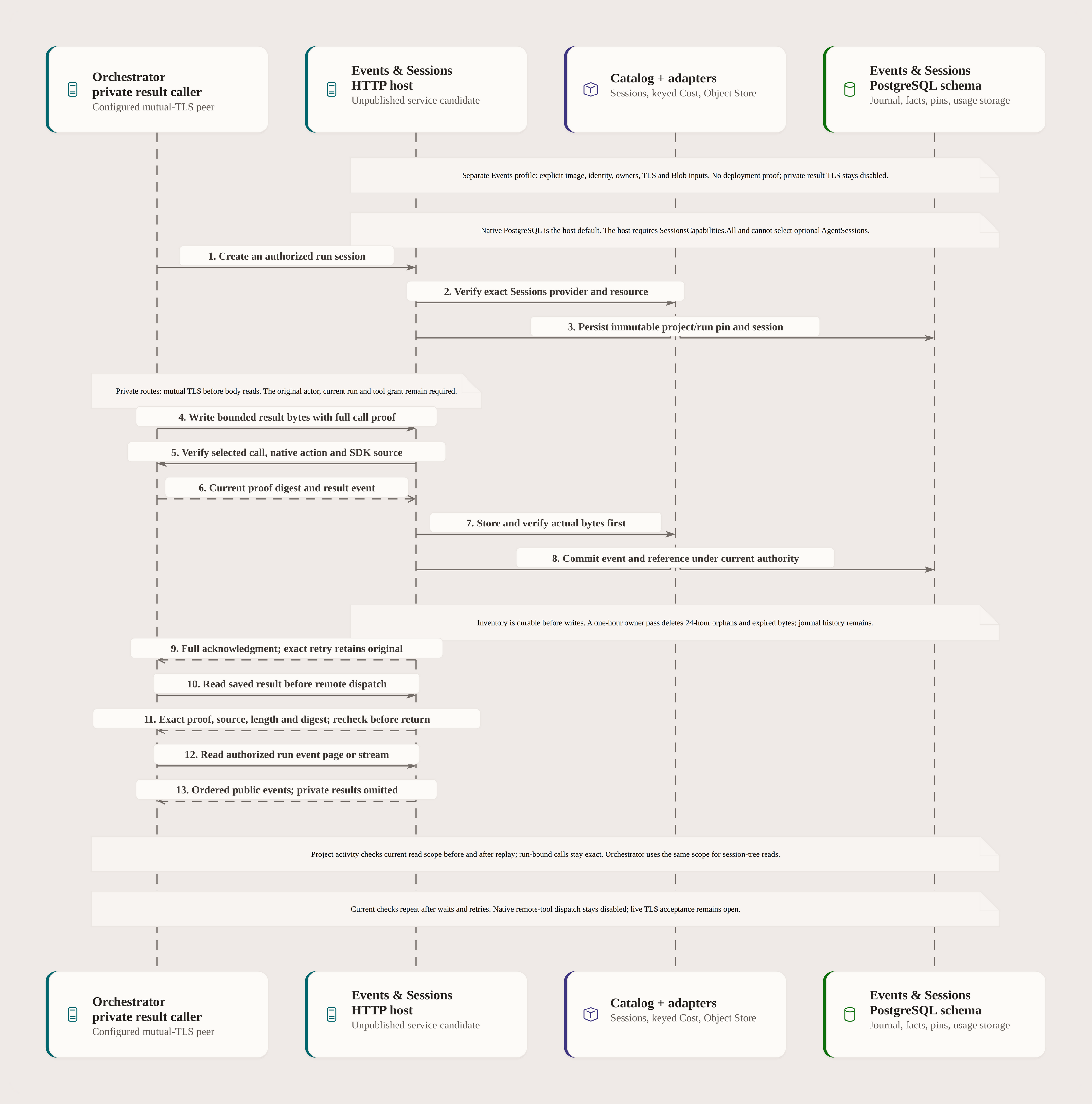
Open full-size PNG · Open editable draw.io source
Ownership and scope
Agentweaver.EventsAndSessions owns the run event journal, separate project-scoped accepted-effect facts, session records, immutable Sessions-provider bindings, object-reference retention metadata, and addressed-message records in its PostgreSQL schema. The Orchestrator owns run/session relationships, execution fences and turn state, coordination requests, parent notifications, and its durable message outbox. The shared Agentweaver.Persistence.Postgres library supplies the transactional outbox and inbox; it does not own these domain tables. The service uses the existing provider catalog/resolver and telemetry helper. The provider-neutral ISessionsJournal interface and SessionSubscriptionRequest contract live in Agentweaver.Abstractions; this service owns their PostgreSQL implementation.
The host binds the native PostgreSQL journal as the default and requires the full SessionsCapabilities.All set. The shared capability identifiers live in Agentweaver.Abstractions; optional provider implementations may advertise fewer capabilities, but the current host does not route runs to a non-native journal.
This source slice connects owner-validated addressed-message delivery to session turn-boundary requests. It does not implement the rest of the proposed platform: automatic AgentHost scheduling, a background delivery relay, gate approval decisions, consistency manifests, MAF checkpoints, or Gateway/UI/MCP routes. The broader Sessions and coordination design remains Proposed for those workflows.
Typed session material
Events owns bounded TurnContent and SdkCache material through the existing IObjectStore provider. This interface is not a general Blob API. The caller supplies actual bytes and an existing execution identity, not an object key, storage URL, container, or credential.
POST /internal/sessions/{sessionId}/material requires the original authenticated bearer, current Projects authority, and the current Orchestrator runtime registration. Events also requires the recorded SDK source and exact actor, tenant, project, run, session, accepted selection, registration revision, and execution fence. An observe credential alone does not authorize a material write.
Events generates the scoped object key and records the kind, SHA-256 digest, byte length, SDK version, runtime version, and model binding. Each object contains at most 1 MiB. Before writing bytes, Events commits an inventory row for the generated key. It stores the bytes before the journal transaction commits the event and reference, and records the reference's retention deadline in that same transaction. Every committed object reference extends the inventory deadline, including references committed by ordinary journal appends. A journal failure leaves the object unreferenced and its inventory row available for cleanup; it does not acknowledge the material. An append cannot create a reference to an object that cleanup has already deleted. It rechecks current authority after storage and database waits, including exact retries. The same event and material return the original acknowledgment. Changed material for the same event conflicts. An object without a committed journal reference is not acknowledged material. The Events owner checks inventory hourly. It deletes unreferenced objects after a 24-hour grace period and deletes referenced object bytes after their recorded retention deadline. Deletion preserves journal history and reference metadata; reads of expired or missing bytes fail instead of rebuilding them. Migration 010 backfills inventory from committed references, but earlier unreferenced objects cannot be discovered because IObjectStore has no listing contract.
GET /internal/sessions/{sessionId}/material/{eventId}/{kind} reads only material from a committed event in the authorized session. Historical TurnContent requires current ReadRunSelection or actually supplied ReadProjects entitlement, exact signed project/run binding, and recorded session membership. Project-summary access alone does not authorize material. SDK-cache reads retain the stricter Core ReadRunSelection boundary. These reads require the immutable Sessions provider binding, not a still-active execution registration. Events checks the recorded digest and length, then rechecks authority before it returns bytes. SDK cache restoration additionally requires compatible SDK and model bindings. Material responses use Cache-Control: no-store. The route accepts turnContent and sdkCache, plus their original CLR names. Numeric or unknown kinds are denied.
RemoteToolResult remains denied on these generic material routes. The dedicated POST /internal/sessions/{sessionId}/remote-tool-results write route and POST /internal/sessions/{sessionId}/remote-tool-results/read route require the configured direct mutual-TLS listener before they read the request body. HTTP requests receive runtime_remote_tool_result_https_required. Without the TLS configuration, HTTPS requests receive runtime_remote_tool_result_route_unavailable. An HTTPS flag, forwarded header, actor token, or project permission alone cannot pass this check. All handled responses use no-store.
Events accepts only the configured Orchestrator peer certificate on this listener. It forwards the original actor bearer to the fixed Orchestrator owner. POST /internal/runtime/remote-tool-results/verify reconstructs the selected tool call and verifies its current native action grant and reserved tool slot. Events also checks current Projects authority, actor, tenant, session provider, runtime registration, execution fence, and native SDK source. It repeats these checks around storage and journal waits, including exact retries. Events stores result bytes before committing their journal reference. An acknowledgment binds the full call proof, runtime identity, source, length, and digest.
Private reads require the same current authority and committed journal reference. Events verifies the recorded proof, source, byte length, and digest before returning bytes. The Orchestrator checks for a saved result after native action admission and before external dispatch. It accepts only the exact recorded call proof; only the previously unknown result content class can differ from the read template. It rechecks current authority before returning saved or newly acknowledged bytes. The ordinary AgentHost material client cannot use these private routes. Public event pages and streams continue to omit private result references and bytes.
Private result TLS configuration
Each service requires its own trusted configuration section: Orchestrator:RemoteToolResults:Tls or EventsAndSessions:RemoteToolResults:Tls. Both require Kestrel:Endpoints:RemoteToolResults:Url with HTTPS and the exact ListenerPort. Core also requires the runtime registration and native SDK source owners. Events requires the configured session material container. Missing sections leave private routes disabled; invalid sections stop startup.
| Setting | Required value |
|---|---|
LocalServiceName, PeerServiceName | Orchestrator and EventsAndSessions, in the local and peer roles. |
LocalServicePrincipalId, PeerServicePrincipalId | Distinct, explicit, nonempty service principal GUIDs. They map the configured services to the pinned certificates; callers cannot supply this mapping. |
LocalCertificatePemPath, LocalPrivateKeyPemPath | Distinct absolute server-side paths to the existing PEM certificate and private key. |
LocalCertificateSha256 | Exact SHA-256 digest of the local certificate bytes. |
PeerCertificateSha256Pins | One to four distinct SHA-256 digests for the trusted peer certificates. |
ListenerPort | The dedicated local HTTPS port. |
PeerOwnerAddress | The fixed HTTPS root address of the other service's dedicated listener. |
Certificates must be current, non-CA certificates with client and server authentication purposes. The native TLS stack checks the peer chain; outbound calls also require a valid server name. TLS 1.2 or 1.3, revocation checks, certificate pins, and redirect rejection remain required. The service keeps its certificate private; it does not give it to AgentHost or accept caller-selected owner addresses. Bounded HTTP reads retain their deadline after response headers arrive. A 409 owner response is an explicit changed-binding denial, not a successful retry.
This source adds no certificate issuance, service principal, trust store, deployment, or approved live TLS configuration. Environment has a separate, optional current-call verifier profile: Orchestrator:RemoteMcpCallVerification:Tls, with local service Orchestrator and peer Environment. It requires the runtime registration owner and the dedicated Kestrel:Endpoints:RemoteMcpCallVerification:Url port. It uses key remote-mcp-call-verification-environment, not the Events profile. The current-call route remains /internal/runtime/remote-tool-results/verify. The actual server listener port selects the configured profile; request bodies and headers cannot select a service role. Wrong transport, listener, or peer denies the request before proof-body reads. If both profiles exist, they must name the same Orchestrator principal and different peer principals and pins. The existing Events listener, options, and peer gate are unchanged.
Environment's matching client uses Environment:RemoteMcpCallVerification:Tls, key remote-mcp-call-verification-orchestrator, and client RemoteMcpCallVerificationOwner. It pins the fixed owner address and has a 15-second timeout. The verifier still checks the original actor, current registration, exact accepted call, current grant and policy, and existing journal acknowledgment. Its receipt is not network evidence or a credential grant.
Native remote-tool dispatch remains disabled. Positive native TLS, complete producer recovery, and private-result acceptance remain open.
GET /internal/projects/{projectId}/runs/{runId}/sessions-provider-binding returns the actual immutable Sessions consumer pin. It requires existing current ReadRunSelection and exact signed project/run binding before and after retrieval. The owner verifies its stored provider, options revision, resource generation, and negotiated capabilities. The no-store response contains no option values or credentials.
Usage storage and Copilot pricing
The service owns separate append-only usage_ledger and immutable usage_rate_cards tables. Migration 005_copilot_usage.sql adds these tables after the session journal, addressed messages, project facts, and explicit session forks. The migration preserves admitted version-4 schemas and the earlier version-2 project-fact layout. Migration 006_native_sdk_usage.sql adds cache-write values and permits unknown request counts. Migration 007_native_usage_receipts.sql adds immutable source receipts and run-scoped Cost bindings. Migration 008_row_lock_record_updates.sql rejects every row update to sessions, session_provider_bindings, and session_fork_lineage. It permits inserts and row locks without permitting data changes. Ordinary startup requires version 8 and checks each enabled, unconditional update trigger. It rejects missing, disabled, conditional, column-limited, or wrong-function triggers. The new migration does not change deletion rules or rewrite earlier migration records.
PostgresUsageLedger implements the low-level IUsageLedger storage contract. An entry records tenant, project, run, session, agent, model metadata, measurements, the Cost binding, and the price. Native submissions also retain the turn, SDK event ID, and complete SDK source snapshot. Optional A2AMessageId and SdkAccounting metadata participate in the canonical hash. Absent metadata preserves the historical canonical payload and hash. Accounting metadata retains the native source session, positive sequence, usage ID, reported credit status, and whether the SDK actually supplied that status. Cache-read and cache-write measurements remain separate. Native request counts stay null because the SDK callback does not report them. Nullable measurements remain unknown rather than zero.
The runtime source mode comes from the immutable platform or project selection. Hosted Copilot retains its copilot.nano_aiu source identity, while pricing uses the SDK's reported input, cached-input, cache-write, and output token counts. BYOK retains native token measurements under byok.tokens, without Copilot units or a hosted multiplier. Without an admitted Cost provider, BYOK accounting remains Unpriced. Only priced usage counts toward Copilot credit limits. Unpriced usage remains visible with its reason and event count; it is not treated as zero-priced usage.
The standalone AzureCostProvider accepts an explicitly configured, versioned rate card with model-scoped standard input/output token rates and a declared currency. It performs exact decimal arithmetic, does not fetch live prices, and does not quote BYOK work. Missing token counts, unsupported cache categories, unknown models, and changed bindings remain Unpriced. Events must also verify trusted Azure provider and deployment facts against the accepted runtime model pin before it can price a source receipt. RequireTrustedAzureByok performs that check. The receipt consumer applies the same source checks, without the dispatch message ID, to every receipt that claims Azure BYOK and rejects a failed claim, so untrusted usage never enters the ledger. Native SDK usage without a dispatch message ID is admitted as Unpriced. Events keeps these token totals but does not assign a cost because it cannot attribute the usage to a dispatch.
Azure BYOK pricing is off by default. To turn it on, configure the EventsAndSessions:Cost:Azure section with AzureCostProviderOptions fields and an explicit RateCard. Events then registers the Azure Cost provider for the byok.tokens meter source, pins the binding per run, and prices only Azure BYOK receipts that pass RequireTrustedAzureByok. Uncorrelated native usage stays Unpriced. Other BYOK providers stay Unpriced with byok-provider-unpriced. A changed rate card never reprices earlier rows. New usage in a run that pinned an earlier card stays Unpriced with pinned-cost-binding-unavailable.
Provisioned-throughput (PTU) usage stays Unpriced per event. AzureProvisionedThroughputAllocator builds a report that splits one fixed PTU period charge across ledger events by input plus output token share. It uses exact integer minor units, assigns leftover units by largest remainder, breaks ties by event ID, and records the rounding method. The shares always add up to the charge. The report never changes ledger rows.
Represented spend evidence
POST /internal/projects/{projectId}/runs/{runId}/usage/spend-evidence returns UsageSpendEvidence for one (meter source, unit) bucket. The caller needs the same read authority as the usage totals route. The request names the bucket, an optional project period with an inclusive start and exclusive end, and at most 64 dispatch IDs. One repeatable-read snapshot supplies:
- Priced amount, priced event count, and unpriced event count for the run and the project period. Unpriced events without a unit count in every unit bucket of their meter source.
- An agent total for the run when the request names an
AgentId. - One
UsageDispatchAccountingWitnessper requested dispatch, with the source receipt identities, receipt digest, and known priced subtotal. A witness matches the dispatch in any run of the project, because a project budget holds exposure for dispatches from other runs. AccountingCursor, the number of ledger events for the project and meter source in that snapshot.
The ledger is append-only, so a later read has an equal or higher cursor and includes every event an earlier read included. Events never reports SourceComplete. A witness is Partial when it has receipts and Unknown when it has none. Orchestrator compares the witness receipts with its own dispatch completion manifest to decide whether every charge is represented. The route reads the existing ledger and needs no new migration.
When EventsAndSessions:RuntimeUsage:Enabled is true, Events requires the same server-owned AgentHost:ModelBindings map and AgentHost:ModelBindingsRevision as AgentHost. It uses the SDK-independent shared resolver, not a separate Events model catalog. The concrete model ID and canonical map identity can therefore match an accepted runtime pin. This configuration does not by itself prove live model availability. The optional copilot-run-admission route accepts only the accepted-selection hash. Events reads the actual selection from its fixed Projects owner with the original bearer. It requires current ReadRunSelection and AcceptRunSelection for the exact signed project/run. The shared resolver supplies the concrete enabled hosted model; caller model IDs are not accepted. The existing Cost lock and transaction bind the zero-work quote and Copilot-only totals. Events rereads Projects selection and authority before committing that Cost pin. An explicit Unpriced quote for a model without a published rate does not block run admission or dispatch. It remains distinct from a zero-price estimate; malformed or tampered pricing receipts still fail closed. No SDK session, usage event, source receipt, or ledger row is invented during admission. Orchestrator persists the typed admission receipt with root acceptance through its existing outbox. Backlog claim uses the same acceptance transaction. An identical accepted-root replay uses that immutable receipt without repricing earlier admission. Configured Copilot credit limits cannot use BYOK token pricing or an unbound hosted connection. The source paths do not prove live PostgreSQL, native availability, or deployment; each still requires separate acceptance.
A transaction commits the rate card and usage entry before returning. The accounting receipt binds the canonical SHA-256 hash, attribution, immutable price, rate-card version, and commit timestamp. Identical retries return the original receipt. Changed content for the same event ID conflicts. Database triggers reject changes and truncation of history. Statement-level guards also reject TRUNCATE, including dependent and multi-table operations, on native source records, accounting receipts, and run-scoped Cost bindings.
Totals retain separate meter-source and unit groups. A missing measurement makes that measurement total unknown. An unpriced entry makes the run or agent pricing incomplete. Rate changes never reprice earlier entries. Exact totals that exceed the numeric range fail rather than round or wrap.
Hosted Copilot entries are priced from their complete token measurements against the provider's pinned published rate card, not by applying a model multiplier to nano-AIU. Complete token measurements remain sufficient when the SDK omits Nano AIU; optional SDK accounting identity and status do not control pricing completeness. Supplied identity text, source session, and positive sequence remain validated. BYOK pricing uses the actual tokens measurement shape and the existing price disposition. Hosted credit status does not determine BYOK token-pricing completeness. Neither a fully priced subtotal nor a native usage watermark proves complete dispatch membership.
CopilotCostProvider prices reported input, cached-input, cache-write, and output tokens directly in AI credits (AIC). Its immutable provider-supplied rate card records per-million-token USD rates for default and long-context tiers, the long-context threshold, 1 AIC = $0.01 USD, and the source URL, snapshot version, and retrieval date. The current snapshot is sourced from GitHub's official Copilot model-pricing documentation, retrieved 2026-10-17. The default snapshot contains the 33 models listed on that page. The operator supplies its strict, versioned JSON through EventsAndSessions:Cost:Copilot:RateCard:Json in runtime configuration. Startup validates the schema and hashes the exact JSON text; each cost binding, snapshot, and accounting receipt retains the rate-card version and content hash. Updating the ConfigMap and rolling out the service loads new rates without a product rebuild. Keep the adapter options revision aligned with the provider catalog; the rate-card version changes independently when pricing data changes. No runtime price fetch, scalar multiplier, or inferred price is used. Unknown model rates, missing token categories, and unavailable context-tier rates remain explicitly Unpriced with a reason; this does not block admission or dispatch. Unpriced usage is recorded and visible but excluded from credit-limit totals. Known priced usage continues to count. The adapter requires an immutable rate-card snapshot and exact provider, configuration, resource, and capability bindings.
IUsageLedger.AppendAsync remains a low-level storage contract without caller authorization. The optional HTTP consumer uses a different, reference-only admission path. POST /internal/sessions/{sessionId}/usage-receipts accepts only receiptId. Callers cannot supply a source URL, SDK measurements, price, rate card, or accepted marker. Events fetches the immutable receipt from its fixed HTTPS Orchestrator owner. The HTTP client rejects redirects and preserves the original validated bearer.
The Orchestrator source writer requires that bearer and an independent observe credential. It checks the current registration, Core permission, accepted selection, active session and turn, Environment lease, and Identity grant after database waits. The actual SDK session supplies the effective model, catalog hash, SDK versions, event identity, and nullable measurements. The pinned SDK does not provide a proven binding from usage events to an A2A send. As a result, the runtime leaves A2AMessageId null. It does not infer ownership from the active turn or event timestamps. Events accepts cost-turn evidence only when a source receipt's A2A ID exactly matches CostTurnId. A callback without that ID cannot release the cost turn. A callback from an earlier send can arrive during a later send. Null correlation is omitted from legacy source payloads, preserving their canonical hashes. The receipt validator rejects changed owner, SDK, model, catalog, event, and selection pins.
Events requires current ReadRunSelection for the exact signed project/run. It resolves the meter source through the existing Cost catalog/resolver and pins the run's first Cost binding or explicit unavailable reason. Before runtime readiness, Events can preflight that immutable binding against the effective model from the current Orchestrator-owned SDK source snapshot. It uses the existing Cost provider quote path without recording usage or exposing the quote amount. A valid explicit Unpriced result, including a model without a published rate, remains visible but does not prevent readiness or dispatch. The SDK source still does not prove per-turn usage-to-A2A affinity for arbitrary or legacy callbacks. Workflow-bound positive-hard-capped Hosted Copilot activation uses the prepared dispatch and begin path with current whole-run priced totals; it denies the next dispatch when observed totals reach the hard limit. A whole-run total does not identify one turn or establish accounting finality. An unbound positive-cap registration still fails with runtime_usage_affinity_unavailable before readiness. Any already-started turn with unknown ownership remains held; its native receipt is retained and cannot release a cost turn without the exact message ID. The transaction commits the price, rate card, ledger, source hash, receipt, and consumer inbox before it returns a no-store accounting acknowledgment. It repeats current Core authority after transaction waits, including duplicate requests. Failed revalidation rolls back the transaction.
The accounting acknowledgment proves a committed price, not runtime credential authority. It remains separate from the source receipt. Committed source receipts support explicit retries after restart. Unavailable providers and missing measurements produce Unpriced, not zero cost. GET /internal/projects/{projectId}/runs/{runId}/usage returns exact run and agent totals. POST /internal/projects/{projectId}/runs/{runId}/usage/copilot-cost-snapshot returns the existing run-pinned binding, a zero-work quote for the actual SDK model, and Copilot-only totals. It uses the same Cost lock and transaction as native receipt ingestion. This quote does not create a usage event or accounting receipt. An empty observed set has a zero priced subtotal without turning an unpriced quote into a priced zero. Unpriced Copilot entries remain incomplete and visible, but are excluded from the priced subtotal used by Copilot credit limits. Other meters do not affect Copilot credit limits. The snapshot endpoint rechecks current signed run authority before it commits. An optional dispatch ID and at most 512 required references request an observed accounting join. Events reads each immutable source receipt, accounting receipt, and ledger row in the same transaction. Each registration, SDK source, platform message, event, accounting hash, and stored price must match. An optional NativeTurn reference requires an authenticated read of Core's persisted native turn. Events reads that proof before taking the Cost lock and again after releasing it. The proof must retain the current registration, execution fence, checkpoint, report hash, revision, and exact event set. Only this verified association permits a raw usage receipt without a platform message ID. A wrong non-null message ID or an event after native completion fails. Without native proof, the existing exact raw-message check remains unchanged. The response returns only those verified references as RepresentedReceipts. Missing rows reject the join; altered references cannot substitute another receipt. For hosted-Copilot snapshots, run and per-agent totals must include the amount and priced or unpriced event count for every represented receipt, and run totals must match agent subtotals. Turn-cost reconciliation keeps a valid Unpriced receipt in the represented set with its reason and event count; it does not block reconciliation or become a zero-cost priced event. Missing rows, altered references, and totals that omit represented amounts or event counts are rejected. Admission and credit-limit validation accept well-formed Unpriced quote and usage shapes, retain their reasons and event counts, and use only the known priced subtotal; malformed or tampered receipts remain rejected. This path neither fetches a Source GET manifest nor writes synthetic usage. These routes are enabled only with EventsAndSessions:RuntimeUsage:Enabled. The AgentHost candidate waits for the observed join and durable owner completion before it returns workflow output. This source has no background usage relay or cloud acceptance.
Addressed-message owner integration
The Orchestrator exposes protected root/child registration and session-scoped send, turn-boundary, turn-completion, notification, and acknowledgment routes. Before each operation it requires the current Projects & Config authorization context and accepted run selection; it does not trust token claims alone for current permission. It writes outbound messages to its durable owner outbox before synchronously admitting them to Events & Sessions. Events asks the Orchestrator to verify that the complete message matches that outbox record, that both sessions belong to the active run, and that sender/recipient writer and execution fences are current. It persists the journal reference and Events-side outbox/inbox transactionally.
For mapped child work, the Orchestrator checks the latest root decision envelope under the root-session lock before it creates the owner child and spawn outbox records. The envelope must still authorize dispatch of the exact confirmed WorkPlan item, with the current actor, accepted-selection hash, and execution fence and no pending gate. Child registration and spawn recheck live Projects authority before transaction commit. The read-only runtime-owner-context endpoint re-reads the child owner row and latest root decision, then rechecks Projects authority and accepted selection before returning agent/model/turn metadata. A changed owner row, decision version, mapping, fence, or pending gate returns a conflict rather than stale context; it does not cancel or schedule runtime work. The runtime-execution-observation endpoint uses the same current-owner checks to read only the child’s own checkpoint status and dispatch metadata. It hashes completed result text and returns only the digest and UTF-8 length; it never returns the result text itself. It can observe active, completed, or failed child sessions under the current execution fence; terminal state does not bypass owner, decision, or selection checks. Observation does not retry or schedule runtime work.
The version-2 runtime-execution-observation route keeps those checks and wraps the unchanged version-1 observation with a checkpointParent object. Its required hasParentMetadata flag and nullable parentCheckpointId come from the same selected latest checkpoint row. True/null identifies a verified root; false/null means unknown legacy metadata. Contradictory or invalid saved parent data returns a conflict. The version-1 route is unchanged.
At an explicit owner turn-boundary request, the Orchestrator asks Events to claim and present the next addressed message. Events re-reads the current owner session binding for every operation. It permits claim or presentation only while the owner reports presenting. Acknowledgment remains available after that boundary under the current execution and claim fences. The owner records delivery and exposes parent notifications. The completed boundary result is stored with its request state version, so retrying the same request returns the same result without claiming another message. A blocked session can resume when a pending wake exists, and a wake received during presentation is not lost. progress messages remain in sender history but are not claimable as recipient input; idempotency is scoped to the sender run and session. When a valid correlated reply is admitted, the owner moves the matching pending request to input_available. Later acknowledgment records receipt only: it does not approve a gate or complete child work. Needs-input and error messages can set a pending wake. The owner drives these calls synchronously; no background relay or automatic AgentHost scheduler is included.
The Broker-backed HTTP integration test uses a real Broker-issued run token, disposable PostgreSQL, and an accepted Projects selection. It tests root/child registration, owner-outbox validation, delivery and journal mapping, turn-boundary presentation, fenced acknowledgment, parent notification, and permission revocation. It is an integration test of the source hosts, not evidence of a deployed service.
Provider pin and session creation
The protected POST /internal/sessions/{sessionId} route validates a caller token issued for the configured HTTPS identity issuer and audience. The authenticated principal must have a GUID sub and exactly one project_id/run_id pair; the Identity Broker adds that owner pair only for an active core grant. The host does not require tenant or platform-role claims. The session ID is checked as a bounded identity. The host resolves the exclusive Sessions provider through the catalog and permitted project override, negotiates the live PostgreSQL database and migrated schema, and pins only after successful negotiation.
The first session for a project/run persists the provider ID, adapter version, options schema version and revision, resource ID and generation, and negotiated capabilities. The binding is immutable across that run. Creating another session with a different effective binding returns a conflict rather than replacing the stored choice.
Every append, replay, and live subscription reads the persisted binding and verifies that the exact provider, version, options, resource, generation, and capabilities are still available. A missing or changed binding fails explicitly; it never selects a replacement default. Pin telemetry records bounded provider and capability data and a hashed resource ID, not option values, credentials, payloads, or raw resource IDs.
Journal durability and replay
Event contracts are versioned independently by schema and event version. Event version 1 supports typed turn, tool-call, accepted-decision, accepted-effect, artifact-reference, and cache-reference payloads. Event version 2 adds the purpose-built PolicyEvaluation payload; existing version-1 payloads remain appendable and replayable. PolicyEvaluation events use a dedicated receipt-reference route; the generic run-scoped append path still rejects every such event because actor equality does not prove Orchestrator Core provenance. POST /internal/sessions/{sessionId}/policy-evaluations accepts only an immutable receipt ID. Events verifies the pinned provider capability, fetches the committed receipt from the fixed Orchestrator owner, and asks that owner to validate the receipt against current admission authority. Every outcome requires current Core write authority and accepted selection, plus a matching actor/tenant and active owner session/run with the same writer and execution fence. After the owner-row check can wait on PostgreSQL locks, the owner reads current Core authority and selection again before admission succeeds. For Allow, it also rechecks grant scope/revision, expiry, and fence. Deny and Error receipts can reference an issued inactive grant, but remain immutable owner facts and cannot authorize an effect.
Events repeats the owner admission check from inside the PostgreSQL transaction before commit, including for an identical retry. The owner repeats current Core authority and accepted-selection checks after owner-row lock waits. The transaction commits the PolicyEvaluation event, inbox identity, run position, object references, and outbox records together. If the recheck fails, those writes roll back. After commit, Events returns a no-store acknowledgment containing the receipt identity and durable event position; a new append returns 201, an identical retry returns 200, and conflicting reuse fails. The event envelope binds project/run/session; its payload stores only bounded actor, tenant/step, grant reference/revision, purpose/action/fence, typed outcome/reason, and provider/options identity metadata. It has no free-form error field or space for rule text, tool arguments, prompts, or credentials. Large content in other event kinds is represented by opaque ObjectKey references with a purpose, optional byte length, and retention metadata; the service does not store referenced bytes or credentials.
Append serializes access to the project/run stream position in PostgreSQL and admits a run-scoped stable event identity through the inbox. It writes the event, object-reference metadata, position, and outbox record in the same transaction. Events from different sessions in one run share a single contiguous sequence while retaining their originating session identity. It commits before returning the event. A retry with identical canonical event content returns the original event; reusing its identity with different content in the same run is a conflict. PostgreSQL, not an in-process counter or channel, assigns the authoritative ordered position.
The Orchestrator receipt writer rechecks the actual request actor, current Projects acceptRunSelection authority, and accepted selection after owner-row lock waits. It rechecks them immediately before committing the owner receipt, after its grant-row lock and insert. This also applies when a receipt ID already exists. An Allow requires the exact current grant, expiry, fence, and selection. Deny/Error can refer to an issued inactive grant, but still require current Core write authority and active owner session/run authority. The Core action guard then awaits the durable Events acknowledgment and rechecks current authority, grant state, and fence after that await. Any failed owner check, journal append, or post-ack recheck prevents the protected effect; evidence alone cannot grant authority. Downstream protected-effect call sites are not claimed to be wired.
Run replay returns a bounded, run-ordered page spanning all sessions; session replay returns only that session's events at their run positions. Run cursors are bound to a project/run, while session cursors are additionally bound to a session. Live subscriptions poll durable journal state across service instances and emit NDJSON SessionEventDelivery records containing the event and its nextCursor. A client reconnects by passing that cursor unchanged; the numeric position alone is not the cursor contract.
Project accepted-effect facts
POST /internal/project-facts/accepted-effects is separate from all session and run journal routes. Its request contains only the receipt ID, schema version, and event version. Events fetches the immutable committed receipt from the configured fixed HTTPS Knowledge address; callers cannot supply a source URL, payload, or accepted marker. Redirects are disabled.
Events requires the caller's validated issuer and subject to match the original receipt, checks project/run bounds and rejects purpose-bound tokens. It forwards the caller bearer and optional tenant selector to Knowledge and Projects & Config, then requires fresh effective project WriteProjects permission. If a caller uses separate existing audience-correct tokens, the Knowledge token is forwarded only in the protected request to the fixed Knowledge owner; neither token is stored or logged.
After validation, Events constructs the accepted-effect fact itself. In one PostgreSQL transaction it admits the receipt ID through the shared inbox, assigns a project-scoped sequence, and persists the immutable fact and acknowledgment. An identical retry returns the same acknowledgment; changed receipt content for the same ID conflicts. The acknowledgment binds the receipt ID and versions to the native fact ID, project, and sequence. No fact or inbox receipt is committed alone.
These facts do not enter session_events, require or modify a Sessions provider pin, or claim a run/session transition. Knowledge uses a caller-driven relay and marks its outbox event delivered only after validating this durable acknowledgment. Failures leave delivery pending for a fresh authorized caller retry. The service has no unattended relay worker.
Schema and validation boundary
The host defaults to the service-owned events_sessions schema. Run the executable with only --migrate to apply its embedded migration. That command requires a separate privileged PostgreSQL connection and workload identity. Ordinary startup uses the runtime Entra role and only verifies that the Events & Sessions and outbox schemas are current; it fails when migration is needed and never creates or alters database objects. Readiness repeats the verification.
Both connections require an explicit WorkloadIdentityCredential configuration. Npgsql obtains a PostgreSQL-scoped token through its async password callback for each new physical connection; Azure Identity manages token caching and refresh. The connection strings must include their Entra PostgreSQL role and must not contain a password. TLS uses VerifyFull. The service has no developer-credential or password fallback. It does not create Azure resources, run a background relay, or publish an image.
Use these separate settings:
For provider selection and runtime setting guidance, see the planned provider configuration guide and runtime configuration reference.
| Configuration | Purpose |
|---|---|
ConnectionStrings:EventsAndSessions | Runtime PostgreSQL endpoint, database, and least-privilege Entra role. |
EventsAndSessions:Database:WorkloadIdentity:{TenantId,ClientId,TokenFilePath} | Explicit workload identity for runtime database access. |
EventsAndSessions:Knowledge:BaseAddress | Required fixed absolute HTTPS Knowledge owner URI used to fetch committed accepted-effect receipts; redirects are rejected. |
ProjectsConfig:BaseAddress | Required fixed absolute HTTPS Projects & Config URI used to recheck current project authority; redirects are rejected. |
ConnectionStrings:EventsAndSessionsMigration | Migration PostgreSQL endpoint, database, and separately granted schema-owner role. |
EventsAndSessions:Migration:WorkloadIdentity:{TenantId,ClientId,TokenFilePath} | Explicit workload identity for the migration command only. |
The migration job and its database grants are not provisioned by this source candidate.
Events runtime input validation
The complete v1 product installation, including the Events Deployment, Service, ServiceAccount, runtime ConfigMap, and Cilium policy, is maintained in the root Kustomization at deploy/k8s. The static workload pins its release image through Kustomize; the install does not generate a Deployment or Service from a JavaScript profile.
deploy/k8s/profiles/events-and-sessions/render.mjs validates operator-selected runtime values before they are written to the checked-in events-and-sessions-runtime-config.json. It requires the admitted P0 database and workload identity, Sessions resource identity and generation, Broker issuer/audiences, private Knowledge/Projects/Orchestrator owner addresses, a Blob container in agentweaverblob, and valid model-binding and rate-card values. Database access remains password-free with VerifyFull; credentials, SAS tokens, extra Blob paths, and encoded paths are rejected. This validator emits configuration data only. It does not produce a Kubernetes List, image, Deployment, Service, policy, Secret, or certificate.
After reviewing a configuration update, render the complete bundle and apply it through Kustomize:
kubectl kustomize deploy\k8s
kubectl apply -k deploy\k8s
kubectl rollout restart deployment/events-and-sessions -n agentweaver
kubectl rollout status deployment/events-and-sessions -n agentweaver
Kubernetes does not restart a process when data in a referenced ConfigMap changes, so restart the affected workload after changing environment-backed configuration. The release helper validates receipt-pinned images and all operator-owned prerequisites before applying the same bundle. It does not create the operator-supplied TLS Secret, public CA data, database grants, migrations, or Gateway placement. The private RemoteToolResults listener remains disabled.
The contract reference lists routes and configuration. The testing guide describes the disposable-PostgreSQL tests and their limits. No earlier v1 Sessions event envelope exists, so no N-1 event-schema compatibility claim applies to this initial version-1 contract.