
Knowledge and memory
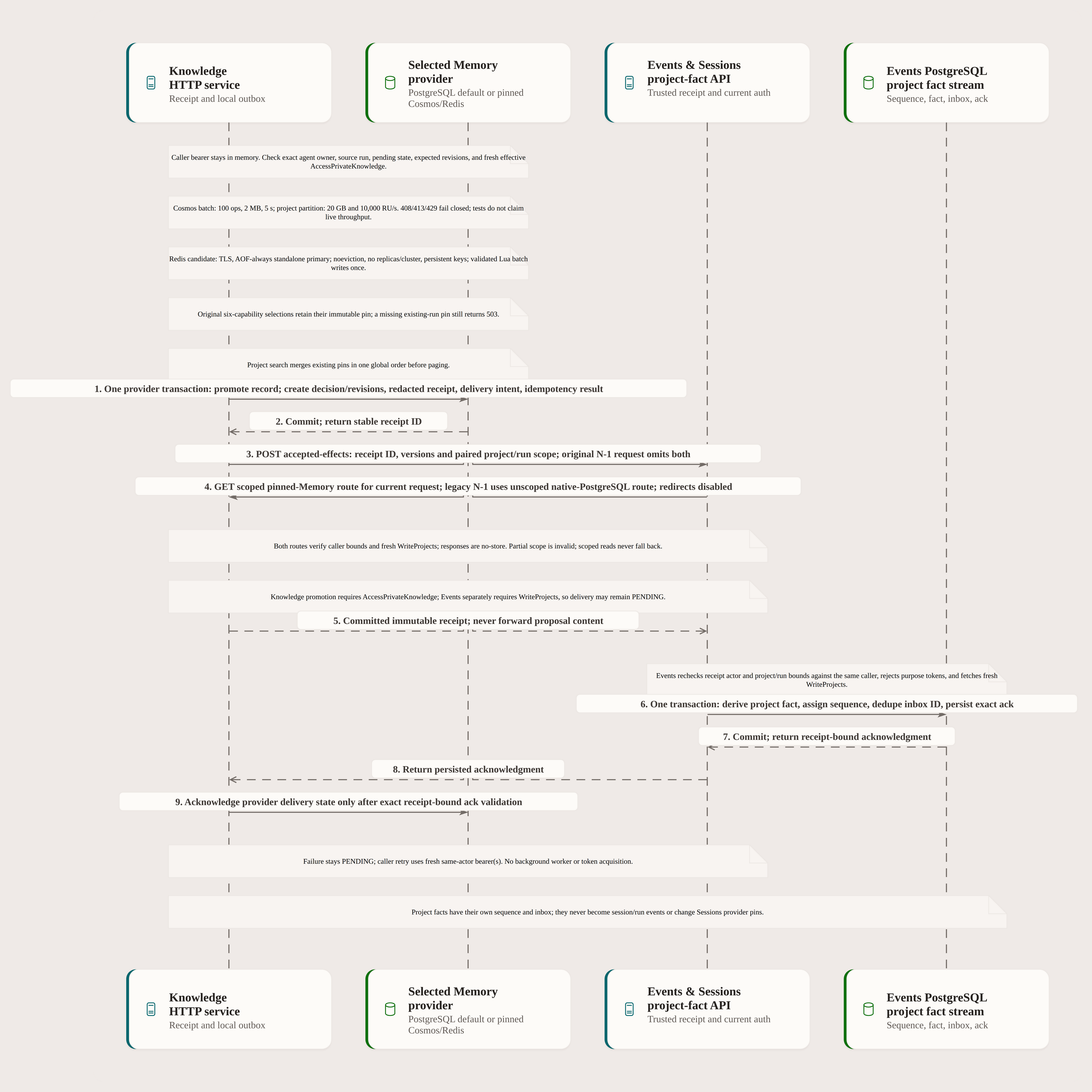
Use this concept to understand how the unpublished .NET 10 Agentweaver.Knowledge service candidate stores project memory and builds context for a run. Knowledge owns the memory API, context compiler, and immutable run-provider bindings in its PostgreSQL knowledge schema. The selected Memory provider stores records, revisions, idempotency receipts, and accepted-effect delivery state. Source presence does not prove deployment or delivery of an accepted outcome to Events. Project facts remain separate from the Sessions run journal.
Open full-size PNG · Open editable draw.io source
Edits, archive, supersession, restore, and approval append immutable revisions. Restore adds an Active+Pending head; it never rewinds history.
Versioned transfers preserve Memory/Decision history. Imports are exact project/agent scoped, bounded, non-merging, and Active+Pending.
Authority and ownership
Projects & Config remains the sole owner of caller memberships and project roles. Before a record operation, Knowledge forwards the validated request's original bearer token and optional X-Agentweaver-Tenant selector to GET /api/authorization/context. Private record reads and writes both require fresh effective AccessPrivateKnowledge for the target project. A run-bound project Owner with projects.admin receives this Knowledge-specific permission without gaining generic WriteProjects; ReadProjects is metadata-only and, even with ReadRunSelection, does not authorize record search, reads, revision history, or context composition. Projects & Config remains the source of the current project-admin permission; Knowledge does not infer it from the route's agentId. A caller's existing signed project/run bindings, when present, must exactly match the requested project/run and the Projects authority response. Knowledge keeps no membership table, role table, authorization cache, or authorization pin.
Provider resolution also requires current effective project ReadRunSelection. Knowledge fetches the immutable run-selection snapshot from Projects & Config with that same caller token. It checks the returned project, run, and revisions before binding a Memory provider. Redirects, owner errors, malformed or mismatched responses, and missing permissions fail explicitly; Knowledge does not mint a token or infer authority from path values.
Context composition always observes Knowledge's configured DefaultContextTokens ceiling. When the accepted run selection has a prompt-token cap, the lower of that cap and the Knowledge ceiling applies; when it omits the cap, the Knowledge ceiling still applies. This retrieval budget does not make a configured runtime prompt cap enforceable.
Visibility is project-admin scoped, not agent-owned: a current project Owner receives AccessPrivateKnowledge for that project, including on an exact run-bound token; generic WriteProjects remains unbound-only. A TenantAdmin receives AccessPrivateKnowledge and WriteProjects at the tenant or project resource scope when the token is not run-bound. These admins can inspect any agent's records in an authorized project through project-wide search or by explicitly selecting an agent for scoped operations. The route's agentId selects rows; it does not prove the caller is that agent, and an admin grant does not extend to another project or tenant. Before provider resolution, Knowledge also requires ReadRunSelection for the exact project and reads its accepted run selection from Projects & Config.
Project-wide discovery uses a separate Gateway route and requires an unbound Broker token with current project AccessPrivateKnowledge and direct project ReadRunSelection. Run-bound tokens are rejected. Knowledge enumerates only existing run-provider bindings, resolves each without creating a pin, groups bindings that share the same provider resource, and searches all agents in each resource. It rechecks authority and bindings before returning results; an inaccessible or unavailable binding fails the request. Each result identifies an access run: the existing run binding that authorizes revision-history reads. The record's sourceRunId, when present, remains separate provenance. Results from all resources are globally ordered before the requested page is selected.
The data paths preserve project and agent/run scope. Scoped search filters by project and agent before counting or returning records; project-wide search filters by project across agents. Direct record reads return the same not-found result when a record is absent or belongs to a different requested agent; the revisions endpoint checks that record/agent match before querying revision history. Context candidates are filtered by project, with active approved decisions available project-wide, agent memories kept agent-local unless approved and tagged cross-team, and SessionContext limited to the requested agent and run. The current runtime authority contract has no agent-to-principal visibility grant, so a runtime caller without current AccessPrivateKnowledge fails closed. Knowledge owns the authorization and data boundaries; the selected Memory provider stores records, revisions, idempotency receipts, and accepted-effect delivery state. The immutable run-provider binding and Knowledge service schema remain in PostgreSQL. Knowledge does not read or write another service's schema.
Memory provider and run binding
For provider selection and Knowledge settings, see the planned provider configuration guide and runtime configuration reference.
Agentweaver.Abstractions defines the provider-neutral IMemoryProvider contract and the read, write, search, revision, proposal-promotion, context-composition, and accepted-effect-delivery capabilities. postgres.native-memory remains the default. The optional cosmos.memory adapter is version 1.0.0 with options schema version 1.
The accepted Projects run selection must contain exactly one exclusive Memory candidate. Knowledge compares it with the catalog-owner snapshot loaded from ProjectsConfig:ProviderCatalog, resolves it through ProviderCatalog and ProviderResolver, and negotiates the live PostgreSQL database identity and schema. It stores an immutable project/run binding containing provider ID, adapter version, options-schema version and revision, resource identity and generation, negotiated capabilities, project revision, configuration revision, and context revision. On later operations, a changed run selection or provider binding fails closed; there is no provider fallback. An original six-capability run selection remains valid against the current catalog's additive accepted-effect-delivery capability. Knowledge verifies the persisted pin against that immutable selection snapshot without rewriting it; a missing pin for an existing run still returns 503.
Cosmos Memory source candidate
When the catalog and Knowledge:CosmosProvider options register Cosmos, an accepted run selection can choose it through the same exclusive IMemoryProvider boundary. Native PostgreSQL remains the default. Negotiation verifies the configured database, container, /projectId partition key, required search composite index, non-expiring default TTL, resource identity, and generation; it does not provision or create Cosmos resources. The Cosmos SDK uses the host's configured runtime workload identity. Records, immutable revisions, idempotency receipts, proposal promotion, and accepted-effect receipt/delivery state are stored in project-partitioned Cosmos batches. Knowledge still stores immutable run-provider bindings and its service schema in PostgreSQL. A missing, unavailable, or incompatible selected provider fails closed; a run never falls back to PostgreSQL.
The Cosmos tests use a fake document-store transport and exercise selection metadata, partition isolation, immutable revisions, conflicts, idempotency, promotion, delivery leases, and restart behavior. They do not prove live Cosmos permissions, throughput, availability, or cloud deployment.
Redis Memory source candidate
When the catalog and Knowledge:RedisProvider options register Redis, an accepted run selection can choose the redis.memory adapter through the same exclusive IMemoryProvider boundary. Native PostgreSQL remains the default. The endpoint must be a rediss:// URI with an explicit port; optional ACL username and password are configured together. Resource identity, generation, options revision, and schema version are pinned with the run. The service does not provision Redis resources.
Negotiation requires Redis 6 or later as a standalone primary, with no replicas or cluster mode, verified append-only persistence (appendonly yes, appendfsync always, no-appendfsync-on-rewrite no), noeviction, and a healthy AOF. Existing namespace keys must not expire; Redis versions that support hash-field expiration are also checked for expiring fields. Project IDs are SHA-256 hashed into project-specific Redis hash keys. Stored Knowledge documents remain opaque JSON. A bounded Lua batch validates all document, ETag, and lease changes before one final hash write; delivery leases use Redis server time. Any incompatible configuration, unavailable backend, or invalid stored data fails closed without provider fallback.
Redis tests use a controlled command-client fake. They cover selection and negotiation, durability/eviction/topology rejection, expiry checks, prevalidated single-write batches, CAS conflicts, idempotent replay after a lost response, server-time lease fencing, and backend-loss behavior. A separate opt-in native suite uses the production Redis command client and document store. It exercises Lua batch atomicity and concurrent CAS. It also tests promotion/receipt/idempotency and server-time lease fencing across a restart of one explicitly test-owned, digest-pinned, loopback-TLS Redis instance with AOF on a dedicated labeled volume. The suite never creates or pulls an instance or flushes keys. The restart case restarts only the validated test-owned instance. These tests do not prove production Redis permissions, availability, or deployment. Neither optional Memory source candidate replaces the PostgreSQL Sessions journal or the PostgreSQL state owned by other services.
Records and revisions
Record content is project/agent scoped. Each successful update appends a full immutable revision with a previous-revision link while compare-and-swap updates the current record with its expected revision. Records cannot be physically deleted. Writes require an Idempotency-Key scoped by project and validated actor: identical retries return the original result; a reused key with different request content conflicts. Not-found, stale-revision, invalid-state, provider, storage, and budget conditions do not return success-shaped placeholders.
Memory and Decision edits, archival, and supersession use the same expected-revision compare-and-swap. A superseded Decision links to its replacement Decision, and the change is appended to its immutable history. Restoring a historical revision does not rewind or replace that history: it appends a new head containing the selected content. The restored record is Active with Pending trust, and a restored Decision must be approved explicitly before it is trusted again. Explicit Decision approval also appends a revision; unlike proposal promotion, it does not create an accepted-effect receipt or deliver a project fact.
Compiled context includes only Active Decisions with Approved trust. A superseded or archived Decision leaves current context on its next compilation, and a corrected or restored Decision stays out until someone approves it. Each compilation returns the record ID, revision number, and revision ID of every item it used. A run that accepted a compilation keeps those references. Later corrections, supersession, archival, and restores append new revisions, so the revision history endpoint still returns the exact content and state each reference identified.
The agent-scoped export and import routes use the selected, already-pinned Memory provider. Version 1 exports only Memory and Decision records with their complete revision chains for one exact project and agent. The bundle is bounded to 25 records, 500 revisions, and 1 MiB. Import requires the bundle's project and agent to match the authorized route, rejects unsupported or incomplete histories, foreign replacement links, cycles, and ID collisions, and never merges an existing record. It preserves the source revisions and appends an imported revision with the importing actor and run; imported records are Active with Pending trust and require explicit approval before Decisions are trusted. Unsupported formats and invalid input fail explicitly.
New proposals are pending and cannot be edited like ordinary memory. Promotion requires the caller's current effective AccessPrivateKnowledge permission, the exact agent owner, source run, pending state, and expected revision. It marks the proposal promoted, creates an approved decision, appends both revision histories, and records an immutable redacted accepted-effect receipt and delivery intent atomically through the selected Memory provider. Native PostgreSQL uses its Knowledge database transaction; Cosmos writes the scoped documents in one project-partition batch. The receipt contains identity and authorization bounds, effect and record IDs, record version, and accepted time. It contains no proposal content or credentials.
Cosmos transactional batches must stay within one logical partition and are limited to 100 operations, 2 MB per batch, and five seconds per execution. A logical partition is limited to 20 GB and 10,000 RU/s (transactional batch limits, service quotas). The adapter fails closed when Cosmos reports a timeout, oversized batch, or throttling response. Tests inject those statuses; they do not validate live throughput, capacity, or RU consumption.
GET /internal/accepted-effects/{receiptId} returns that receipt with Cache-Control: no-store. Knowledge requires the original issuer and subject, matching resource bindings, no purpose-bound token, and a fresh current WriteProjects authorization. It returns receipt metadata only; it does not expose the decision or proposal contents. This unscoped native-PostgreSQL route remains for the original N-1 accepted-effect delivery request. Current deliveries include both project and run scope and use GET /internal/projects/{projectId}/runs/{runId}/accepted-effects/{receiptId}, which reads only from the already-pinned Memory provider and does not create a missing run binding. A partial scope is invalid, and a failed scoped read never falls back to the legacy unscoped route.
After the commit, a caller-driven relay sends the receipt ID, contract versions, and paired project/run scope to the fixed HTTPS Events endpoint. It forwards the existing Knowledge bearer when one token covers both owners. If separate tokens are already available, the request can provide the same caller's Events-audience bearer in X-Agentweaver-Events-Authorization; both tokens stay in request memory and are never stored in the outbox. No token is minted or fetched, and there is no background relay.
Events fetches the committed receipt from its fixed trusted HTTPS Knowledge address. It rechecks the same issuer, subject, bounds, and current project WriteProjects authority. It then constructs and commits a native project fact, project sequence, and inbox receipt in one Events PostgreSQL transaction. Knowledge marks the outbox delivered only after validating the persisted Events acknowledgment. A transport, authorization, or persistence failure leaves the accepted decision and receipt committed and reports delivery as PENDING; for example, a caller with only AccessPrivateKnowledge can promote, but Events can reject delivery without WriteProjects. A fresh authorized caller can retry the same receipt. For Cosmos Memory, the accepted-effect receipt and delivery intent are committed with the promoted records in the selected project's partition, and the relay claims and acknowledges delivery through that same provider. These project facts are not session events, do not enter the run journal, and do not create or change a provider pin.
Context composition
Context lookup first enforces project, agent, and run scope and a configured maximum candidate count. The compiler includes active approved project decisions of type architectural or scope, active memories for the requested agent plus approved cross-team memories, and only the requested agent's approved SessionContext for the current run. Pending memories can be included as historical data; they are not promoted to trusted decisions.
The compiler optionally scores and orders memories by token overlap, importance, and recency. It emits JSON inside explicit untrusted-context delimiters and instructs consumers never to follow instructions embedded in stored values. Each selected decision, memory, and SessionContext includes an immutable revision reference. Configured item and token limits can only be narrowed by a request; the token limit is also bounded by the accepted run's Knowledge retrieval budget. This does not limit the complete prompt sent to a model. Candidate overflow and mandatory-decision or output-budget overflow are visible errors, not silent truncation of mandatory content.
The public routes and configuration keys are listed in contracts and endpoints. The test suite uses disposable PostgreSQL and TestServer owner fakes; see the testing guide.