AKS Architecture
This page describes the checked-in AKS deployment, not an attestation of a live cluster. For provisioning and deployment commands, see Deploy to AKS.
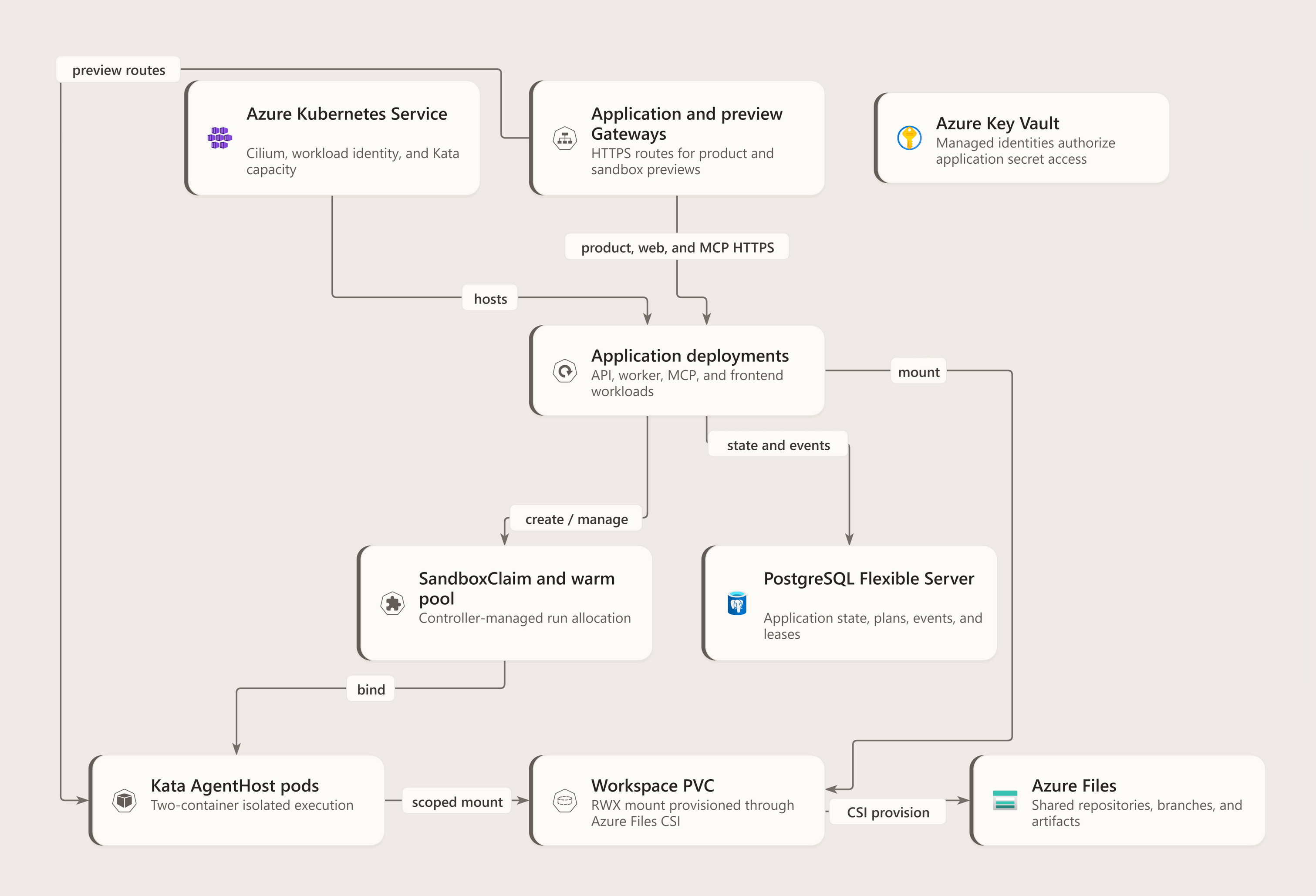
Deployed components
The application Gateway routes to Frontend, API, and MCP Services. Worker is a background control-plane workload, not another public Gateway backend. Its configured floor is two replicas; the HPA permits two to three using CPU 70% and memory 80%. API and Worker both read and write the same EF-backed PostgreSQL stores and use the shared workspace PVC. API/Worker use the privileged control-plane identity; AgentHost has a separate identity without Key Vault roles, and MCP mounts no secrets.
Preview browser traffic uses a separate preview Gateway, not the application Gateway or an API reverse proxy. The network diagram and credential diagram below show these boundaries.
AgentHost warm-pool lifecycle
Worker runs in pod-per-run: coordinator children execute in AgentHost pods rather than in-process on Worker. The shared agentweaver-agent-host warm pool keeps two pods pre-warmed (k8s/base/sandbox-warmpool-agenthost.yaml).
Warm pods boot without a RunId and enter standby. The executor creates a claim, persists its identity, and waits for pod binding. It probes /healthz for HTTP reachability: standby also returns 200. One-time POST /configure supplies run identity, bounded credentials, purpose, and the workspace contract. Successful configuration completes setup and marks IsReady before returning. A2A traffic is gated by that ready state; there is no second post-configuration health poll.
Before the first A2A request, dispatch is fenced to the run lifecycle generation, project, submitting user, agent, accepted provider snapshot, and an opaque dispatch identifier. Concurrent callers join the same launch. Readiness, configuration, or endpoint failure can replace the claim once while delivery is still known not to have started; after the streaming request begins, Agentweaver never replays the turn. A stale launch cannot satisfy a newer generation. Exhaustion records one retryable, credential-redacted agent_host_unavailable terminal outcome for that dispatch.
Shared execution uses /workspace. Assembly Build/Test uses LocalReadOnly: fetch an immutable source ref, verify base commit and tree, and check out detached into the disk-backed /local-workspace emptyDir. Its preview uses the same verified checkout. This mode forbids write-back, not local build output. Current Worker configuration also enables pod-local implementation work; it is not just a future seam. Assistant-purpose setup skips project checkout and ordinary agent setup.
The first valid /configure atomically binds the pod before setup finishes. Later valid attempts return 409, including after setup failure. Configuration cannot require the turn bearer it delivers; subsequent streamed turns require that per-run bearer. Network reachability and production mTLS are separate controls: the preview Gateway's allowed port range also includes 8088.
A successful Assistant turn retains its configured pod and renews MCP authorization separately for later turns. Failure/cancellation releases it. Ordinary release deletes the claim and revokes/unregisters run capabilities; an active preview can defer cleanup. Turn completion therefore does not always mean claim deletion.
The executor uses AgentHostWarmPoolRef (default agentweaver-agent-host), not per-run templates or warm pools. Grounding: KubernetesSandboxExecutor.cs claim/configuration and release paths, AgentHostReadinessProbe.cs, AgentHostStartupService.cs, and RemoteOperatorAssistantAgent.cs; detailed citations accompany the diagram review.
Networking flow
Inbound request path
Both TLS Gateways listen on 443 using approuting-istio. Each Gateway → HTTPRoute → Service → pod chain is explicit. API manages preview resources but is not a browser traffic hop. Exact paths and longer prefixes win over the frontend / catch-all.
| Route | Matches | Service → pod |
|---|---|---|
| API | Prefix /api, /auth, /openapi; exact /.well-known/oauth-authorization-server, /.well-known/openid-configuration, /oauth/authorize, /oauth/token, /oauth/register, /oauth/resume, /oauth/revoke, /oauth/jwks | agentweaver-api:8080 → API:8080 |
| MCP | Prefix /mcp; exact /.well-known/oauth-protected-resource and /.well-known/oauth-protected-resource/mcp | agentweaver-mcp:8080 → MCP:8080 |
| MCP health | Exact /mcp/health, rewritten to /healthz | agentweaver-mcp:8080 → MCP:8080 |
| Frontend | Prefix / | agentweaver-frontend:80 → Frontend:8080 |
| Preview | Dynamic {token}-preview.{zone} hostname on the separate Gateway; upstream hostname rewritten to localhost | preview-{token}:80 → run-labeled AgentHost target port |
There is no blanket /oauth prefix route. The same diagram covers the effective policy boundaries below; a second traffic diagram is unnecessary.
Security model
Network security — Cilium NetworkPolicy
The cluster uses Azure CNI Overlay and Cilium (--network-dataplane cilium). Application Routing uses an Istio-based gateway data plane; this does not mean workload pods have Istio sidecars or an ambient service mesh.
NetworkPolicy rules
| Boundary | Selector / permitted source | Effect |
|---|---|---|
| Application ingress | Application Gateway pods or aks-istio-ingress namespace | API, MCP, Frontend pod TCP 8080 |
| Application egress | API, MCP, Frontend | Deny by default, with explicit DNS/internal/external rules |
| AgentHost default | app=agentweaver-agent-host | Deny ingress except additive allows |
| A2A ingress | Same-namespace API or Worker pods | TCP 8088 to AgentHost |
| Preview ingress | Same-namespace pods labeled gateway.networking.k8s.io/gateway-name=agentweaver-preview-gateway | TCP 3000–9000 inclusive to AgentHost |
| AgentHost internal egress | Destination app=agentweaver-api or app=agentweaver-mcp | TCP 8080 using pod selectors |
| AgentHost DNS | kube-system + k8s-app=kube-dns, or 10.0.0.10/32 | UDP/TCP 53 |
| AgentHost public-address HTTPS | IPv4/IPv6 CIDR rules below | TCP 443, not a GitHub-only CIDR |
Sandbox isolation
The selected policies are additive allows, not intersecting restrictions. The preview range includes 8088, so network policy does not make API/Worker the only sources able to reach the A2A listener. Production mTLS/client-certificate authentication is a separate control.
API ingress requires both app=agentweaver-agent-host and agentweaver.dev/sandbox=true; MCP ingress requires app.kubernetes.io/component=agent-host. The template carries these labels. Destination pod selectors permit API/MCP access without granting broad private network access. Under the documented Cilium path, CIDR/world permission does not replace cluster-pod identity permission.
Public-address HTTPS permits 0.0.0.0/0 except 10.0.0.0/8, 172.16.0.0/12, 192.168.0.0/16, 169.254.0.0/16, and ::/0 except fc00::/7, fe80::/10. These are the actual exclusions, not every nonpublic range: 100.64.0.0/10 is not listed. The manifests document the Kata DNS-hook limitation and explicit IP/port fallback. A narrower-looking FQDN policy does not make this effective union FQDN-only. HTTPS reachability does not grant Key Vault authorization.
Agent execution uses Kata VM-isolated pods (runtimeClassName: kata-vm-isolation) claimed through SandboxClaim (extensions.agents.x-k8s.io/v1beta1). The in-cluster API selects KubernetesSandboxExecutor when KUBERNETES_SERVICE_HOST is present. See Sandbox verification.
Non-root containers
API and Frontend run as UID 1000 with runAsNonRoot: true and dropped capabilities. API also sets allowPrivilegeEscalation: false.
Secrets management
Azure Workload Identity lets API/Worker use Key Vault without embedded Azure credentials. The trusted control-plane broker redeems a run's purpose-bound capability snapshot and fences authority before and after retrieval. It supplies copilotCredential through one-time /configure, or supplies the selected BYOK configuration. Repository credentials, A2A turn tokens, and Assistant MCP tokens remain separate. AgentHost does not resolve an ambient user's token or read Key Vault.
API and Worker ServiceAccounts federate through AKS OIDC to agentweaver-api-identity, which has Key Vault Secrets User and Secrets Officer grants. Their Kubernetes RBAC remains distinct; Worker does not inherit API preview-management permissions. agentweaver-agent-host federates to agentweaver-agenthost-identity, with no Key Vault roles. Provisioning removes its legacy federation to the privileged identity. The broker is trusted API/Worker application code, not a separate public service.
One static SecretProviderClass, agentweaver-secrets, configures CSI app-secret delivery for API and Worker. It is not the vault itself. It mounts files and syncs a Kubernetes Secret. The manifest includes the internal API key, provider-key signing key, telemetry connection string, and Repo/Copilot App configuration.
| Value | Consumption |
|---|---|
mcp-api-key | Startup wrapper reads /mnt/secrets-store/mcp-api-key for internal API authentication; not a hosted MCP bearer key |
ai-execution-provider-key-signing-key | Synchronized Kubernetes secretKeyRef supplies AiExecution__ProviderKeySigningKey |
| OAuth signing/encryption certificate families | API runtime SecretClient loads usable Key Vault versions with active/previous overlap; not CSI delivery |
The CSI mount triggers synchronization; do not describe all values as file-only. MCP mounts no secrets and accepts only Agentweaver-minted broker JWTs for the exact /mcp audience and mcp:invoke scope. Worker does not host the API OAuth certificate loading path.
CSI app-secret rotation polling is two minutes. Create the provider-key signing key once with high-entropy material and rotate only with a coordinated API rollout: serving replicas must agree, and rotation invalidates prepared execution contexts. AgentHost receives no OAuth-client-secret mount. See Configuration for credential import, migration, and recovery procedures.
Authentication
Microsoft Entra ID provides browser identity; end users are not issued API keys.
- The user selects Sign in with Microsoft Entra ID.
- API redirects to the configured Entra application.
- Entra returns to
https://<host>/auth/entra/callback; API establishes platform identity and roles. - Repository discovery and GitHub project creation use a separate Repo App handoff and opaque selection code.
- Model access follows the project versus personal provider hierarchy.
The renderer derives Auth__Entra__RedirectUri and Auth__Entra__FrontendUrl from the public host, without localhost fallback. Register the exact callback under the Entra app's publicClient platform; npm run azure:setup-entra-app -- --redirect-uri https://<host>/auth/entra/callback prepares registration. Do not change a production identity registration without its owner's approval.
MCP authentication
MCP forwards authorized caller context to API at http://agentweaver-api:8080. MCP OAuth, repository authorization, and model capabilities are separate boundaries. See MCP connection and Authentication.
External dependencies
| Service | Purpose | Boundary |
|---|---|---|
| GitHub APIs | App capability and permitted repository operations | Control-plane HTTPS; AgentHost public-address HTTPS is not FQDN-only |
| GitHub browser origin | Repo/Copilot consent handoffs | Browser connectivity, not pod network authorization |
| Azure Key Vault | CSI and trusted runtime credentials/certificates | Reachability plus privileged workload identity; no AgentHost vault grant |
| Azure Container Registry | Image pulls | Kubelet/cluster ACR authorization, not pod credential delivery |
| PostgreSQL | Durable application state | TCP 5432; private subnet or rendered public-access FQDN policy according to deployment |
| Telemetry endpoint | Monitoring export | Deployment-specific telemetry configuration; see Operations |
Storage model
PostgreSQL (primary data store)
API and Worker use EF-backed application stores via MemoryDbContext, including projects, runs, revisions, workflow state, memory, decisions, OAuth state, and durable events. This is neither an API-read/Worker-write split nor a production Dapper/EF partition. Provisioning stores connection configuration in agentweaver-postgres, not in images.
| Connection string key | Precedence | Used by |
|---|---|---|
ConnectionStrings__Postgres | First | Shared EF stores |
ConnectionStrings__MemoryDb | Fallback | Same EF stores |
Database__ConnectionString | Final fallback | Same EF stores |
PostgreSQL supports multiple API replicas with RollingUpdate, without SQLite's single-writer deployment constraint.
Workspace volume
The shared agentweaver-workspace PVC is 50 GiB RWX Azure Files, with StorageClass azurefile-csi-premium-uid1000, mounted at /workspace. AgentHost separately mounts an 8 GiB disk-backed execution-scratch emptyDir at /local-workspace; it is not durable shared state.
PVC: agentweaver-workspace (Azure Files, RWX)
  storageClass: azurefile-csi-premium-uid1000
  mountPath: /workspace
  |
  +-- .home/                (shared app/runtime state; no GitHub token mirror)
  +-- worktrees/            (git worktrees per run)
  +-- <project workspaces>  (project working directories)
EF Core migrations
API and Worker init containers (migrate-memory-db) run /app/efbundle --verbose -- --postgres-migrations before their main containers start. They use the API image and injected ConnectionStrings__MemoryDb / ConnectionStrings__Postgres from agentweaver-postgres. No connection string is embedded in the image or manifest. Local design-time commands default to SQLite; use --postgres-migrations only with configured PostgreSQL credentials.
For release-candidate acceptance, deploy the committed candidate with npm run azure:deploy-from-commit -- <candidate-sha> and run representative integration plus feature-specific API/UI tests against that exact-SHA deployment before preparing or publishing the release. See RELEASING.md.
Ephemeral storage for testing
For throwaway SQLite testing, set Database__Provider=Sqlite and replace the shared workspace volume with:
volumes:
  - name: workspace
    emptyDir: {}
Data is lost on pod restart. SQLite requires one replica and Recreate strategy to avoid write contention; this is not a production storage migration procedure.
Diagram details and constraints
| Element | Contract |
|---|---|
| title | AKS network: two ingress planes |
| takeaway | Routes select Services; additive policies bound AgentHost access, not a vault credential path. |
| n-app-title | APPLICATION ORIGIN • EXACT MATCHES / LONGER PREFIXES BEAT / |
| n-preview-title | PREVIEW ORIGIN • API MANAGES RESOURCES, NOT BROWSER TRAFFIC |
| n-egress-title | EFFECTIVE AGENTHOST POLICY UNION |
| Client | Client |
| Client | Browser / MCP |
| Client | Public app origin |
| App Gateway | App Gateway |
| App Gateway | agentweaver-gateway |
| App Gateway | TLS :443 |
| HTTPRoutes | HTTPRoutes |
| HTTPRoutes | API / MCP / / |
| HTTPRoutes | Exact OAuth routes below |
| Services | Services |
| Services | API/MCP :8080 |
| Services | Frontend :80 |
| App pods | App pods |
| App pods | API / MCP / web |
| App pods | All target :8080 |
| Browser | Browser |
| Browser | {token}-preview |
| Browser | Separate hostname |
| Preview GW | Preview GW |
| Preview GW | preview-gateway |
| HTTPRoute | HTTPRoute |
| HTTPRoute | preview-{token} |
| HTTPRoute | Host rewrite: localhost |
| Service | Service |
| Service | preview-{token}:80 |
| Service | Run-label selector |
| AgentHost | AgentHost |
| AgentHost | Preview target port |
| AgentHost | Gateway: 3000–9000 |
| API / MCP | API / MCP |
| API / MCP | Selector-based TCP 8080 |
| API / MCP | DNS: UDP/TCP 53 separately |
| Public HTTPS | Public HTTPS |
| Public HTTPS | TCP 443, IPv4 + IPv6 |
| Public HTTPS | Private/link-local exclusions |
| Additive allows | Additive allows |
| Additive allows | API/Worker → A2A :8088 |
| Additive allows | Preview range includes 8088 |
| n-internal | TCP 8080 |
| n-public | TCP 443 |
| n-routes-heading | APP ROUTES |
| n-routes-body | API: /api, /auth, /openapi + exact OAuth/discovery. MCP: /mcp + resource metadata; /mcp/health → /healthz. |
| n-exclusions-heading | EGRESS EXCLUSIONS |
| n-exclusions-body | 10/8, 172.16/12, 192.168/16, 169.254/16; fc00::/7, fe80::/10. Not FQDN-only; no vault authority implied. |
| notes | [object Object]; [object Object] |
| groups | [object Object]; [object Object]; [object Object] |
Diagram details and constraints
| Element | Contract |
|---|---|
| title | AgentHost: bind once, serve ready |
| takeaway | HTTP reachability is not setup readiness; claim lifetime can span Assistant turns. |
| l-launch-title | 01 CONTROL-PLANE LAUNCH |
| l-setup-title | 02 PURPOSE-BOUND SETUP |
| l-turns-title | 03 TURN AND CLAIM LIFETIME |
| Claim warm pod | Claim warm pod |
| Claim warm pod | Persist claim; wait for binding |
| Claim warm pod | Shared pool: 2 warm pods |
| Probe listener | Probe listener |
| Probe listener | /healthz success: reachable |
| Probe listener | 200 can mean standby |
| Configure once | Configure once |
| Configure once | Run, purpose and capabilities |
| Configure once | POST /configure |
| Select workspace | Select workspace |
| Select workspace | Shared or verified local checkout |
| Select workspace | LocalReadOnly: no write-back |
| Finish setup | Finish setup |
| Finish setup | Assistant skips project checkout |
| Finish setup | Accepted binding stays consumed |
| Ready for A2A | Ready for A2A |
| Ready for A2A | Setup finished before response |
| Ready for A2A | IsReady gates traffic |
| Stream a turn | Stream a turn |
| Stream a turn | Run-bound bearer authentication |
| Stream a turn | message:stream |
| Retain Assistant | Retain Assistant |
| Retain Assistant | Successful turn keeps its pod |
| Retain Assistant | Renew MCP token, not configure |
| Release claim | Release claim |
| Release claim | Unregister and revoke capabilities |
| Release claim | Active preview defers cleanup |
| l1 | bound |
| l2 | reachable |
| l3 | accepted |
| l4 | prepare |
| l5 | complete |
| l6 | dispatch |
| l7 | success |
| l8 | next turn |
| l9 | run ends / failure |
| l-409-heading | CONFIGURATION BOUNDARY |
| l-409-body | Later valid configure attempts return 409, even after accepted setup fails. |
| notes | [object Object] |
| groups | [object Object]; [object Object]; [object Object] |
Diagram details and constraints
| Element | Contract |
|---|---|
| title | Credentials: authority stays in the control plane |
| takeaway | Separate Azure identities; separate Copilot, repository, turn and MCP capabilities. |
| s-control-title | TRUSTED CONTROL PLANE |
| s-host-title | ISOLATED AGENTHOST |
| s-delivery-title | DISTINCT DELIVERY CHANNELS |
| API + Worker SAs | API + Worker SAs |
| API + Worker SAs | Separate Kubernetes RBAC |
| API + Worker SAs | AKS OIDC federation |
| API managed identity | API managed identity |
| API managed identity | Secrets User + Secrets Officer |
| API managed identity | agentweaver-api-identity |
| Azure Key Vault | Azure Key Vault |
| Azure Key Vault | Credential and app-secret authority |
| Azure Key Vault | Runtime and CSI consumers |
| Capability broker | Capability broker |
| Capability broker | Fence run + purpose before/after read |
| Capability broker | No ambient user-token lookup |
| AgentHost identity | AgentHost identity |
| AgentHost identity | Separate ServiceAccount federation |
| AgentHost identity | No Key Vault role assignments |
| AgentHost runtime | AgentHost runtime |
| AgentHost runtime | One-time /configure delivery |
| AgentHost runtime | Copilot or BYOK; repo separate |
| CSI app secrets | CSI app secrets |
| CSI app secrets | SecretProviderClass configuration |
| CSI app secrets | Files + synced secretKeyRef |
| OAuth certificates | OAuth certificates |
| OAuth certificates | API runtime SecretClient |
| OAuth certificates | Usable active / previous versions |
| MCP resource server | MCP resource server |
| MCP resource server | Agentweaver broker JWT only |
| MCP resource server | Exact /mcp + mcp:invoke |
| s1 | federate |
| s2 | authorize |
| s3 | credential |
| s4 | configure |
| s5 | pod identity |
| s6 | app secrets |
| s7 | cert versions |
| s8 | Assistant JWT |
| s-separation-heading | NO AGENTHOST → VAULT EDGE |
| s-separation-body | Network reachability is not authorization. Repository, A2A and MCP tokens are not Copilot credentials. |
| notes | [object Object] |
| groups | [object Object]; [object Object]; [object Object] |
Visual model
AKS deployment