Blueprints
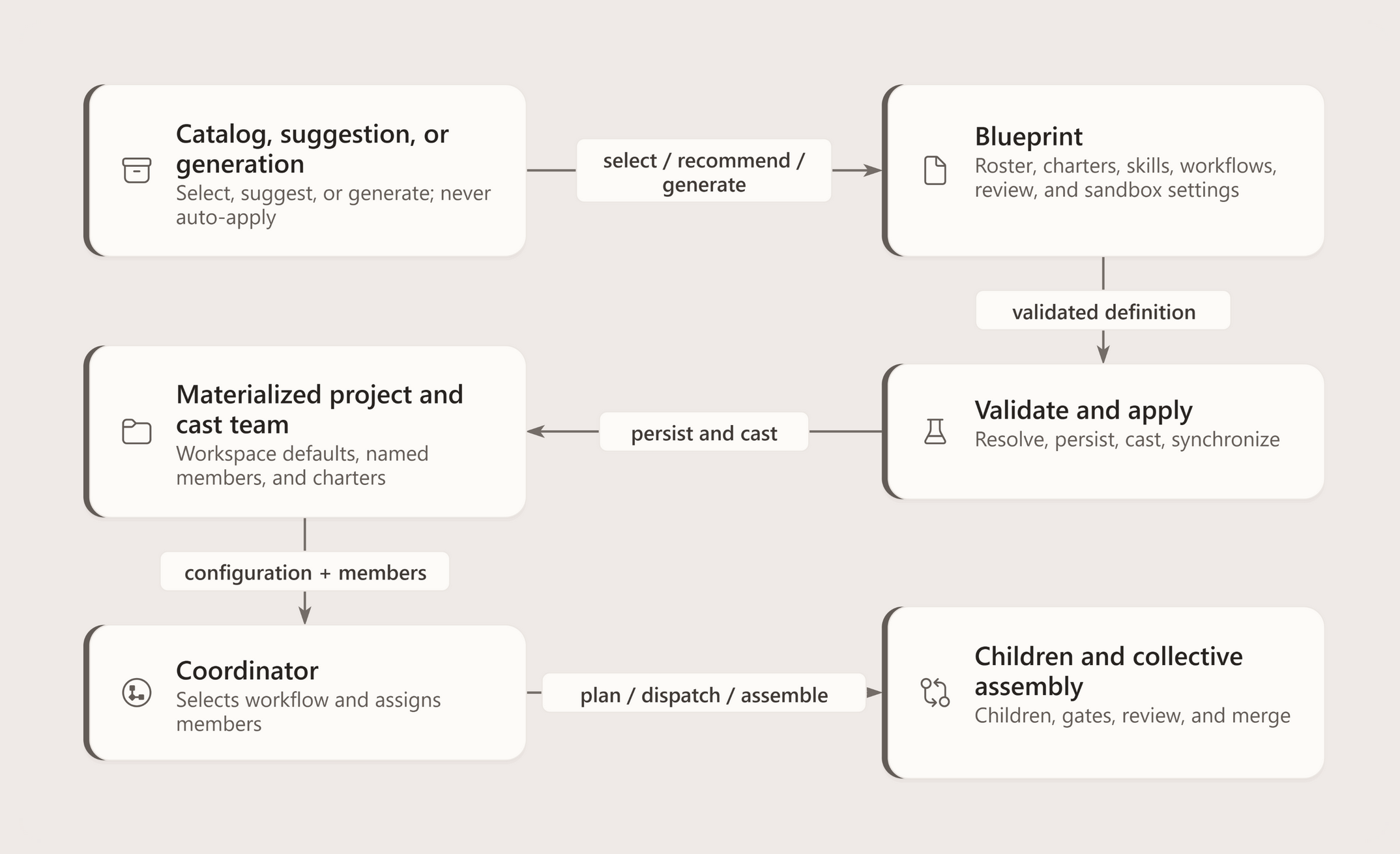
Blueprints define the initial team roster, workflow set, review policy, and sandbox profile for a project.
Blueprint validation
Generated and user-supplied blueprints are validated before they can be applied. Validation checks that:
- required fields are present (
id,name,review_policy,sandbox_profile, roster, and workflows); - roster roles are known catalog roles or declared bespoke roles with charters;
- workflow ids exist and their graphs are runnable, connected from
start, and free of unreachable nodes; review_policyisdefault, the only currently accepted policy;sandbox_profileis one of the supported profiles (defaultorrestricted).
If generation returns an invalid blueprint, the generation job ends with a canonical failure. Invalid blueprints are not saved or applied.
Durable generation jobs
Blueprint generation runs asynchronously so complex Blueprint and custom-workflow requests are not limited by one HTTP response window. POST /api/blueprints/generate requires an Idempotency-Key header and returns 202 Accepted with a job id plus status, result, cancel, and retry URLs.
The accepted job snapshots the caller, project or repository context, effective provider and model selection, and credential-binding version. Reusing the same idempotency key with the same request returns the original job; reusing it for different input returns 409 Conflict.
Poll the status URL until the job is terminal:
completed: fetch the result URL. The result identifies one immutable Blueprint artifact byartifact_id, Blueprintlogical_id, and version.failed: inspect the redacted failure code and message. Provider deadlines useblueprint_provider_timeout; temporary provider failures useblueprint_provider_unavailable. Retry is available only when the failure is marked retryable. If the accepted provider or credential binding changed, reauthorize and submit a new request so the new job captures the replacement provider snapshot.cancelled: use the retry URL to queue the same job again. Retry cannot create another artifact for a job that already completed.
Status, result, cancel, and retry requests reauthorize the current caller and any bound project. Provider failures never substitute a default workflow and report success.
Generated blueprint hardening
Blueprint generation is library-first. The generator selects built-in workflows only when their process fits the requested team, not just because names or domain words overlap. When no built-in workflow fits, Agentweaver can generate a custom workflow draft and, on apply, write it into the new project's .agentweaver/workflows/ directory so it is immediately selectable.
Generated blueprints may also include bespoke roles, but only as a last resort. Every non-catalog role must have a matching bespoke role definition with an inline charter, and validation rejects unrostered bespoke roles or bespoke ids that collide with catalog roles.
See Workflow generation for the generation path and Workflows for editing and saving generated workflow drafts.
Visual model
Blueprint relationships