A2A Transport & the MAF Bridge — Conceptual Deep Dive
Experimental
The A2A transport runs on the Microsoft.Agents.AI.A2A / Microsoft.Agents.AI.Hosting.A2A package line, which is -preview at every published version. It sits on the agent-execution hot path, mitigated by exact version+hash pinning and an instant rollback flag (Sandbox:AgentExecutionMode=in-api). Treat the surface as subject to change until the A2A line reaches GA.
This deep dive explains how Agentweaver moves a single agent turn out of the worker process and into an isolated sandbox pod without changing how the rest of the system thinks about that turn. The goal is to describe the design as rebuildable ideas: an engineer who has never seen Agentweaver should be able to reconstruct the same behavior from reasoning alone.
The transport is A2A (Agent2Agent), the .NET Agent Framework's standardized agent-to-agent protocol. The bridge that uses it is deliberately thin, and most of its power comes from where it cuts the system, not from any clever protocol work.
For the surface-level catalogue (endpoints, package names, the H1–H7 security gates), see the A2A reference. For how distributed execution feels to a user or operator, see Distributed agents over A2A. For the pod lifecycle around the bridge, see Sandbox pod execution and its reference. For the broader east-west picture, see Agent communication.
1. The mental model: cut at the leaf, not the graph
Agentweaver runs a MAF (Microsoft Agent Framework) workflow graph for every run. The graph is the orchestration: it sequences executors, raises events, and suspends on human-in-the-loop gates. At the bottom of that graph is a single leaf: the agent turn — one AIAgent doing one unit of model work (the CopilotAIAgent wrapping the GitHub Copilot SDK session).
The central design choice is where to introduce the process boundary. There are two candidates:
- Remote the graph. Ship the whole MAF workflow — events, gates, supersteps — across the wire. This forces a translation layer between MAF's typed event model and whatever the transport understands.
- Remote the leaf. Keep the entire graph in the worker. Replace only the leaf
AIAgentwith a proxy that forwards a single turn to a pod and streams the result back.
Agentweaver remotes the leaf. This is the decision that makes everything else simple. Because the cut is at the AIAgent seam:
- The MAF workflow graph — and all of its
WorkflowEventandRequestPortlogic (the review/HITL gates) — stays entirely in the worker. - Those typed events (executor-invoked, executor-completed, request-info) are emitted by the graph around the leaf, so they never cross the wire.
- There is therefore no MAF↔A2A translation layer. A2A's task state machine (
submitted/working/input-required/completed) is simply not in the path, because only the leaf's chat-style streaming response travels.
The crux question for any remoting design — "does the transport flatten our rich, typed event stream?" — is avoided by construction. Only the leaf agent's AgentRunResponseUpdate stream crosses, and that is exactly what A2A's streaming message surface carries natively.
2. The two halves of the bridge
The bridge is a pair of components on either side of the A2A wire.
RemoteAgentProxy (worker side)
RemoteAgentProxy is an AIAgent. It is a drop-in replacement for the concrete leaf agent the worker's turn executor used to hold directly. The executor still calls the same surface — set up the agent, run the turn, stream updates — and never learns that the agent is now remote. Instead of holding a heavy Copilot SDK session, the proxy forwards each call over A2A and re-emits the pod's event and token-delta stream locally, so the rest of the worker graph (and the SSE relay to the browser) is unchanged.
In code this proxy is RemoteAgentProxy : IWorkflowTurnAgent. It is realized by the framework-native A2A client — a Microsoft.Agents.AI.A2A.A2AAgent wrapping an A2AHttpJsonClient — rather than a bespoke HTTP proxy. The transport is A2A's HTTP+JSON profile (MapA2AHttpJson on the host, A2AHttpJsonClient on the worker), not JSON-RPC: the two A2A client transports are not interchangeable, and the JSON-RPC A2AClient would 404 against the HTTP+JSON routes. The only thing Agentweaver writes is a thin adapter that maps its turn-setup parameters (AgentSetupParams: worktree, repo, run id, model id, system prompt, project/agent identity, API broker URL/key, user id, and the per-turn IsRevision flag) onto the A2A message — encoded as the first DataContent part of the turn message, not a separate init call. RemoteAgentProxy also reads the run's turn token from IAgentHostTurnTokenRegistry and sets Authorization: Bearer {token} on every A2A turn call. RemoteWorkflowAgentFactory returns a RemoteAgentProxy for all four workflow roles (worker, RAI, Rubberduck, Scribe); the proxy holds no ICheckpointStore and the pod has no database connection.
AgentHost (server side, in-pod)
Agentweaver.AgentHost is a minimal per-run process baked into the sandbox image. It does not run a MAF graph. It hosts a singleton CopilotAIAgent, but it does not expose it directly: the agent registered with the A2A server is A2ATurnBridgeAgent (a DelegatingAIAgent whose MAF name is agentweaver-pod), wired via builder.AddAIAgent(name, factory, Singleton).AddA2AServer(...) and mounted with app.MapA2AHttpJson(builder, A2APath). The default path is /a2a/agent, so it exposes exactly two HTTP endpoints — POST /a2a/agent/v1/message:stream and GET /a2a/agent/v1/card — on port 8088 by default. The turn endpoint is application-layer authenticated: POST /message:stream must carry Authorization: Bearer {AgentHostOptions.TurnBearerToken}.
The bridge exists to close two gaps a direct CopilotAIAgent registration would leave open:
- Inbound: it decodes the inbound message's first
AgentSetupParamsDataPartand forwards itsIsRevisionflag intoCopilotAIAgent.RunTurnAsync, so a revision turn resumes the session instead of starting fresh. - Outbound: it installs a per-turn channel as the runner's stream writer and re-emits each pod-side
RunEventback over A2A as aDataContentpart, interleaved with the assistant text.
The run-scoped setup is now deferred until a warm pod is claimed. AgentHost starts without a RunId, enters standby, and accepts POST /configure while still excluded from the readiness gate. The executor binds a pod from the shared agentweaver-agent-host warm pool, then posts runId, userId, turnBearerToken, and kvUserSecretName. AgentHostRuntimeState.TryConfigure(...) stores those values once, AgentHostStartupService.ConfigureAsync(...) runs CopilotAIAgent.SetupAsync, and only then /healthz returns ready. Backward-compatible env-launched pods still initialize from AgentHostOptions at startup.
The security property remains per-run: each AgentHost pod accepts only the token configured for that run on message:stream. A stolen token from one run cannot be replayed against another run's pod because the other pod has a different runtime token, and NetworkPolicy/mTLS still constrain which callers can reach port 8088. /configure itself is not protected by that token (it delivers it); the NetworkPolicy restricting AgentHost ingress to API/worker pods is the guard.
MAF therefore stays in-process on the worker only. The pod is just a hosted leaf agent behind a thin bridge.
3. What actually crosses the wire
Only two things travel from worker to pod and back:
- The turn input — forwarded onto an A2A streaming message.
- The agent's output — its streaming updates and token deltas, returned over the same stream.
There is one subtlety. Agentweaver's agent emits rich RunEvents through a side-channel (a recording writer), not through the AIAgent return stream. Those events are what populate the run timeline. They are encoded as A2A DataContent parts (media type application/x-agentweaver-run-event+json) on the streaming message by the pod and decoded back into RunEvents on the worker, where they flow into the run stream store and out to the browser as SSE. Both ends share one codec, RunEventDataPartCodec. (The per-turn AgentSetupParams payload uses a sibling media type, application/x-agentweaver-agent-setup+json.)
This RunEvent codec is the only shim the bridge owns — and it is required by any transport. Even a hand-rolled HTTP/2+SSE design would have to serialize the same side-channel across the process boundary. A2A is not adding a translation tax here; it is supplying a standard envelope (DataPart) for a serialization that has to happen regardless. Because Agentweaver owns both ends — same team, same framework, same language — the encoding is lossless.
Honest scope note. Today the side-channel
RunEvents are forwarded in-band as A2ADataParts on the samemessage:stream— the simplest path, and the one the worker decoder already supports with no new infrastructure. Fanning RunEvents out over an external bus (Event Hub / Service Bus / Redis pub-sub) for higher scale is a deliberate future option, not what ships today.
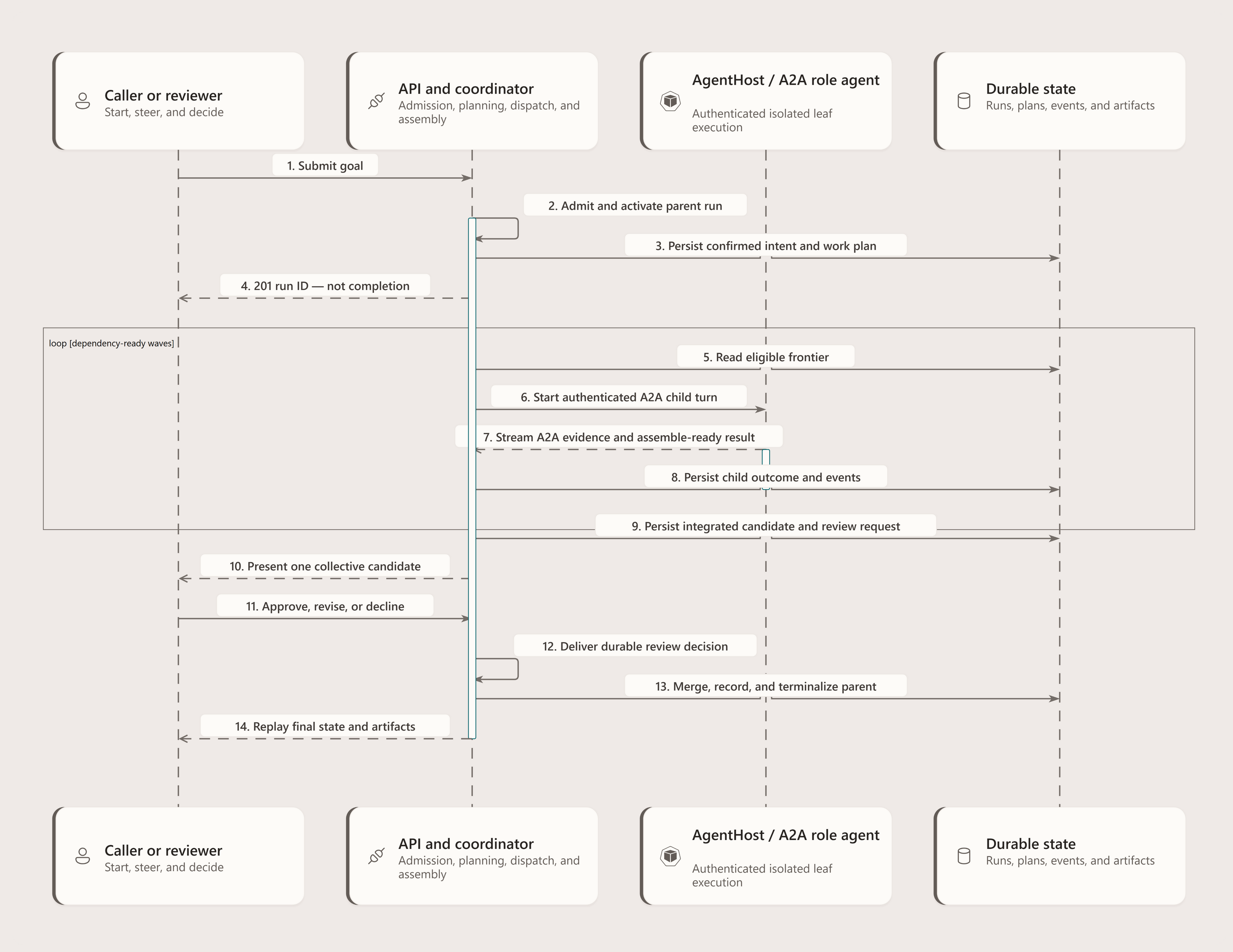
Note what does not appear in that sequence: no MAF event ever crosses, no HITL gate crosses, and the worktree commit and diff stay on the worker side because the worktree lives on the shared workspace PVC that both tiers mount. The run record is written where the graph runs.
4. Ordering and the streaming contract
The frontend contract is "events arrive in a stable, monotonic order." The worker preserves this with a single monotonic sequence allocator under lock. The bridge must therefore deliver events in order within a turn — one stream per turn — so that re-injection assigns sequence numbers in arrival order. A2A message:stream is a single ordered SSE stream per turn, which fits this requirement directly. There is no fan-in, no reordering buffer, and no second channel competing for sequence numbers.
5. Message-mode only: no task-model tax
A2A defines two ways to interact:
- A task model — long-running, with a server-managed task lifecycle (
submitted→working→input-required→completed) and durable continuation tokens. - A message model — plain streaming chat over
message:stream.
Agentweaver uses message-mode only. It never opens an A2A task. This is deliberate and it is what keeps the bridge cheap:
- No long-running A2A task means no task-model tax — no task IDs to track, no
input-requiredround-trips over the wire, no continuation-token bookkeeping. input-requiredwould be the natural place for an HITL gate to live if the gate crossed the wire. It does not. The review/confirm gate is a MAFRequestPortthat suspends the worker graph; it is a graph construct, not an agent turn. So message-mode is sufficient — there is nothing for a task to wait on.
The win from A2A, stated honestly, is "standardized Option C," not "interop we needed." Agentweaver crosses only a process boundary (worker → pod), same team and framework on both ends — so A2A's headline value (cross-framework, cross-organization interop) does not apply. What A2A buys is a maintained .NET host and client, a standard HTTP+SSE framing, agent-card discovery, and a security-scheme model — so the team deletes bespoke transport, schema, and auth code instead of hand-rolling it. A2A is the standardized realization of "Option C" (the prior hand-rolled HTTP/2+SSE design) and supersedes it for free.
6. Durable resume lives on Agentweaver's checkpoint store, not on A2A
This is the most important honesty in the design.
A2A maintains a server-side conversation history keyed by contextId. That history is ephemeral by design — it lives in the pod's memory and dies with the pod. It is not durable resume. Agentweaver deliberately bypasses it.
Durable resume stays where it has always been: on the worker's CheckpointManager (file-backed in P1, DB-backed in P2), plus the serialized CopilotAIAgent session blob. The reasoning:
- The Copilot session already produces a serializable session blob. The pod forwards that blob to the worker, which persists it through a brokered, DB-backed checkpoint store — never on one pod's local disk.
- Any worker can then read the same checkpoint. On pod death, the worker re-claims the run, restores the latest checkpoint blob, re-attaches or re-spawns a pod, and replays the session by deserializing it.
- A checkpoint carries the serialized session blob and MAF superstep state, including the correlation id of any suspended external request, so a run can be released on suspension and rehydrated exactly.
This separation is clean: A2A handles live per-turn streaming; Agentweaver handles durable resume. Relying on A2A contextId history for durability would tie run survival to pod survival — exactly the coupling the pod-per-run, release-on-suspend model is designed to avoid. See Agent runtime and Orchestration for how checkpoints and the graph fit the larger run lifecycle.
Mid-turn drop: re-drive from the last checkpoint
A2A message:stream has no Last-Event-ID replay. If the stream drops mid-turn, A2A cannot resume the partial stream from where it left off — reconnection is beginning-only.
Agentweaver's answer is not to ask A2A for replay it cannot give. Instead, on a mid-turn drop the worker re-drives the whole turn from the last checkpoint. Because checkpoints are durable and the session blob is serialized, re-driving is well-defined: restore, re-spawn, replay. Re-injection of the side-channel RunEvents is sequence-based and idempotent, so re-driving a turn does not duplicate timeline entries. The turn is the unit of retry; the checkpoint is the recovery point.
7. The honest cost: a preview library on the hot path
The design carries one residual risk, stated plainly: an A2A -preview library on the agent-execution hot path, with no alternate wire transport. Agentweaver chose A2A as the sole wire transport — there is no second protocol behind it.
The mitigations are concrete and they are the reason the design is acceptable:
- Pin an exact, known-good A2A build (by version and hash) aligned with Agentweaver's package line.
- Roll back with a flag, not a protocol. The degraded/rollback path is
Sandbox:AgentExecutionMode=in-api, which reverts to today's in-process execution — the instant, fully-tested fallback for any A2A defect or outage. Switching back needs no second wire and no redeploy of a different transport. - Track the A2A line to GA and advance the pin only after validation.
A kube-exec-stdio path remains available strictly as a degraded-mode fallback, not as a wire transport for agent turns. The default execution mode stays in-api until the pod-per-run path completes soak, precisely because of this residual risk.
A2A is a cross-vendor standard, which makes standardizing on it strategically sound rather than just convenient. The MCP server, by contrast, is Agentweaver's inbound tool door and is documented separately in the MCP server deep dive; A2A is the east-west agent transport, a different seam entirely.
8. Invariants to preserve when rebuilding
- The MAF workflow graph and every HITL
RequestPortgate stay in the worker. Only the leafAIAgentturn is remoted. - No MAF event crosses the wire; therefore no MAF↔A2A translation layer exists.
- Use A2A message-mode only — never open an A2A task.
- The
RunEventside-channel codec (encode asDataPart, decode back) is the only owned shim, and it is transport-independent. - Durable resume is the worker's
CheckpointManager(file-backed in P1, DB-backed in P2) plus the serialized session blob. A2AcontextIdhistory is ephemeral and bypassed. - A mid-turn drop re-drives the turn from the last checkpoint; re-injection is idempotent and sequence-based.
- A2A is the sole wire transport. The rollback is the
in-apiflag, not a second protocol. - The preview dependency is pinned by version+hash and gated behind the execution-mode flag.