Sandbox Pod Execution (pod-per-run) — Conceptual Deep Dive
Why this exists: one fix for two problems
Before pod-per-run shipped, production agent subtasks ran in-process inside the shared Worker pod. That pod held the live GitHub Copilot SDK session for each active run, the in-process workflow runner, the streaming buffers, the tool/shell execution, and an in-memory history of recent runs. Because all of it lived in one process, memory scaled with concurrent + recently-completed runs × (SDK session + graph + history), and the pod ran out of memory.
Sandbox pod execution starts from a single insight: memory relief and security isolation are the same fix. Moving each run's agent execution out of the shared Worker process and into its own per-run, Kata-isolated pod simultaneously:
- relieves the OOM — the heavy SDK session, the runner, and tool execution leave the shared process, so no single process holds more than the runs it actively owns; and
- isolates execution — each run's tool, shell, file, and model I/O happens inside its own VM-backed pod with a restricted egress allowlist, instead of sharing one blast radius.
After the move, the API/worker tier becomes a thin orchestrator: HTTP, SSE relay, database, and the orchestration graph. The heavy, untrusted work runs elsewhere, per run, and dies with the run.
This page explains the logic of pod-per-run. For the existing isolation model (filesystem containment, governance, executor selection, claim lifecycle, hardening) see Sandbox; for the cluster topology see Infrastructure. The exhaustive flag/identity/token reference is Sandbox pods reference, and the operator/user-facing view is Sandbox pod execution experience.
Before and after: where agent execution runs
Before pod-per-run: single-Worker-pod execution
Before this rollout, the leaf agent — the object that wraps a live Copilot SDK session — was created and driven inside the Worker process. The workflow graph ran in-process there too, and the sandbox pod was used only to exec one shell command at a time through a warm-pool claim. The pod was a place to run run_command; it was not where the agent lived.
Every box inside the Worker pod multiplies by concurrent and recent runs. That is why it OOMed, and why production had to keep subtasks on one shared in-process owner.
Now: per-run sandbox pod
Under pod-per-run, the leaf agent turn relocates into the pod. The orchestration graph and its human-in-the-loop (HITL) gates stay in the worker tier; only the agent turn — the part that holds the SDK session and runs tools — moves out.
The decisive architectural fact: the coordinator's orchestration loop stays in the API/worker tier. Only agent turns are sandboxed. Remoting happens at the AIAgent leaf seam — the workflow graph, the RequestPort/HITL/review logic, and the suspend/resume machinery never cross the wire. This keeps all the state that decides what happens next in the durable, observable worker, and ships only the expensive doing into the disposable pod.
The worker↔pod transport is the A2A bridge (Agent Framework's Agent2Agent), used in message/stream mode. A2A ships in the .NET Agent Framework on a
-previewpackage line and is therefore experimental; it is adopted deliberately, pinned by version, behind the same execution-mode flag that provides rollback. See A2A bridge deep dive, the A2A reference, and the A2A distributed agents experience.
The in-pod AgentHost
The pod runs a minimal host process — AgentHost — baked into the sandbox image. Conceptually it is the pod-side counterpart of the leaf seam:
- it receives the forwarded turn (setup + run) from the worker;
- it requires the run's bearer token on
POST /a2a/agent/v1/message:stream; - it hosts the real leaf agent (the Copilot SDK session) directly, and runs the turn locally;
- it executes tools, shell, and file operations in-pod, inside the Kata VM boundary; and
- it streams agent updates and token deltas back to the worker, which re-injects them into the existing run-event stream so the SSE contract to clients is unchanged.
A key simplification: because remoting is at the leaf seam, AgentHost does not run its own workflow graph. The graph lives only in the worker. AgentHost hosts one AIAgent and serves its turns. The worktree commit/diff stays on the worker side, over the shared workspace volume both tiers mount, so the database-write logic stays central and the pod stays stateless beyond the live turn.
With the Worker deployment now set to Sandbox:AgentExecutionMode=pod-per-run, the dedicated AgentHost warm pool is on the live execution path: its standby pods are claimed, configured, and serve real child-run turns instead of sitting idle.
The AgentHost claim path binds to AgentHostWarmPoolRef (default agentweaver-agent-host) and calls /configure after the warm pod is bound; it does not create an AgentHost-specific per-run SandboxTemplate or per-run warm pool. Source: apps/Agentweaver.Api/Sandbox/KubernetesSandboxExecutor.cs:40, apps/Agentweaver.Api/Sandbox/KubernetesSandboxExecutor.cs:332, apps/Agentweaver.Api/Sandbox/KubernetesSandboxExecutor.cs:480, apps/Agentweaver.Api/Sandbox/KubernetesSandboxExecutor.cs:497.
The existing per-command exec path is retained for its current utility purpose (ad-hoc run_command); it is simply never the agent-turn transport. Nothing about pod-per-run deletes that capability — see Sandbox.
The executor seam: how commands are actually isolated
Pod-per-run answers where the agent turn runs. It does not, by itself, answer how a single run_command is isolated from the host — that is the job of a second, older seam: the executor abstraction. Both seams matter, and they are easy to conflate, so this section pins down the relationship.
Whenever an agent runs a shell command, the runtime hands a uniform command object (command line, working directory, environment, filesystem policy, timeout, network-enabled flag, run id) to an ISandboxExecutor, and gets back a uniform result (exit code, stdout, stderr, timeout flag, truncation flag). The executor decides how and where the process actually runs. That uniform contract is what lets the same agent code run unchanged whether isolation comes from a Windows process container, a Linux namespace sandbox, or a Kata-isolated Kubernetes pod. The contract itself is described in Sandbox › Executor abstraction.
One executor per host, chosen at run start
The API router chooses Kubernetes versus local first; the local factory then probes supported local backends. Runtime observability emits sandbox.selected with backend, isolation status and reason. The in-pod PodExec client is a separate executor seam.
The ladder, top to bottom:
processcontainer(Mxc, Windows) — the first choice on Windows.mxcis Microsoft's open-source sandbox isolation tool; its Windowsprocesscontainerbackend (BackendNameMxc) is driven by binaries inMXC_BIN_DIR(for examplewxc-exec.exe --probereturns atiersuch asbase-container). Setup is in Sandbox setup › Windows.wsl-bwrap/wsl-unshare(WslMxc, Windows) — whenprocesscontaineris unavailable but WSL2 offers a usable Linux backend.linux-bwrap(bubblewrap) — the preferred Linux backend, a selective-mount namespace sandbox.lxc-native-linux— the Linux fallback when bubblewrap is absent butlxc-execis present.kubernetes-sandbox-claim(K8s) — selected automatically in-cluster. Each command runs in a warm pod obtained through aSandboxClaimcustom resource (extensions.agents.x-k8s.io/v1beta1), with Kata VM isolation and a NetworkPolicy egress allowlist. This is provisioned by the upstream agent-sandbox controller, a distinct runtime from MXC — see The agent-sandbox controller (MXC vs. the controller) below.direct(Passthrough) — the last resort, chosen only when nothing else is available. It runs the command directly on the host with no isolation layer; the shell still runs, relying on whatever isolation the surrounding deployment already provides.
IsRealIsolation is false for both wsl-unshare and direct. Live run_command additionally requires ShellEnabled. The governance gate enforces a hard rule: a shell command is allowed only when the selected executor reports IsRealIsolation == trueor is the direct backend. Any other non-isolating executor denies run_command outright — so an agent never silently runs a shell command under a half-isolated backend. The exact rows and selection conditions live in the Sandbox backends table.
Two seams, one contract, three tiers
Editable source: canonical-pod-process-boundaries.drawio.
The connective idea for pod-per-run is that the executor abstraction and pod-per-run agent execution are the same seam at different deployment tiers — and the A2A agent-turn remoting is orthogonal to both. Three things are deliberately distinct:
- The executor seam (
ISandboxExecutor) isolates an individual command. Local dev gets MXC (processcontainer) or bubblewrap; in-cluster gets the Kubernetes claim backend. Same command contract, different backend. - The Kubernetes claim backend is the in-cluster implementation of that same executor contract:
KubernetesSandboxExecutorruns each command in a warm pod obtained via aSandboxClaimCR, with Kata VM isolation and NetworkPolicy egress. There is no special second contract for the cluster — it is the sameISandboxExecutorseam, fulfilled by a pod instead of a local process. - A2A agent-turn remoting (the A2A bridge) moves an entire agent turn — the SDK session and its tool loop — out to the per-run pod. That is the pod-per-run story above. It is orthogonal to backend selection: the in-pod AgentHost still runs each
run_commandthrough its ownISandboxExecutor. WhenAgentHost:SandboxMode=kata, that executor isPodExecSandboxClient: it forwards every model-controlled command to the executor sidecar container of the same pod, whereKataBwrapExecutorbuilds the per-run mount namespace. The Kata VM isolates the pod from the node, the sidecar container isolates model-controlled processes from AgentHost, and bubblewrap removes the shared PVC root from each shell/preview child process.
Read the whole isolation stack top-down: pod-per-run decides which process hosts the agent turn (worker vs. per-run pod, via A2A); the executor abstraction decides how each command inside that turn is isolated (MXC / bwrap / Kata-pod claim plus an in-pod mount namespace); and the governance gate decides whether the command may run at all given the selected backend's IsRealIsolation. On a laptop these collapse onto one host — the agent turn runs in-process and commands isolate via MXC or bubblewrap; in-cluster they fan out — the agent turn runs in its own Kata VM and commands execute in a run-scoped mount view within that VM. The contract a reader has to remember is single: one command in, one uniform result out, isolation chosen per host and announced by sandbox.selected.
Every Kata AgentHost pod still mounts the shared RWX /workspace PVC because linked git worktrees refer to git metadata outside the worktree directory and the generic warm pool cannot vary pod mounts after adoption. The pod therefore applies the per-run policy at the process/mount boundary, not by parsing shell syntax. Two containers share the pod:
agentweaver-agent-hosthosts the agent turn and the run's brokered GitHub token. It never executes a model-controlled command.agentweaver-exec(same image,--exec-agent) executes every model-controlled command insideKataBwrapExecutor's per-run mount namespace. It is a real, runtime-created PID namespace with a runtime-provided procfs, holds no Kubernetes or AAD identity, and shares only the pod network namespace (so preview ports stay reachable), workspace volumes and a pod-private authenticated IPC volume.
Within that structure:
- only the current run worktree, its explicitly registered run HOME, authorized run-scoped scratch, pod-private tmp, and the exact linked worktree git metadata are bind-mounted; git control metadata is read-only, while the platform performs the durable commit after the turn;
- the PVC root and sibling worktrees are absent, so absolute paths, variable indirection,
.., symlinks, and direct Python/.NET file APIs cannot resolve them; /procis the executor container's own procfs, bound into the run's mount namespace. It contains only that container's processes, so CoreCLR process discovery works while AgentHost's process tree is not merely hidden but absent from the namespace;- the child environment is cleared and rebuilt from a minimal baseline plus explicitly supplied values; and
- the sidecar runs a real bwrap capability probe before it binds its socket — if bubblewrap cannot build the mount namespace the daemon exits and the container never serves, so there is no window in which a command could run unisolated; and
- AgentHost runs a one-shot startup probe against that socket and refuses to start unless the sidecar answers, proving it is reachable, isolated (the probe re-runs the bwrap capability check server-side on every request), and in a different PID namespace than AgentHost. It is a startup gate, not a periodic health check: afterwards each individual command still fails closed with exit 126 if the socket ever stops answering. There is no passthrough fallback in Kata mode.
Why a sidecar and not a nested PID namespace
The original design asked bubblewrap for --unshare-pid --proc /proc. That cannot work in any Kubernetes container: the kernel's mount_too_revealing() check refuses a fresh procfs inside an unprivileged user namespace whenever the visible procfs has masked or covered submounts, and every container runtime — Kata's guest agent included — masks /proc/kcore, /proc/keys, /proc/timer_list, /proc/interrupts and read-only-binds /proc/bus, /proc/fs, /proc/irq, /proc/sys, /proc/sysrq-trigger. In production this surfaced as bwrap: Can't mount proc on /newroot/proc: Operation not permitted and, because the isolation probe is fail-closed, a 0/2 warm pool. CI never caught it because GitHub runners are VMs with an unmasked /proc.
Every way to make the nested mount succeed weakens the boundary — procMount: Unmasked, CAP_SYS_ADMIN, a privileged container, or a synthetic /proc. Dropping --unshare-pid while keeping --proc is worse than useless: bubblewrap then silently binds the outer /proc, so the sandbox looks isolated and is not. A second container gets the same guarantee for free, because the runtime creates the PID namespace and the matching procfs itself — no capability, no privilege, no host namespace. Bubblewrap keeps doing the per-run mount scoping it can still do, with --bind /proc /proc and no PID claim it cannot back.
The AgentHost↔sidecar channel is a Unix domain socket on a pod-private emptyDir mounted into only those two containers, never bound into a sandboxed child's mount namespace, and guarded by a 32-byte token written mode-0600 next to it and compared in constant time. Long-lived preview processes are supervised by a relay child of AgentHost that holds the connection: if the relay or AgentHost dies, the sidecar sees the disconnect and terminates the sandboxed process group, preserving die-with-parent semantics across the container boundary.
The IPC volume must be a guest-owned tmpfs (#1008)
That emptyDir carries medium: Memory. It was a default emptyDir from the sidecar's introduction until 2026-08-27T17:41:48Z, when the AKS katapool node image was upgraded (AKSAzureLinux-V3katagen2-202608.14.0) and brought Kata Containers 3.32.0. Upstream had flipped disable_guest_empty_dir from false to true, so a default emptyDir stopped being a directory the guest agent creates and became a host directory re-exported over virtio-fs with a per-container share path. Measured on the node:
shared_fs = "virtio-fs"
disable_guest_empty_dir = true
emptydir_mode = "shared-fs"
A pathname AF_UNIX socket is matched by inode identity in the connecting task's own kernel, so the AgentHost container saw the socket file with S_ISSOCK set and got ECONNREFUSED on every connect — and failed closed with AgentHost Kata filesystem isolation is unavailable; refusing to start. Nothing in the application changed: the v0.20.0..v0.21.2 diff of this template touches only resource requests, limits, and comments.
medium: Memory restores the previous behaviour for this one volume. Kata takes the IsTmpFSEmptyDir branch before and independently of disable_guest_empty_dir and emptydir_mode, creating one guest tmpfs at /run/kata-containers/sandbox/ephemeral/<volume> and bind-mounting it into every container of the sandbox — a single real inode, so the rendezvous works. It also survives the knob's removal, which upstream has already done for the Rust runtime. Measured on the same pod, same node: default medium errno=111 Connection refused; medium: MemoryCONNECT-OK.
The sidecar reads /proc/self/mountinfo at startup and refuses to bind on a shared filesystem, so a future node-image change that reintroduces this names itself instead of crash-looping silently.
ShellCommandValidator and SharedWorkspacePathGuard remain compounding controls, but the security claim for #476 no longer depends on command text.
Process lifetime without a nested PID namespace
Because the sandbox deliberately does not claim a PID namespace of its own, nothing implicitly reaps what a command leaves behind, and two kernel details of the Kata guest matter:
/proc/<pid>/task/<pid>/childrendoes not exist there (CONFIG_PROC_CHILDRENis off), so neither the executor nor .NET'sProcess.Kill(entireProcessTree: true)may depend on it. The executor therefore discovers the sandboxed process by scanning/proc/*/statfor the single entry whose PPID is the bubblewrap process it just started, and reads that entry's process-group id from the same line. Because--new-sessionalready made that child a session and process-group leader and the workload is exec'd directly (no extrasetsidindirection), the pid it finds is the run's process-group id. The scan polls until bubblewrap has forked (bounded by a deadline) and fails closed if bubblewrap exits first or if the resolved group is the executor's own. Bubblewrap's--info-fdis deliberately not used: pointing it at fd 1 closes the workload's stdout (every write then fails withEBADF), and .NET'sProcessStartInfocannot hand an arbitrary extra pipe to the child, so there is no spare descriptor to point it at instead.--die-with-parentonly SIGKILLs bubblewrap's immediate child. Anything the command daemonised (a Roslyn build server, a watcher) would survive. So every command path — one-shotexecas well as supervised preview processes — ends by terminating that process group (TERM, thenKILL), and the executor refuses to signal a group that is its own. For one-shotexecthat reap happens before the executor drains stdout/stderr: a daemonised grandchild inherits the command's output pipes, so waiting for end-of-file first would stall the whole command until that leftover process happened to exit, and report a spurious timeout.
Commands in one pod share the executor container's PID namespace with each other. That is the correct boundary rather than a gap: a sandbox pod is claimed by exactly one run, and the boundary that carries credentials — AgentHost, its brokered GitHub token, and the pod's workload identity — is a different container in a different PID namespace, which the sidecar re-verifies on every probe.
Disclosure: intra-run argv visibility
One consequence of that shared PID namespace is worth stating explicitly rather than leaving to be rediscovered. /proc/<pid>/cmdline, /proc/<pid>/stat and /proc/<pid>/status are world-readable and are not gated by procfs' ptrace check, so a sandboxed command can read the command line of other processes running in the same executor container — that is, other commands of the same run, and the sidecar daemon's own argv. It cannot read their environment, memory, cwd or mount root: /proc/<pid>/environ, /proc/<pid>/mem, /proc/<pid>/cwd and /proc/<pid>/root are gated by ptrace_may_access, and every command runs in its own user namespace (--unshare-user), which is neither an ancestor nor a descendant of the sidecar's or of a sibling command's, so those accesses are refused.
The blast radius is therefore one run's own commands, and the contract that follows is: secrets belong in the environment (or a file inside the run's own mount view), never in a command line. That is how the runtime already passes the brokered token — the executor clears the child environment and rebuilds it from explicitly supplied values, and those values are unreadable across the user-namespace boundary. Cross-run and AgentHost-facing exposure is unaffected: sibling runs are in different pods, and AgentHost is in a different PID namespace in this one.
Contract with #481
#481 remains the pod-wide storage redesign: relocate authoritative worktrees off the API HOME tree, empirically prove volumeClaimTemplates warm-pool behavior on the pinned controller, provision a private volume/source snapshot for every run, define authenticated write-back/resume semantics, and securely sanitize/delete the volume. It may then remove the shared PVC mount from the AgentHost pod entirely. #476 does not create dynamic PVCs, templates, or pools and does not alter controller adoption; it guarantees that model-triggerable shell and preview child processes cannot see the shared root while preserving existing linked-worktree operation. Until #481 lands, linked worktrees still receive read-only access to their repository's shared common git metadata, so commits and refs already present in that same repository are not a per-run confidentiality boundary; other projects' worktrees and git metadata remain absent.
The agent-sandbox controller (MXC vs. the controller)
In-cluster, the sandbox pod a run executes in is not created by Agentweaver directly and is not MXC. It is provisioned by the upstream agent-sandbox controller (kubernetes-sigs/agent-sandbox), which Agentweaver installs in scripts/azure/steps/10-create-cluster.mjs (default v0.5.3). The naming overlap trips people up, so pin it down:
- MXC =
Sabbour.Mxc.Sdk/wxc-exec.exe, the local-host command-isolation runtime behind theprocesscontainer, WSL, andlxc-execexecutors. It runs on a laptop or non-cluster host and has no controller and no CRDs. - agent-sandbox controller = the in-cluster operator that turns a
SandboxClaiminto a bound, Kata-isolated pod. The in-clusterISandboxExecutor(KubernetesSandboxExecutor) talks only to this controller's CRDs; there is no MXC binary in the cluster.
So "how is the sandbox implemented with MXC?" has two honest answers depending on tier: locally, a command is isolated by MXC spawning a wxc-exec.exe sandbox process; in-cluster, a command (or a whole agent turn) runs in a pod the agent-sandbox controller bound for the run. Both present the identical ISandboxExecutor contract.
How the controller provisions a run's pod
The three CRDs (API group extensions.agents.x-k8s.io; KubernetesSandboxExecutor targets the v1beta1 storage version — SandboxClaimConventions.cs:23) Agentweaver applies are:
SandboxTemplate(k8s/base/sandbox-template-agenthost.yaml,agentweaver-agent-host) — the live AgentHost pod shape and hardening:kata-vm-isolationruntime class, non-root UID/GID 1000, dropped capabilities,/workspacePVC, and the A2A listener on container port8088.SandboxWarmPool— keeps AgentHost pods pre-built from a template so a claim binds without a cold start. The live pool isagentweaver-agent-host(k8s/base/sandbox-warmpool-agenthost.yaml,replicas: 2). It pre-warms the .NET process and Copilot SDK; per-run context arrives later via/configure.SandboxClaim— created per run byKubernetesSandboxExecutorwithspec.warmPoolRef.name(the pool to bind) andspec.lifecycle.{ttlSecondsAfterFinished, shutdownPolicy: Delete}. AgentHost claims omitspec.env; static paths, port, and mTLS settings belong to the template/config map. Run identity, turn authentication, and the selected provider payload are delivered after binding byPOST /configure. The controller adopts a warm pod and signals readiness via aReadycondition.
The executor reads the pod name from status.sandbox.name (the agent-sandbox controller's shape) once the claim's Ready condition is True. For pod-per-run AgentHost pods it then polls the pod's status.podIP to build the A2A endpoint. Agentweaver never deletes pods itself — it deletes the claim (or lets the TTL expire) and the controller garbage-collects the pod and its service. Anything not visible in these manifests or the executor code (controller replica count, leader election, image, RBAC of the controller itself) is operationally configured by the agent-sandbox release, not specified by Agentweaver.
Transient Kubernetes API resilience
Pod-claim creation and the bind/IP polls that follow it are guarded against transient Kubernetes API faults (issue #230). A single mid-flight connection reset during CreateClaimAsync used to fail the subtask's first agent turn outright, cascading into assembly_blocked for every dependent subtask. The executor now wraps the idempotent k8s calls — the mutating claim create plus the read-only WaitForBoundAsync and GetPodIpAsync polls — in a bounded retry (ExecuteK8sWithRetryAsync<T>, MaxK8sAttempts = 3 total tries) with exponential backoff (~250 ms · 2^(n−1), capped ~2 s) plus 0–250 ms jitter to de-sync concurrent launches retrying the same API server after a blip.
IsTransientK8sFault decides what is worth retrying:
- Retried — a socket/IO connection reset (
SocketException 104→IOException→HttpRequestException, directly or nested in an inner exception), a429or5xxfrom the API server, and anHttpClienttimeout (OperationCanceledException/TaskCanceledExceptionwith no caller cancellation). - Never retried — caller cancellation short-circuits to
false, so a genuine cancel aborts immediately (the backoffTask.Delayalso honors the token). 409 Conflictis not a transient fault. It is handled attempt-awarely to preserve idempotency: a first-attempt409is a genuinely pre-existing claim owned by an earlier launch (wait for it); a409on a retry means our own create committed server-side before a reset hid the response, so the claim is treated as created and configured — never reused un-configured and token-less.
The retry wrapper must only wrap idempotent calls: the non-idempotent AgentHost POST /configure stays outside it, because a second delivery hard-fails 409.
Warm-pool configure and readiness gate (AgentHost)
A bound claim means the controller assigned a pod; it does not mean the run-specific AgentHost is ready to serve turns. AgentHost warm pods start with no RunId, enter standby, and log that they are waiting for /configure. This lets k8s/base/sandbox-warmpool-agenthost.yaml run at replicas: 2 without CrashLooping: the .NET process and Copilot SDK host are already warm, but no run context is required until a claim binds. With the Worker now in pod-per-run, those two standby pods are the hot path for coordinator child turns.
At run launch, KubernetesSandboxExecutor generates a 256-bit turn bearer token, resolves the shared orchestration worktree, and reads AutoApproveTools from IRunOptionsStore. It calls POST {scheme}://{podIP}:8088/configure with run identity, workspace descriptors, approval settings, and provider data. The provider data is copilotCredential or byokProviderConfiguration; copilotCredential is required only without BYOK. Repository, preview, and MCP broker credentials are optional and purpose-scoped. /configure is one-time, excluded from the readiness gate, and not protected by the turn token because it delivers that token. Its exposure therefore depends on configured transport controls and the complete additive NetworkPolicy set, not an API/worker-only ingress assumption.
Normal order: claim bound -> pod IP -> HTTP 200 standby listener -> one-time configuration/SetupAsync -> effective workspace and endpoint registration -> first turn. /healthz is 200 before configuration (standby) and afterward (ready); other nonexempt routes return 503 before setup. Claims omit spec.env. Shared mode uses a valid shared worktree, local modes use verified ephemeral checkouts, and missing Shared coordinates fall back to pod-private storage. Production sends a token; middleware equality is conditional on a nonempty token. The additive preview range includes port 8088, so network policy alone is not API/worker-exclusive.
Pod-local execution workspaces
PodLocalWorkspaceManager is the materialization and publication seam for work that should not run directly on Azure Files SMB. ExecutionWorkspaceMode separates location from mutation policy:
Sharedruns against the existing PVC-backed worktree.LocalReadOnlycreates a verified pod-local checkout and refuses publication.LocalWritablecreates the same verified checkout for an implementation turn, then publishes its resulting commit back to the authoritative repository.
The API-visible worktree remains on the shared /workspace PVC for orchestration, review, and durable branch state. Dependency installation, compilation, tests, preview artifacts, and implementation edits happen in a complete checkout under /local-workspace/{run-hash}/{tree-hash}. That root is an 8 GiB, disk-backed emptyDir: it is local to the claimed pod, is not synchronized to Azure Files, and disappears when the pod is released. The shared repository receives changes only through the explicit write-back path described below.
Materialize and verify before execution
The /configure payload carries the shared/source coordinates rather than pretending that a pod-local directory already exists: sourceRepositoryPath, sourceRef, baseCommitSha, expectedTreeHash, and scratchRoot. AgentHost derives the scratch path, checks free ephemeral capacity, initializes a repository, shallow-fetches the requested ref, and verifies both the fetched commit and its tree before checking out the immutable base detached. A mismatch is fatal; execution never proceeds on a nearby revision.
Assembly Build/Test selects LocalReadOnly. Implementation child turns select LocalWritable and must fetch their authoritative agentweaver/{childRunId} branch. Both modes therefore execute away from SMB while retaining a precise coordinate back to the durable branch.
Write-back is ordinary Git, not a custom transport
At the end of a successful writable turn, AgentHost prepares a platform-owned alternate index from the immutable base, stages the final filesystem state, writes a tree, and creates a single-parent commit with the configured platform author identity. It then invokes Git directly with the literal shape:
git push --no-force origin {resultCommit}:{writebackRef}There is no bespoke file-copy protocol, patch transport, or force push. The command inherits the pod's existing Git environment and credential context; write-back does not mint, serialize, or deliver a second credential. In the current pod-local flow, origin is the shared source repository path delivered in /configure, so this publication is a normal Git repository-to-repository push rather than a custom network transport. Purpose-bound credentials live in configured runtime state, not an ambient AgentHost token store. Filesystem-origin writeback mints no second GitHub credential.
The pushed ref is a unique temporary ref under the Agentweaver write-back namespace. The API side then validates the descriptor, commit parent, tree, and authoritative branch state before applying a fast-forward. If the local filesystem produced no tree change, AgentHost returns the immutable base and does not push a temporary ref.
Nested repositories are flattened into content
A nested checkout or submodule cannot be staged naively. Git normally records it in the parent tree as mode 160000 — a gitlink pointing at another commit — rather than recording the nested files. That pointer is unusable when the nested repository is only ephemeral pod state or when the receiving branch must contain the generated content.
Before writing the result tree, AgentHost discovers nested .git directories and .git files, deepest first. It temporarily moves their metadata outside the workspace, removes any cached gitlink, stages the nested directory as ordinary files, and restores the metadata even on failure. A final git ls-tree check rejects any remaining mode-160000 entries.
The discovery walk is deliberately bounded operationally:
- it checks cancellation while popping and enumerating directories;
- it prunes
.git,.next,bin,build,dist,node_modules, andobjunless that directory is itself a nested repository root; - it does not traverse reparse points; and
- filesystem access failures become a typed
writeback_invalidfailure instead of silently producing an incomplete tree.
This keeps write-back responsive on dependency-heavy workspaces while still detecting a repository that an implementation turn intentionally created inside an otherwise ignored path.
One HOME/XDG cache contract for every toolchain
Every non-operator AgentHost run gets a HOME outside the checkout at <execution-scratch>/runtime-home/<run-hash>. After resolving the final Shared or pod-local working directory, PodLocalWorkspaceManager creates the HOME and its XDG children, then registers that exact path through IRunWorkspaceRegistrar — in Kata mode that registration travels over the executor socket and is applied by the sidecar's KataBwrapExecutor:
| Variable | Registered value |
|---|---|
HOME | <runtime-home> |
XDG_CACHE_HOME | <runtime-home>/.cache |
XDG_DATA_HOME | <runtime-home>/.local/share |
XDG_CONFIG_HOME | <runtime-home>/.config |
This tech-agnostic contract replaced the former matrix of npm-, Yarn-, and pnpm-specific variables. Tools that follow HOME/XDG conventions now place caches and state on the same fast scratch disk without every new ecosystem requiring another environment-variable exception. Because the runtime HOME is outside the checkout, it cannot enter write-back. Kata shell and preview children fail closed until the workspace and runtime HOME are both registered, bind only the registered HOME read-write, and rebuild HOME/XDG from that immutable registration. Inherited or command-supplied HOME/XDG values cannot select another mount or override the registered values.
Preview command discovery still reads the API-visible tree, but PreviewStep maps the resolved relative cwd into the verified local checkout. The preview therefore sees the exact dependencies and build artifacts produced by the gate without copying those artifacts to Azure Files.
Node topology: the dedicated kata user pool
Sandbox/AgentHost pods require Kata VM isolation, which on AKS is the workloadRuntime: KataVmIsolation node-pool property (nodes get the kubernetes.azure.com/kata-vm-isolation=true label and a Kata-capable gen2 image). The cluster uses cluster-autoscaler (not NAP):
- NAP and cluster-autoscaler are mutually exclusive. This cluster uses cluster-autoscaler on all three pools;
--node-provisioning-mode Autois not set. - Kata capacity lives in a fixed user pool.
katapoolis created with--workload-runtime KataVmIsolation --enable-cluster-autoscaler --min-count 1 --max-count 5so it scales automatically under load without requiring manual resize. - System pool is reserved.
nodepool1carriesCriticalAddonsOnly=true:NoSchedule; only kube-system / critical-addon pods land there. App workloads go toapppool(no taint, no tolerations required in app deployment YAMLs).
The three-pool layout:
# apppool — app workloads (api, worker, mcp, frontend, jobs); no taint
az aks nodepool add \
  --resource-group "${RESOURCE_GROUP}" --cluster-name "${CLUSTER_NAME}" \
  --name apppool --mode User --os-sku AzureLinux \
  --node-vm-size Standard_D4s_v6 \
  --enable-cluster-autoscaler --min-count 1 --max-count 5 \
  --ssh-access disabled

# katapool — sandbox/AgentHost pods; taint keeps non-sandbox pods out
az aks nodepool add \
  --resource-group "${RESOURCE_GROUP}" --cluster-name "${CLUSTER_NAME}" \
  --name katapool --mode User --os-sku AzureLinux \
  --workload-runtime KataVmIsolation --node-vm-size Standard_D4s_v6 \
  --enable-cluster-autoscaler --min-count 1 --max-count 5 \
  --node-taints sandbox=kata:NoSchedule --labels agentweaver.io/kata=true \
--ssh-access disabled| Pool | Mode | workloadRuntime | Autoscaler | Taint | Label | Receives |
|---|---|---|---|---|---|---|
nodepool1 | System | (standard) | 1–3 nodes | CriticalAddonsOnly=true:NoSchedule | — | kube-system / critical addons |
apppool | User | (standard) | 1–5 nodes | (none) | — | api, worker, mcp, frontend, jobs |
katapool | User | KataVmIsolation | 1–5 nodes | sandbox=kata:NoSchedule | agentweaver.io/kata=true | Sandbox / AgentHost pods |
The Kata SandboxTemplate pod spec (k8s/base/sandbox-template-agenthost.yaml) wires pods to katapool — the CRD podTemplate.spec is a full PodSpec, so tolerations/affinity pass straight through to the rendered pod:
- a toleration for
sandbox=kata:NoScheduleadmits pods onto the taintedkatapool; and - a preferred (not required)
nodeAffinityforagentweaver.io/kata=truebiases pods ontokatapool; autoscaling can add capacity, but preferred affinity does not guarantee scheduling, quota or capacity.
The CriticalAddonsOnly taint lives only on nodepool1; app workloads schedule onto apppool without any toleration changes.
The hybrid pod-granularity model
How long should a run hold a pod? Two naive answers both fail:
- Pod-per-turn (claim a pod for each turn, release between turns) pays a warm-pool claim, an agent setup, and a session deserialize on every turn. That is unaffordable latency and token cost, and it risks session round-trip drift.
- Pod-per-run, held continuously (one pod for the whole run, never released) keeps a pod — with its live SDK session — alive through unbounded human-review waits and through a coordinator's long idle life while it awaits child runs. That recreates a softer, distributed OOM and wastes capacity.
Agentweaver therefore uses a hybrid: pod-per-run with checkpoint-and-release on suspend.
| Transition | Current contract |
|---|---|
| Claiming -> standby | Controller binding and listener liveness, not configured readiness. |
| Standby -> active | One-time configuration prepares the effective workspace and leaf. |
| Active -> active | Consecutive turns retain the pod. |
| External suspension -> release attempt | With release enabled, checkpoint workflow state and best-effort release/delete the claim. |
| Active preview -> retained | Positive unexpired route evidence may defer release; keepalive reconciles retention. |
| Released -> resume | Adopt a replacement warm pod, configure fresh context, resume workflow state. |
| Terminal / expiry | Cleanup follows claim and preview retention rules. |
The rules of the model:
- A pod is warm for an active reasoning burst. One pod, one live session, serves all the consecutive agent turns of an active burst. Inter-turn boundaries do not release the pod — releasing and re-setting up between every turn is exactly the cost pod-per-turn would pay.
- The pod is checkpoint-and-released when the graph suspends on an external gate. The release boundary is graph suspension on a
RequestPort— a HITL/review gate, or the coordinator loop idling while it awaits child runs — not a mere inter-turn boundary. While a human is deciding, or while the coordinator waits on children, there is nothing for the SDK session to do, so the pod is released by deleting/releasing the claim when retention permits, not by returning the same configured pod to the pool. - Resume re-claims a warm pod and rehydrates. On the resume signal (a HITL decision arrives, or a child run completes), the worker re-claims a warm pod and rehydrates the run from the brokered checkpoint.
Workflow checkpoint state preserves the external-request correlation. Local provider serialization does not prove perfect restoration in a replacement AgentHost pod; the remote proxy creates its own A2A session. Durable worktree and fresh configuration are separate:
- the worktree is already durable on the shared workspace volume, so no file state needs to travel in the checkpoint; and
- the run-scoped context is re-delivered at re-claim via
/configure, so a resumed pod gets fresh credentials and a turn token rather than inheriting stale state (see the credential model below).
A tuning sub-flag, Sandbox:ReleasePodOnSuspend (default true), disables the release for low-latency-resume or debugging — the pod then stays warm across a suspension at the cost of holding capacity. The release is internal behavior of pod-per-run; it does not change the execution-mode flag value.
Credential model
The API brokers purpose-bound capability data to each pod through /configure. The model-provider payload is copilotCredential or byokProviderConfiguration. Repository, preview, and MCP broker credentials are separate optional fields. Each value is run-scoped and is never baked into the image.
The sandbox identity cannot retrieve Key Vault secrets or ambient user credentials. There is no per-user token CSI mount or shared token store. See AgentHost capability credential delivery.
The A2A turn path has its own run-scoped secret. At AgentHost launch, KubernetesSandboxExecutor generates a 256-bit bearer token, sends it in POST /configure, and registers it in IAgentHostTurnTokenRegistry. RemoteAgentProxy sends that value as Authorization: Bearer ... on every message:stream call, and AgentHost accepts only its own token. This means NetworkPolicy/mTLS are not the only gates on the turn endpoint, and a token stolen from one run cannot reach another run's pod.
Egress is default-deny plus public-IP HTTPS with CIDR exclusions, DNS and API/MCP exceptions, not only named model/git endpoints. AgentHost has no application database connection. See actual policy limits.
The pod-root control endpoints use the separately minted per-run preview-runner credential. It is delivered only in the /configure body, kept in AgentHost memory, and separately persisted best-effort by the server-side secret store under the replica-safe key returned by PreviewRunnerCredential.SecretKey(runId). The API re-fetches this credential when it must call back into the pod for preview control or tool-approval resolution.
Returning tool-approval decisions to AgentHost
Pod-per-run moves the approval wait into AgentHost: its in-memory IToolApprovalGate owns the pending request while the public approval endpoint runs in the API process with a DurableToolApprovalGate. Issue #196 closed the missing API-to-pod return leg.
When an operator posts either the child run id or its coordinator run id, the API resolves the owning child. If the durable gate reports Unknown and Sandbox:AgentExecutionMode is pod-per-run, the API resolves the pod origin, loads the per-run credential, and forwards the decision over the existing a2a-sandbox-pod HTTP client. AgentHost authenticates the request and resolves its local gate. A terminal result is mapped to HTTP 200 and the API emits tool.approval_resolved; unknown, pending, and unreachable results map to 404, 409, and 503 respectively.
| Source | Role |
|---|---|
apps/Agentweaver.Api/Endpoints/EndpointHelpers.cs:43-98 | Resolves a coordinator post to the owning child, including persisted approval-required events. |
apps/Agentweaver.Api/Endpoints/RunEndpoints.cs:1559-1705 | Tries the durable gate, invokes the pod fallback, and exposes the public status contract. |
apps/Agentweaver.Api/Endpoints/RunEndpoints.cs:2590-2718 | Loads the per-run credential, maps pod outcomes, and emits tool.approval_resolved. |
apps/Agentweaver.Api/Sandbox/AgentHostApprovalHttpClient.cs:28-112 | Resolves the pod origin and sends authenticated decisions through a2a-sandbox-pod. |
apps/Agentweaver.AgentHost/Program.cs:287-288,486-588 | Hosts and authenticates the pod-local approval routes and resolves the in-memory gate. |
Reaching into the pod: browser preview
Default-deny egress governs traffic out of the pod. A separate, deliberate path lets an operator (or a running agent) reach into a run's sandbox pod: the sandbox browser preview. When an agent starts a server inside its sandbox (a dev server, a built app, a debug endpoint), the run's pod can expose that port through an API-provisioned and HTTPS-validated Gateway-direct route, so a human can open a live preview scoped to exactly that run's pod.
In AKS deployments (where Sandbox:Preview:Enabled=true) this is a Gateway-direct reverse proxy: the API creates a per-preview ClusterIP Service + HTTPRoute that attaches to the shared agentweaver-preview-gateway and routes {token}-preview.{ZoneSuffix} directly to the sandbox pod. The response includes a public preview_url; no loopback port or kubectl process is involved. The agent or the operator UI can also initiate this via the start_preview MCP tool, which first routes through a human-in-the-loop approval gate.
In local dev (where Sandbox:Preview:Enabled=false) the fallback path still exists: the implementation (PortForwardService) shells out to kubectl port-forward --address 127.0.0.1 pod/{podName} :{targetPort} -n {namespace}, parses the chosen loopback port from kubectl's Forwarding from 127.0.0.1:<port> -> line, and probes TCP until ready. It returns a local_port on the API host — not a public URL; the preview_url/previewUrl fields are not populated and the UI says so honestly when no proxied URL is returned. Sessions are tracked in memory, capped at 3 per run and 20 globally, and cleaned up explicitly.
Neither path widens the pod's own egress allowlist; both are inbound tunnels the operator/agent opens, not capabilities the sandboxed code can grant itself. The AKS NetworkPolicy sandbox-allow-preview-ingress (k8s/base/networkpolicy-sandbox.yaml) admits TCP 3000-9000 from same-namespace preview Gateway pods. TCP 8088 also has API/worker control allows; the additive rules are not exclusive for every port.
Dedicated pages: the browser preview has its own first-class docs — Deep Dive, Reference, and User Guide. For the AKS-specific setup see Sandbox browser preview — Deploy to AKS.
The execution-mode flag and rollback
Everything above is gated behind a single flag so the change is reversible at any moment:
Sandbox:AgentExecutionMode ∈ { in-api, pod-per-run }.
pod-per-runis now the production Worker setting. It activates the bridge and the per-run AgentHost pod, with the hybrid release behavior tuned bySandbox:ReleasePodOnSuspend(defaulttrue).in-apiremains available as the fallback / rollback path. If pod-per-run misbehaves — including any instability in the-previewA2A transport — flipping back toin-apirestores the old in-process execution model without deploying a second transport.
This "default to today's behavior, flip per environment, roll back by flag" discipline is the same posture used across the distributed-execution rollout. Pod-per-run is the first, independently shippable phase — it stops the OOM on its own, before the later data-store and web/worker-split phases. See Distributed execution & scaling for the surrounding phasing.
Rebuild blueprint
To rebuild pod-per-run from these ideas:
- Keep the orchestration graph and HITL gates in the worker. Relocate only the leaf agent turn. Remote at the
AIAgentseam so the graph never crosses the wire. - Introduce a remote leaf proxy on the worker that forwards setup/run to the pod and re-emits the pod's update stream locally, so the rest of the graph and the SSE relay are unchanged.
- Bake a minimal AgentHost into the sandbox image that hosts the real leaf agent, requires the per-run bearer on
message:stream, and runs tools in-pod; stream updates back to the worker. - Make checkpoints brokered/durable so any worker (and a re-claimed pod) can read them — the serialized session blob plus superstep state, including the suspended external-request correlation id.
- Implement the hybrid lifecycle: warm across consecutive turns; checkpoint-and-release on
RequestPort/coordinator-idle suspension; re-claim + rehydrate on resume. Gate the release withSandbox:ReleasePodOnSuspend. - Give the pod run-scoped context through one-time
/configure: identity, workspace descriptors, turn authentication, redeemed Copilot capability or BYOK, and purpose-scoped repository/preview/broker credentials. The pod does not fetch ambient user tokens from Key Vault. - Use the actual network contract: explicit control/preview ingress and egress exceptions, not a model/worker/git-only allowlist.
- Gate the whole thing behind
Sandbox:AgentExecutionModeso production can runpod-per-runwhile retainingin-apias an instant rollback path.
Capability contract: what a run can actually do
An agent that discovers halfway through a task that the sandbox cannot perform an operation is indistinguishable from a bug. The executor therefore publishes a capability contract — a capabilities op on the pod-private executor protocol (packages/Agentweaver.SandboxExec/SandboxCapabilities.cs) — that states, for every developer workload we support, whether it works here, why not if it doesn't, and what would change that. An operation the platform genuinely cannot perform is declared explicitly; it is never silently omitted from the list, and never reported as supported.
| Capability | State on the Linux Kata executor | Why |
|---|---|---|
npm_install | Supported | Installs into the run's own workspace over the sandbox's egress allowlist; no system-root write is needed. |
nuget_restore | Supported | dotnet restore/run write to the run's workspace and per-run NuGet cache. |
preview_port_binding | Supported | The app binds loopback inside the sandbox; AgentHost forwards it to the preview Gateway, because both containers of the run's pod share one network namespace. |
apt_install | Supported (via the per-run writable system root, below) | apt-get install needs a writable /usr, /var and /etc; the run gets a private overlay of them. |
image_build | RequiresExternalService until a builder sidecar is present | BuildKit cannot run in the sandbox container at all — see below. An opt-in builder sidecar in the run's own Kata VM provides it; availability is probed from the socket, not assumed. |
winget_install | UnsupportedOnPlatform | winget is Windows-only; see "winget and the Windows executor". |
Unavailable and RequiresExternalService mean "a deployment change would fix this". UnsupportedOnPlatform means "no configuration of this executor will ever do it — move the work to another executor". Callers branch on that distinction; both carry a remediation string.
npm_install, nuget_restore and apt_install all depend on the sandbox reaching public package registries, so it is worth being precise about what egress is actually enforced today rather than what the surrounding sections describe. Kubernetes NetworkPolicies are additive, and the controller-generated per-template policy permits all ports to public CIDRs; unioned with the narrow base policy, the effective rule is broader than the "HTTPS only" description implies, and the Azure IMDS address is reachable from a sandbox run. That is a confidentiality gap rather than an isolation break — the run still has no host namespaces, no hostPath, no service-account token, and no cross-run workspace access — and it is pre-existing, tracked in issue #759 with the measurement that found it. It is recorded here because a reader comparing this document against the cluster should not have to discover the discrepancy themselves.
The per-run writable system root
Package managers that install into the system root cannot work against a read-only image, so each run that needs one gets a private, disposable system root. The executor does not create this root for every run_command: ordinary commands run against the read-only image view, while package-manager commands (apt, apt-get, aptitude, dpkg, add-apt-repository) trigger the writable-root holder lazily. If a holder startup fails, that run falls back to the read-only view and the sidecar backs off before retrying, so a broken optional package-install feature cannot add a multi-minute delay to every shell command.
apps/Agentweaver.AgentHost/sandbox/awx-run-rootcreates an unprivileged user + mount namespace, mounts a size-bounded tmpfs, layers/usrand/varas overlays whose upper directories live on that tmpfs, and copies/etconto it. It then holds those namespaces open for the lifetime of the run.- The executor re-enters them per command with
nsenter --target <pid> --user --mount --preserve-credentials, and runs the same bubblewrap command line inside — same namespace flags,--cap-drop ALL,--die-with-parent, same mount plan. The only difference is that/usr,/etcand/varare bound from the run's private overlay instead of read-only from the image.
Properties that make this safe:
- No pod-level privilege is added. The pod spec is unchanged: non-root,
allowPrivilegeEscalation: false, all capabilities dropped,RuntimeDefaultseccomp, no host namespaces, no hostPath. "Root" inside the run's user namespace is the sandbox's own unprivileged uid everywhere else. - Nothing escapes the run. The upper layer is a tmpfs private to one user namespace: another run, the AgentHost container, and the node never see what was installed.
- Nothing persists. When the holder exits, the namespaces and the tmpfs die with it, so a run cannot leave anything behind in the image or on the node. Installed packages last for the run, not beyond it.
- Failure is strictly more restrictive. If the helper is missing or any mount fails, the executor logs it, reports
apt_installasUnavailable, and runs the command against the read-only image system root exactly as before. There is no path where a failure grants more. - It is RAM. The overlay upper must be tmpfs — under Kata every persistent pod volume is virtiofs, which cannot back an overlay upper — so the writable system root counts against the container's memory limit. It defaults to 1 GiB (
AGENTWEAVER_EXEC_WRITABLE_ROOT_SIZE) and can be disabled entirely withAGENTWEAVER_EXEC_WRITABLE_ROOT=0.
One image requirement follows from the kernel, and is worth stating because it looks surprising in a diff: directories under /usr and /var are owned by uid 1000 in the image. The run's user namespace can map exactly one id (mapping a range needs an effective CAP_SETUID, which a runAsNonRoot + allowPrivilegeEscalation=false container cannot hold), so root-owned directories are unmapped inside it — and overlayfs must copy a directory up before anything can be created in it, which fails with EOVERFLOW when the directory's owner has no representation in the namespace. This grants model-controlled code nothing: it never sees the image's /usr and /var directly, only the read-only bind or the per-run overlay.
A second kernel limitation needs a small apt hook. dpkg installs a package's directories by extracting each under a temporary .dpkg-new name and renaming it into place; renaming a directory across overlay layers requires overlayfs's redirect_dir feature, and the kernel refuses redirect_dir=on for a mount created in a non-initial user namespace. Without help, apt-get install downloads and unpacks correctly and then fails with Invalid cross-device link. dpkg only performs that rename when the directory does not already exist, so apps/Agentweaver.AgentHost/sandbox/awx-apt-predirs — registered as apt's DPkg::Pre-Install-Pkgs hook — pre-creates the directories of the packages apt is about to install, which is an ordinary mkdir in the overlay's upper layer. It creates directories and nothing else.
Image builds need a separate builder, in this pod's own VM
Building container images in the sandbox container is not a policy choice we can relax, and every step below was measured on the live cluster rather than assumed:
buildkitdmust create a cgroup and perform mounts for every build step, which needsCAP_SYS_ADMINandCAP_NET_ADMIN. The sandbox container holds no capabilities (measuredCapEff: 0000000000000000).CAP_SYS_ADMINis rejected by PodSecuritybaseline, which theagentweavernamespace enforces. Measured verbatim:pods "…" is forbidden: violates PodSecurity "baseline:latest": non-default capabilities (container "…" must not include "NET_ADMIN", "SYS_ADMIN" in securityContext.capabilities.add).- Rootless
buildkitdis not an escape hatch: it needs a sub-UID range, and mapping a range requiresnewuidmapto carry file capabilities. The Kata guest filesystem cannot storesecurity.capabilityxattrs at all —setcapreturnsNot supported— sonewuidmapfails with "Could not set caps".rootlesskithas no single-id fallback either; it exits withNo subuid ranges found.
So the builder is a separate container. The question is where.
Why not a shared broker
The first implementation was one shared BuildKit broker reached over mTLS. It was rejected in review, correctly. The sandbox must hold a client certificate and the buildctl binary for docker build to work at all, so a run can ignore the awx-docker shim and call the daemon directly — and BuildKit exposes debug histories, debug logs <ref> and debug get <digest> to any authenticated client. One run could therefore enumerate another run's build references and download its logs and content blobs. A daemon shared between mutually untrusted runs cannot be the boundary between them, and no amount of shim hardening fixes that, because the shim is not in the trust path.
The builder sidecar that does work
k8s/optional/sandbox-buildkit-sidecar.yaml is opt-in and off by default. It puts buildkitd in the sandbox pod itself, reached over a pod-local unix socket at /run/buildkit/buildkitd.sock. Because a sandbox pod is a Kata VM, the builder, its cache, its history and its content store live and die inside that one run's VM. There is no shared daemon, no network endpoint, and no credential to hand to untrusted code.
Eight findings shaped it, each of which breaks builds — or breaks isolation — if reverted:
- Rootful, not rootless, for the reason above. Rootless does work on ordinary AKS nodes, but only with seccomp and AppArmor
Unconfined—baselineforbids both, and an escape would land beside the API and worker pods on a shared kernel. Rootful inside a per-run Kata VM is the stronger position: the VM is the boundary. CAP_NET_ADMINis required, andCAP_BPFdoes not substitute.runcattaches aBPF_CGROUP_DEVICEprogram for the cgroup v2 device controller, and the kernel gatesBPF_PROG_QUERYonCAP_NET_ADMIN. Without it everyRUNfails withbpf_prog_query(BPF_CGROUP_DEVICE) failed: operation not permitted. AddingCAP_BPFinstead was tested and does not help.- The 14 default container capabilities must be present.
runccannot raise a build step's capabilities above its own bounding set, so dropping them producesunable to apply caps: operation not permittedon everyRUN. - The container must override the pod's
runAsNonRootandrunAsGroup. The base template setsrunAsNonRoot: true,runAsUser: 1000,runAsGroup: 1000at pod level and each line is inherited unless overridden. WithoutrunAsNonRoot: falsethe kubelet refuses to start the container at all (CreateContainerConfigError: container's runAsUser breaks non-root policy); with it but withoutrunAsGroup: 0the daemon runs as uid 0 / gid 1000 and every build step dies inruncwithopen container mntns: open /proc/N/ns/mnt: permission denied. Neither shows up in a standalone probe pod that omits the pod-levelsecurityContext— both were found by patching the real template. CAP_SYS_PTRACEis required in CNI network mode.runcopens/proc/<pid>/ns/mntof its own init process to join the prepared namespace; without it, build steps fail with the sameopen container mntnserror. It does not appear under host networking. It is scoped to the builder's own PID namespace — the pod does not setshareProcessNamespace, so the builder cannot see, let alone trace, a process in the sandbox container, and build steps do not inherit it (measuredCapEff: 00000000a80425fb, identical with and without it on the daemon).- BuildKit state must be tmpfs. A default
emptyDirin a Kata pod is virtiofs, which does not implement xattrs, so the OCI exporter fails at the final step withfailed to get xattr …: operation not supportedafter every layer has already built.tmpfslives in the guest and supports xattrs. The cost is that build state is RAM, charged against the container's memory limit. /sys/fs/cgroupmust be remounted read-write. Kubernetes mounts it read-only for unprivileged containers (EROFSotherwise). Inside a Kata guest that tree is the VM's own, so the remount cannot reach the node's cgroups — which is why this is acceptable here and would not be on a shared-kernel node.
The socket is published under /run, deliberately not under /mnt: the per-run writable system root mounts a tmpfs over /mnt, which would mask anything published there and break every sandboxed command, not just builds.
Build steps do not run in the pod's network namespace
This is the one place where the first working version of this design was not safe, so it is worth being explicit about what changed and why.
Under --oci-worker-net host a RUN step joins the pod's network namespace. runc grants build steps the default capability set, and CAP_NET_RAW is in it — and it cannot be dropped, because runc refuses to start any step whose capabilities exceed the daemon's bounding set. So a Dockerfile could open an AF_PACKET socket on the pod's interfaces. Demonstrated on the live cluster before this change:
#6 CapEff:  00000000a80425fb
#6 2: eth0    inet 10.244.2.183/32 ... scope global eth0
#6 tcpdump: listening on any, link-type LINUX_SLL2 ...
That is a real escalation rather than a theoretical one, because not all in-pod traffic is encrypted: AgentHost__McpEndpoint is plain http://, and the run owner's GitHub token and turn bearer token arrive over the in-pod POST /configure call. Model-controlled code is specifically designed not to hold those credentials, so a build step that can sniff them would obtain something the sandbox is built to withhold.
The builder therefore runs with --oci-worker-net cni and a CNI configuration that attaches nothing: each build step gets a fresh network namespace containing only a lo interface. Measured after the change, on the same cluster, from the unprivileged uid-1000 container:
| Property | Evidence |
|---|---|
| Build steps are in a different netns from the pod | RUN_NETNS=net:[4026532186] vs caller/pod net:[4026531840]. |
| Nothing but loopback is attached | IFACES=lo, and /sys/class/net/lo/flags is 0x9 (IFF_UP|IFF_LOOPBACK). |
| No name resolution in a build step | DNS_BLOCKED_GOOD. |
| No network egress in a build step | NET_IN_RUN_BLOCKED_GOOD, IMDS_BLOCKED_GOOD. |
| Builds still work end to end | BUILD_EXIT=0 and a 28,738,560-byte OCI tar containing blobs/sha256/…. |
Two consequences, stated plainly rather than buried:
- A
RUNstep has no network.RUN apt-get install …,RUN npm installand any other network-dependent build step do not work. Package installation from the run's allowed egress is unaffected in the sandbox shell itself, which keeps normal pod networking; only in-build networking is removed. - Base images still pull. The daemon resolves and fetches them itself from the pod's netns, under the pod's NetworkPolicy, which is why the build above succeeded at all.
--oci-worker-net bridge was tried as a middle ground and does not work here. The CNI bridge plugin must write /proc/sys/net/ipv4/ip_forward; /proc/sys is read-only (failed to enable forwarding: … read-only file system), a mount -o remount,rw /proc/sys makes every build step fail with open container mntns: permission denied, and pod-level sysctls are rejected (SysctlForbidden: net.ipv4.ip_forward not allowlisted), which would require a kubelet change on the node. Re-enabling in-build networking by returning to host networking would put attacker-controlled RUN steps back on the pod's netns with NET_RAW, so it is deliberately not offered as a flag.
The builder holds no identity
buildkitd is added to azure.workload.identity/skip-containers and mounts an empty emptyDir over /var/run/secrets/kubernetes.io/serviceaccount, exactly as the executor sidecar already does. The annotation value must be semicolon-separated (agentweaver-exec;buildkitd) — the deployed azure-workload-identity webhook (measured at image tag v1.5.1-17) parses skip-containers as one semicolon-delimited list, so a comma-joined value matches neither container name and the webhook silently injects the federated token into both anyway. This was caught live on AKS Kata (SHA 04b3fdc6): with the comma-joined value in place, kubectl exec -c buildkitd -- env | grep -c ^AZURE_ returned 4 and /var/run/secrets/azure/tokens/azure-identity-token existed and was readable — a real credential leak into the builder, and into agentweaver-exec as well. Measured in the builder container after the fix: the service-account directory contains only . and .., no token file exists, /var/run/secrets/azure/tokens/ does not exist, and env | grep -c ^AZURE_ returns 0. The socket it publishes is srw-rw---- root 1000, which is what lets the uid-1000 sandbox container connect without granting it anything else.
What was measured, and the trade-off
On the live AKS Kata cluster, from a sandbox-shaped pod (agent container runAsUser: 1000, drop: ["ALL"], measured CapEff: 0000000000000000, no service-account token):
| Property | Evidence |
|---|---|
| Build runs inside the run's VM, not on the node | The RUN step reports kernel 6.6.137.mshv1-1.azl3; the node runs 6.6.137.mshv2-1.azl3. |
Full build incl. RUN and OCI export | BUILD_EXIT=0; RUN output recovered from the exported layers, and a 28,738,560-byte OCI tar whose entries begin blobs/sha256/…. |
| Cross-run isolation | A second run's buildctl debug histories and du are empty while the first run shows 2 histories and 617 MB of cache. The shared-broker leak is structurally gone. |
| No host/node access | No docker or containerd socket; no service-account token; kubelet 10250 unreachable. |
| Strict NetworkPolicy holds | IMDS blocked from both containers. Adding a route to 169.254.169.254 from inside the guest succeeds and IMDS stays blocked — Cilium enforces on the host side of the VM boundary, so in-guest NET_ADMIN cannot defeat it. Builds still succeed through the DNS + 443 allowance. |
| Build steps are not privileged | RUN steps get the runc default set (CapEff: 00000000a80425fb), and the daemon refuses the escape hatch: granting entitlement security.insecure is not allowed by build daemon configuration. |
| The builder cannot reach the shared workspace | With CAP_SYS_ADMIN, the builder still cannot see the RWX workspace: it is not in its mount table, sibling PIDs are invisible (the pod does not set shareProcessNamespace), /proc/<pid>/root traversal finds nothing, and no guest block devices are exposed. |
| Deterministic cleanup | Deleting the pod destroys the VM and its RAM-backed build state in 8s; the sibling run is unaffected. |
The trade-off, stated plainly for review. A run that can reach this socket can drive a root-capable build daemon inside its own VM. security.insecure is refused and build steps are runc-confined, so this is not a direct privilege grant — but a buildkitd vulnerability would be a root-in-guest compromise. It is bounded by the Kata VM: no node access, no other run's data, no credential. Compared with a sandbox that has no builder at all, this is a real reduction in defence-in-depth, which is exactly why it is opt-in and not part of the base template.
Two invariants this design depends on. Both are properties of the manifest, so a future edit could silently remove them:
- The builder container must never mount the workspace volume.
- The pod must never set
shareProcessNamespace: true, which would merge the PID namespaces and expose/proc/<pid>/rootof the container holding the workspace.
Pod Security Admission. SYS_ADMIN/NET_ADMIN/SYS_PTRACE are outside the baseline allow-list, so build-enabled sandbox pods need a namespace whose PSA level admits them for that one container. Do not relax agentweaver itself — it hosts the control plane. On a stock cluster the sidecar is absent, the socket does not exist, and the capability contract reports image_build as RequiresExternalService; availability is probed from the socket, never inferred from an environment variable. The probe is protocol-level, not existence-level: it connects and sends the HTTP/2 client preface, and only reports Supported when the peer answers with a SETTINGS frame. A crashed daemon leaves its socket inode behind, and a sidecar that is still starting will accept without speaking gRPC — both would otherwise be advertised as a working builder to a caller whose every build then fails at connect time.
Registry publishing: what actually stops it, and what merely helps. The real reason a build cannot publish is that there is no credential to publish with — the builder holds no registry credentials, no service-account token and no workload identity (measured above), so an authenticated push has nothing to authenticate with.
awx-docker refuses --push and validates --output by parsing it as CSV field by field — rejecting --output type=image,name=…,push=true, type=registry, a quoted "push=true" field, a second type= anywhere in the value, and any quoted field at all — with exit 2, while allowing type=oci|docker|tar|local; with no socket present it exits 3 with the contract's explanation instead of a connection error. (A substring scan was not enough: buildctl reads this value as CSV, so type=image,name=x,"push=true",k=type=oci would have been read as a pushing image build while a last-match scan saw a permitted oci.) That is ergonomics and defence-in-depth, not a boundary — buildctl ships in the AgentHost image and BUILDKIT_HOST is exported, so a run can call the daemon directly and skip the shim entirely. This is the same reasoning that ruled out the shared broker above: the shim is not in the trust path, so no property may rest on it. Stated as an invariant: every guarantee in this section must hold when the shim is bypassed, and each one listed here does — they rest on the absent credential, the empty build netns, and the per-run VM.
Per-run builders were tracked as issue #761; this design closes it.
Reproducing the capability evidence
scripts/validation/collect-kata-evidence.mjs collects the transcript. It renders the shipped k8s/base/sandbox-template-agenthost.yaml under a validation name, and — whenever the requested cases include buildkit — applies the shipped k8s/optional/sandbox-buildkit-sidecar.yaml patch with kubectl patch --local, so what gets deployed is exactly patch(reviewed manifest) rather than a hand-written copy. The warm pool must then reach 3/3 ready containers, not 2/2.
node scripts/validation/collect-kata-evidence.mjs \
  --image <registry>/agentweaver-agent-host:<tag> \
  --phase capability --cases npm,nuget,apt,buildkit,preview
Two properties make the transcript trustworthy rather than merely plausible. Every kubectl exec that runs a probe is checked, so a probe that died produces a failed collection instead of a truncated transcript; and inside the probe, each positive proof is marked required, so a build that failed, a registry that was unreachable or a missing builder socket ends the run loudly. The build case drives the shipped docker/awx-docker shim over the pod-private socket — the artifact a run actually gets on its PATH, which is how a shim gap in --progress plain was found and fixed — and captures the build's own exit status directly rather than through a pipeline, because docker build … | tail reports tail's status and would turn a failed build into a passing proof.
How the preview hop was verified
The preview chain has two hops, and they were proven separately rather than as one run, so it is worth being precise about which evidence covers which:
- App → forwarder. The app binds
127.0.0.1only; a fetch of that loopback address from inside the sandbox returns the app's own payload. The forwarder reaches it because both containers of the run's pod share one network namespace — the same property the exec sidecar relies on. - Gateway → pod. A request to
https://<name>.<zone>/throughagentweaver-preview-gatewayreturns HTTP 200 with the expected body: real DNS-free SNI to the gateway's public address, real TLS termination against the zone wildcard certificate, a matchedHTTPRoute, and a routed backend.
What has not been captured as a single end-to-end transcript is one run doing both at once. The forwarder itself is unchanged by this work, so nothing here alters that hop; it is called out so the evidence is not read as more than it is.
winget
winget is the Windows Package Manager, and the sandbox is a Linux container inside a Linux Kata VM, so it cannot execute there — not with an added capability, a mount, or a policy change. The contract reports winget_install as UnsupportedOnPlatform with the remediation "use apt-get for Linux runs, or a Windows executor backend", so callers get a machine-readable no with a reason rather than a silent omission or a mysterious failure. A Windows executor backend is out of scope here and deferred to issue #760. The state is deliberately distinct from Unavailable: no redeployment of the Linux executor will ever change it.
Security invariants
- The orchestration graph, HITL decisions, and run record live in the worker, never in the pod — a compromised pod cannot rewrite what happens next.
- Each run's heavy execution is confined to its own Kata-isolated pod with a default-deny egress allowlist; the pod cannot reach the database or arbitrary in-cluster services.
- The pod holds only run-scoped provider and repository credentials received through
/configure. It cannot retrieve ambient user credentials. - The A2A turn endpoint is application-layer authenticated with a per-run bearer token; a token from one pod is not valid against any other pod.
- The pod is disposable and re-creatable: durable state lives in the shared workspace volume and the brokered checkpoint, so killing a pod loses no run.
- The whole capability is reversible by a single flag (
Sandbox:AgentExecutionMode=in-api). - A run that installs system packages does so into a per-run, RAM-backed, disposable system root; the pod's privilege envelope is unchanged, and nothing installed is visible to another run, to the AgentHost container, or to the node.
image_buildrequires an external service by default. The optionalk8s/optional/sandbox-buildkit-sidecar.yamlenables an opt-in BuildKit sidecar with its required elevated container capability.
Orphaned-pod reaper and Kubernetes-owned admission
Why orphaned pods happen
Pod-per-run expects every run lifecycle path (normal completion, stall-fail, cancellation) to call ReleaseAgentHostPodAsync before exiting. Any path that fails to do so leaves a pod running without an active run — an orphaned pod that consumes cluster CPU quota but does no work. Over time these accumulate and exhaust the katapool capacity.
The reaper
AgentHostReaperService (IAgentHostReaper, singleton) sweeps all agent-host pods in the namespace and identifies pods that have no matching active run record. It is driven by the coordinator heartbeat's 3rd tick phase on a tunable cadence:
Coordinator:ReaperIntervalTicks (default 12)With the default heartbeat interval the reaper fires roughly every 2 minutes (12 ticks × ~10 s). It terminates orphaned pods and emits a telemetry event for each one reaped.
Fresh claims are protected by the creation-grace policy documented in the sandbox pods reference.
All stall-fail and cancellation paths in CoordinatorDispatchService call ReleaseAgentHostPodAsync explicitly to minimize the reaper's workload. The reaper is the belt to that suspender.
Kubernetes owns admission — there is no app-side capacity gate
Agentweaver does not pre-flight namespace quota before it launches a pod (issue #217). Earlier builds ran a CheckAgentHostCapacityAsync headroom check and, if the namespace had less than ~2 CPU of headroom, threw AgentHostCapacityPendingException, parked the subtask in PendingCapacity, and retried on a fixed interval before hard-failing with capacity_unavailable. That made the application second-guess the scheduler and discard runs while nodes sat idle.
The model is now simpler: the executor submits the SandboxClaim and waits for Kubernetes to bind it (WaitForBoundWithProvisioningHeartbeatAsync → WaitForBoundAsync). Kubernetes owns pod admission, scheduling, queueing, and — through the cluster autoscaler — headroom. A pod that sits Pending while a node frees up or katapool autoscales is a legitimate wait, not a failure. The namespace ResourceQuota no longer caps CPU/memory; it bounds only object counts (see the sandbox pods reference).
Provisioning heartbeat and the coordinator stall exemption
A claim can stay unbound longer than the coordinator's subtask-stall timeout (Coordinator:SubtaskStallTimeoutMinutes, default 5 min). To keep that legitimate wait from being misread as a hung child, the executor emits a sandbox.provisioning_pending heartbeat (EventTypes.SandboxProvisioningPending) into the child run's event stream about every 20 s (SandboxProvisioningHeartbeatInterval) while the claim is unbound. This mirrors the #212 tool.approval_pending heartbeat pattern.
The coordinator's child-observation loop exempts a subtask whose most recent event is sandbox.provisioning_pending: it resets the stall window and keeps observing instead of firing agent_stall_timeout. The guard self-heals and cannot latch — any other real event (the pod binding, agent output, a terminal event) clears the flag, so a pod that genuinely hangs after provisioning is still caught. The heartbeat is best-effort: if the run-event stream is unavailable the wait degrades to a plain bind poll and never fails the launch.
Legacy states
The SubtaskStatus.PendingCapacity enum, the subtask.pending_capacity event, and the amber ⏳ Waiting for capacity badge are retained for back-compat only. New runs never enter PendingCapacity; a pre-upgrade subtask stranded in that status is recovered to pending and re-attempted. The terminal capacity_unavailable detail code is likewise legacy — Kubernetes now absorbs the wait instead of hard-failing.
OutcomeSpecPanel.tsx still surfaces human-readable messages for terminal detail codes such as agent_stall_timeout and agent_pod_reconciler_error; capacity_unavailable and agent_quota_exceeded remain mapped for older records but are no longer produced.
Where this lives:
apps/Agentweaver.Api/Sandbox/KubernetesSandboxExecutor.cs— claim submit, bind wait,sandbox.provisioning_pendingheartbeat.apps/Agentweaver.Api/Coordinator/CoordinatorDispatchService.cs— child-observation stall exemption and thePendingCapacity → pendingback-compat recovery.packages/Agentweaver.Domain/EventTypes.cs—SandboxProvisioningPending.apps/Agentweaver.Api/Sandbox/AgentHostReaperService.csapps/Agentweaver.Api/Coordinator/CoordinatorHeartbeatService.cs
Source
| Concern | Source |
|---|---|
| Scratch checkout creation, immutable commit/tree verification | apps/Agentweaver.AgentHost/PodLocalWorkspaceManager.cs:38-139 |
| Alternate index, commit creation, literal non-force push | apps/Agentweaver.AgentHost/PodLocalWorkspaceManager.cs:152-326 |
| HOME/XDG directory creation and Kata registration | apps/Agentweaver.AgentHost/PodLocalWorkspaceManager.cs |
| Cancellable, pruned nested-repository discovery | apps/Agentweaver.AgentHost/PodLocalWorkspaceManager.cs:575-628 |
| Nested metadata removal, content staging, gitlink rejection | apps/Agentweaver.AgentHost/PodLocalWorkspaceManager.cs:631-735 |
| Writable-turn finalization after the agent response | apps/Agentweaver.AgentHost/A2ATurnBridgeAgent.cs:198-250 |
| Purpose-bound credentials in configured runtime state | apps/Agentweaver.AgentHost/AgentHostRuntimeState.cs |
| Local-writable launch coordinates | apps/Agentweaver.Api/Sandbox/IRunAgentHostContextResolver.cs:65-99 |
| API-side descriptor validation and authoritative fast-forward | apps/Agentweaver.Api/Git/WorktreeManager.cs:482-644 |
| Immutable Kata HOME mount and child environment | packages/Agentweaver.SandboxExec/KataBwrapExecutor.cs |
| Executor-sidecar wire protocol, daemon, client, and relay | packages/Agentweaver.SandboxExec/PodExec/ |
| Fail-closed sidecar probe at AgentHost startup | apps/Agentweaver.AgentHost/Program.cs |
| Executor sidecar container and its volumes | k8s/base/sandbox-template-agenthost.yaml |
| HOME propagation through WSL/bubblewrap | packages/Agentweaver.SandboxExec/WslMxcSandboxExecutor.cs:130-158 |
Disk-backed 8 GiB execution-scratch emptyDir | k8s/base/sandbox-template-agenthost.yaml:139-175 |
Visual model
Pod and process boundaries
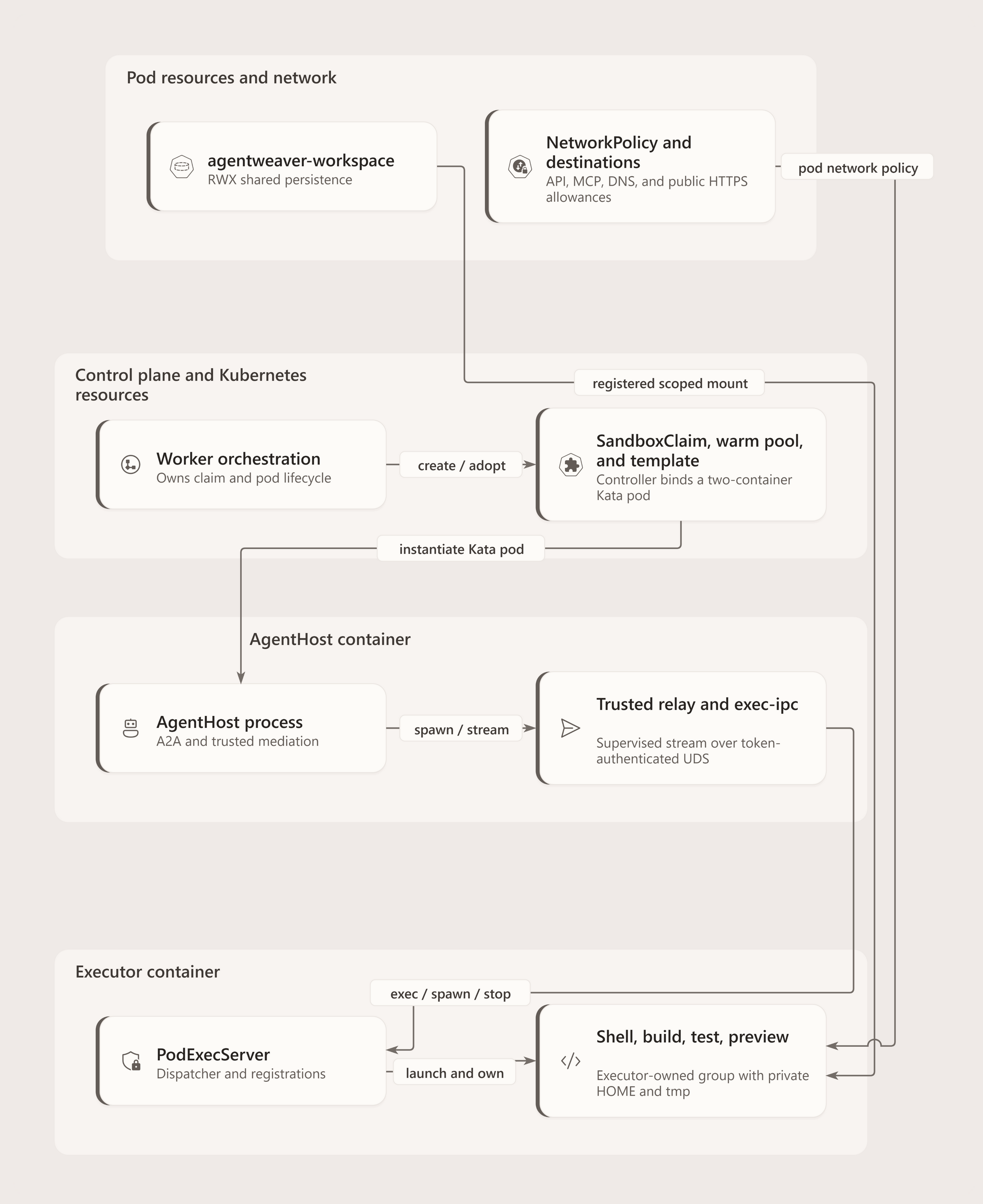
Structured source · Editable draw.io
Related reading
- Sandbox — the underlying isolation model, claim lifecycle, and hardening.
- Sandbox setup — the backend ladder, the
sandbox.selectedevent, and the MXC binary /MXC_BIN_DIRinstall. - Infrastructure & deployment — cluster topology, PVCs, and network policy.
- Sandbox pods reference — flags, pod identity/quota, token injection, pod naming, and security properties.
- Sandbox pod execution experience — what users and operators see and feel.
- A2A bridge and A2A reference — the
-previewtransport that carries agent turns to the pod. - Sandbox browser preview — exposing a server running inside the run's pod to the user over a public HTTPS reverse proxy.
- Tool Approval SSE Contract — public approval outcomes and
tool.approval_resolvedbehavior.
Diagram details and constraints
| Element | Contract |
|---|---|
| title | Move heavy leaf state, keep orchestration |
| takeaway | Remoting compute and migrating the database are independent changes. |
| Before: worker graph | Before: worker graph |
| Before: worker graph | Workflow and gates |
| Before: worker graph | Same host as live leaf state |
| Before: live SDK | Before: live SDK |
| Before: live SDK | Provider session in worker |
| Before: live SDK | Heavy per-run footprint |
| Command sandbox | Command sandbox |
| Command sandbox | Individual shell commands |
| Command sandbox | Separate executor seam |
| Now: worker graph | Now: worker graph |
| Now: worker graph | Workflow and checkpoints |
| Now: worker graph | Keeps orchestration ownership |
| Remote leaf proxy | Remote leaf proxy |
| Remote leaf proxy | Claim/configure then A2A |
| Remote leaf proxy | No database migration implied |
| Per-run AgentHost | Per-run AgentHost |
| Per-run AgentHost | Live SDK + controlled tools |
| Per-run AgentHost | Kata pod with executor sidecar |
| arrow-1 | invoke |
| arrow-2 | command |
| arrow-4 | A2A |
| note-0 | Top: earlier host-local leaf. Bottom: pod-per-run execution. |
| note-1 | P1 can retain one SQLite writer; multiple writers require suitable shared storage. |
| note-2 | Graph-level gates stay host-side; pod-local tool approval has a return path. |
| notes | Top: earlier host-local leaf. Bottom: pod-per-run execution.; P1 can retain one SQLite writer; multiple writers require suitable shared storage.; Graph-level gates stay host-side; pod-local tool approval has a return path. |
Diagram details and constraints
| Element | Contract |
|---|---|
| title | Choose Kubernetes before local probing |
| takeaway | The API router owns cluster selection; the local factory can fall back to direct. |
| API executor router | API executor router |
| API executor router | Backend override / cluster detect |
| API executor router | Explicit local bypasses cluster |
| Kubernetes selected | Kubernetes selected |
| Kubernetes selected | Initialize claim executor |
| Kubernetes selected | Failure throws; no local fallback |
| Claim backend | Claim backend |
| Claim backend | Bound pod command contract |
| Claim backend | Not the in-pod PodExec client |
| Local factory | Local factory |
| Local factory | Only when router selects local |
| Local factory | Probe host-supported backends |
| Windows ladder | Windows ladder |
| Windows ladder | processcontainer -> WSL |
| Windows ladder | wsl-bwrap real; unshare not real |
| Linux ladder | Linux ladder |
| Linux ladder | bubblewrap -> LXC |
| Linux ladder | Host tools must be available |
| No usable isolation | No usable isolation |
| No usable isolation | Automatic local fallback |
| No usable isolation | Also explicit direct option |
| Direct passthrough | Direct passthrough |
| Direct passthrough | IsRealIsolation = false |
| Direct passthrough | Trusted/disposable host only |
| Command registration | Command registration |
| Command registration | ShellEnabled AND real or direct |
| Command registration | wsl-unshare: no controlled shell |
| arrow-1 | select |
| arrow-2 | ready |
| arrow-3 | local |
| arrow-4 | Windows |
| arrow-5 | Linux |
| arrow-6 | unavailable |
| arrow-8 | warn |
| arrow-9 | gate |
| note-0 | The local platform ladders are alternatives, not a Windows-to-Linux chain. |
| note-1 | Kubernetes failure never silently descends into the local ladder. |
| note-2 | Runtime emits sandbox.selected; factory choice is not an isolation guarantee. |
| notes | The local platform ladders are alternatives, not a Windows-to-Linux chain.; Kubernetes failure never silently descends into the local ladder.; Runtime emits sandbox.selected; factory choice is not an isolation guarantee. |
Diagram details and constraints
| Element | Contract |
|---|---|
| title | Local checkout, explicit authoritative writeback |
| takeaway | A temporary Git ref is prepared in-pod and validated before the worker fast-forwards. |
| Source coordinates | Source coordinates |
| Source coordinates | Shared repository + ref |
| Source coordinates | Expected base commit and tree |
| Materialize checkout | Materialize checkout |
| Materialize checkout | Initialize + shallow fetch |
| Materialize checkout | Verify both commit and tree |
| Ephemeral checkout | Ephemeral checkout |
| Ephemeral checkout | Detached immutable base |
| Ephemeral checkout | HOME/XDG outside checkout |
| LocalReadOnly | LocalReadOnly |
| LocalReadOnly | Build / test can write locally |
| LocalReadOnly | Publication is refused |
| LocalWritable | LocalWritable |
| LocalWritable | Implementation edits |
| LocalWritable | Alternate-index final tree |
| Prepare publication | Prepare publication |
| Prepare publication | Flatten nested repo content |
| Prepare publication | No gitlinks; restore metadata |
| Equal result tree | Equal result tree |
| Equal result tree | No-change descriptor |
| Equal result tree | No temporary ref push |
| Changed result tree | Changed result tree |
| Changed result tree | Single-parent commit |
| Changed result tree | Push unique temporary ref |
| Worker validation | Worker validation |
| Worker validation | Run / ref / base / tree / clean |
| Worker validation | Fast-forward authoritative branch |
| arrow-1 | fetch |
| arrow-2 | verify |
| arrow-3 | stage |
| arrow-4 | validate |
| note-0 | LocalReadOnly limits publication, not ephemeral build/test writes. |
| note-1 | Equal-tree and changed-tree outcomes are alternatives. |
| note-2 | Source origin is the shared repository; writeback mints no second GitHub token. |
| notes | LocalReadOnly limits publication, not ephemeral build/test writes.; Equal-tree and changed-tree outcomes are alternatives.; Source origin is the shared repository; writeback mints no second GitHub token. |
Diagram details and constraints
| Element | Contract |
|---|---|
| title | Provisioning progress is not turn readiness |
| takeaway | Bound claims, standby health and configured leaf readiness are separate milestones. |
| Coordinator dispatch | Coordinator dispatch |
| Coordinator dispatch | Child launch begins |
| Coordinator dispatch | Admission owned by Kubernetes |
| Child executor | Child executor |
| Child executor | Create/adopt claim |
| Child executor | Poll until controller binding |
| Provisioning progress | Provisioning progress |
| Provisioning progress | provisioning_pending about 20s |
| Provisioning progress | Child stream shows legitimate wait |
| Coordinator observer | Coordinator observer |
| Coordinator observer | Recognize provisioning wait |
| Coordinator observer | Not a completed agent turn |
| Claim bound | Claim bound |
| Claim bound | Ready condition + pod name |
| Claim bound | Resolve actual pod IP |
| Configure leaf | Configure leaf |
| Configure leaf | Standby listener then SetupAsync |
| Configure leaf | Only then start A2A turn |
| arrow-1 | launch |
| arrow-2 | waiting |
| arrow-3 | progress |
| arrow-4 | bound |
| arrow-5 | setup |
| note-0 | Provisioning events distinguish capacity wait from a silent execution stall. |
| note-1 | Claim Ready is controller binding, not configured AgentHost readiness. |
| note-2 | The configure diagram owns the credential and endpoint-registration sequence. |
| notes | Provisioning events distinguish capacity wait from a silent execution stall.; Claim Ready is controller binding, not configured AgentHost readiness.; The configure diagram owns the credential and endpoint-registration sequence. |
Diagram details and constraints
| Element | Contract |
|---|---|
| title | Bind, reach standby, configure once |
| takeaway | Liveness precedes configuration; production delivers run credentials out of pod specs. |
| Prepare launch | Prepare launch |
| Prepare launch | Resolve provider and run context |
| Prepare launch | Mint fresh turn token |
| Claim warm pod | Claim warm pod |
| Claim warm pod | Create/adopt; omit spec.env |
| Claim warm pod | Wait Ready + bound pod name |
| Resolve and register | Resolve and register |
| Resolve and register | Pod mapping / token registry |
| Resolve and register | Resolve actual pod IP |
| GET /healthz | GET /healthz |
| GET /healthz | HTTP 200 standby |
| GET /healthz | Listener liveness, not turn ready |
| POST /configure | POST /configure |
| POST /configure | Identity / workspace / approvals |
| POST /configure | Copilot capability OR BYOK |
| AgentHost setup | AgentHost setup |
| AgentHost setup | One-time configuration |
| AgentHost setup | Effective workspace + HOME |
| Configuration guards | Configuration guards |
| Configuration guards | Second configure: 409 |
| Configuration guards | Other routes: 503 before ready |
| Register effective endpoint | Register effective endpoint |
| Register effective endpoint | Return effective working directory |
| Register effective endpoint | Shared/local/private fallback |
| First A2A turn | First A2A turn |
| First A2A turn | Production sends turn bearer |
| First A2A turn | Equality guard when nonempty |
| arrow-1 | launch |
| arrow-2 | bound |
| arrow-3 | poll |
| arrow-4 | reachable |
| arrow-5 | setup |
| arrow-6 | ready |
| arrow-7 | invoke |
| note-0 | Top, middle and bottom rows are successive launch stages. |
| note-1 | Repository / preview / broker credentials have separate purposes. |
| note-2 | Optional schema fields do not imply unconditional endpoint enforcement. |
| notes | Top, middle and bottom rows are successive launch stages.; Repository / preview / broker credentials have separate purposes.; Optional schema fields do not imply unconditional endpoint enforcement. |
Diagram details and constraints
| Element | Contract |
|---|---|
| title | Return the decision to the owning gate |
| takeaway | Only an Unknown durable-gate result takes the authenticated pod fallback. |
| Operator decision | Operator decision |
| Operator decision | Coordinator or child run ID |
| Operator decision | Authorize request and owner |
| API approval endpoint | API approval endpoint |
| API approval endpoint | Resolve owning child |
| API approval endpoint | Try durable gate first |
| Durable gate | Durable gate |
| Durable gate | Known terminal: return result |
| Durable gate | Unknown: pod-per-run fallback |
| Public response | Public response |
| Public response | Return mapped result |
| Public response | 200 / 404 / 409 / 503 |
| Approval HTTP client | Approval HTTP client |
| Approval HTTP client | Resolve pod origin + credential |
| Approval HTTP client | Authenticated control callback |
| AgentHost local gate | AgentHost local gate |
| AgentHost local gate | Resolve pending tool request |
| AgentHost local gate | Return resolution to API |
| arrow-1 | grant |
| arrow-2 | try |
| arrow-3 | unknown |
| arrow-4 | forward |
| arrow-5 | result |
| arrow-6 | return |
| arrow-7 | respond |
| note-0 | The fallback uses ApprovalHttpClient; arrows summarize request and return. |
| note-1 | Configured control auth accepts turn or preview credential; dev can omit both. |
| note-2 | Errors and provisional-grant rollback/finalize stay in the consumer prose. |
| notes | The fallback uses ApprovalHttpClient; arrows summarize request and return.; Configured control auth accepts turn or preview credential; dev can omit both.; Errors and provisional-grant rollback/finalize stay in the consumer prose. |
Diagram details and constraints
| Element | Contract |
|---|---|
| title | Two PID namespaces, a narrower child mount view |
| takeaway | Kata isolates the pod; the executor container separates model processes from AgentHost. |
| AgentHost container | AgentHost container |
| AgentHost container | PID namespace A |
| AgentHost container | Provider / A2A / control state |
| Pod-private IPC | Pod-private IPC |
| Pod-private IPC | Authenticated UDS + token |
| Pod-private IPC | Memory-backed emptyDir |
| Executor container | Executor container |
| Executor container | PID namespace B |
| Executor container | No Kubernetes or AAD identity |
| Platform registration | Platform registration |
| Platform registration | Exact workspace and HOME |
| Platform registration | Reject unregistered paths |
| Child mount view | Child mount view |
| Child mount view | Workspace / HOME / scratch / tmp |
| Child mount view | Exact Git metadata read-only |
| Model-controlled child | Model-controlled child |
| Model-controlled child | Runtime-provided executor procfs |
| Model-controlled child | No nested bwrap PID namespace |
| Kata pod / VM | Kata pod / VM |
| Kata pod / VM | Shared pod network |
| Kata pod / VM | VM separates pod from host node |
| Absent from child view | Absent from child view |
| Absent from child view | PVC root / siblings / IPC token |
| Absent from child view | AgentHost PID tree unavailable |
| System runtime roots | System runtime roots |
| System runtime roots | Optional run-private overlays |
| System runtime roots | Not universally read-only /usr |
| arrow-1 | request |
| arrow-2 | dispatch |
| arrow-3 | allowlist |
| arrow-4 | spawn |
| arrow-5 | execute |
| note-0 | All cards are inside one Kata pod; containers have distinct PID namespaces. |
| note-1 | The child view is a mount boundary, not a third container/PID namespace. |
| note-2 | Startup rejects same-PID-namespace execution; no model access to IPC secrets. |
| notes | All cards are inside one Kata pod; containers have distinct PID namespaces.; The child view is a mount boundary, not a third container/PID namespace.; Startup rejects same-PID-namespace execution; no model access to IPC secrets. |