
Browser console — Deep Dive
⚠️ Removed from the UI (#346). The frontend half of this design (
BrowserConsole.tsx,ConsolePanelContext, the LeftNav/top-bar trigger) has been deleted; the Sessions/Assistant page is now the sole assistant entry point. The backend facade (ConsoleTurnService,CopilotConsoleFacadeAgent) still exists with no other caller, kept only until a follow-up pass confirms it can be deleted outright. This document describes the pre-#346 design.
The browser console is a singleton operator facade for the web app. The browser owns the terminal-style shell, route context, and shortcut commands; the API owns natural-language routing, safe tool execution, and gate surfacing. For the route and DTO contract see the reference; for the user flow see the experience guide.
Flow
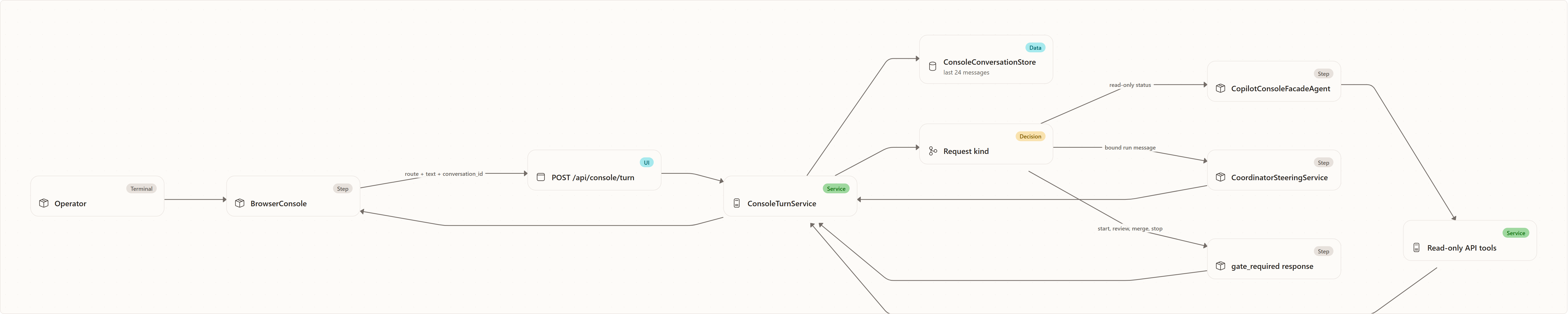
Shell and context
BrowserConsole computes context from the current route: orchestration routes bind both project_id and run_id, project routes bind project_id, and other routes use global scope (apps/web/src/console/BrowserConsole.tsx:295). On natural-language submit, the browser posts message, text, conversation_id, and the route context to apiClient.sendConsoleMessage (BrowserConsole.tsx:606; apps/web/src/api/client.ts:463). The shell renders stateful responses as clarification, gate, or error blocks and shows returned links and tool summaries (BrowserConsole.tsx:361, :674).
ConsolePanelContext keeps the panel mounted at the app-shell level, and ConsoleRouteRedirect opens the panel then redirects /console to /overview (apps/web/src/components/shell/ConsolePanelContext.tsx:1; ConsoleRouteRedirect.tsx:1).
Backend routing
ConsoleEndpoints exposes both POST /api/console/messages and POST /api/console/turn through the same handler (apps/Agentweaver.Api/Endpoints/ConsoleEndpoints.cs:63). It maps console validation errors to the service-selected status code, steering validation to 400, steering recovery exhaustion to 409, and provider failures to 401, 429, or 503 based on AgentProviderFailureKind (ConsoleEndpoints.cs:24, :37, :48, :70).
ConsoleTurnService normalizes text/message, creates or reuses a conversation_id, resolves the supplied project/run with ownership checks, and rejects a project/run mismatch with 409 context_mismatch (apps/Agentweaver.Api/Console/ConsoleTurnService.cs:61, :68, :77). It then chooses one of four safe paths:
- gate-intent words such as confirm, approve, merge, or review return
gate_requiredrather than bypassing a human gate (ConsoleTurnService.cs:93,:315); - destructive words such as delete, archive, cancel, or stop return a destructive-action gate (
ConsoleTurnService.cs:96,:354); - read-only status/list/show questions run through the Copilot facade (
ConsoleTurnService.cs:105,:443); - prose with a bound run is sent as coordinator steering (
ConsoleTurnService.cs:108,:278).
The in-memory ConsoleConversationStore keeps the last 24 messages per conversation id (ConsoleTurnService.cs:22). That preserves short context for the facade but is intentionally not a durable audit log.
Facade agent
CopilotConsoleFacadeAgent starts a GitHub Copilot MAF session with streaming enabled, a session id derived from the console conversation, session-store persistence disabled, and a read-only tool list from ConsoleFacadeApiTools.Build (packages/Agentweaver.AgentRuntime/ConsoleFacadeAgent.cs:78). The system addendum tells the model it is the singleton browser console, must ask one focused clarification only when needed, and must not claim to execute budget-consuming, destructive, merge, review, or gate decisions (ConsoleFacadeAgent.cs:158).
The available facade tools are status-oriented only: project listing and lookup, project runs, backlog board, run status, coordinator work plan, coordinator children, orchestration topology, blueprints, catalog roles, workflows, decisions, decision inbox, and memory (ConsoleFacadeAgent.cs:269). Tool calls use the caller's authorization header when present (ConsoleFacadeAgent.cs:388) and return compact completion/failure summaries for display (ConsoleFacadeAgent.cs:369).
Error surface
Provider failures are normalized before reaching the browser. AgentProviderException classifies GitHub Copilot auth, rate-limit, model-list, model-unavailable, runtime-not-configured, and transient HTTP failures into Authorization, RateLimited, Configuration, or ProviderUnavailable, with a machine-readable error code and user message (packages/Agentweaver.AgentRuntime/Providers/AgentProviderException.cs:41). The web helper formatApiError maps API status codes into consistent user messages for unauthorized, forbidden, not found, conflict, rate-limited, server, network, and unknown errors (apps/web/src/api/errors.ts:34).
Source
| Concern | File |
|---|---|
| Singleton panel context and redirect | apps/web/src/components/shell/ConsolePanelContext.tsx; ConsoleRouteRedirect.tsx |
| Browser shell, route binding, submit, rendering | apps/web/src/console/BrowserConsole.tsx |
| API client method | apps/web/src/api/client.ts |
| Console endpoints and provider status mapping | apps/Agentweaver.Api/Endpoints/ConsoleEndpoints.cs |
| Request routing, gates, steering, response builder | apps/Agentweaver.Api/Console/ConsoleTurnService.cs |
| MAF-backed facade and safe tools | packages/Agentweaver.AgentRuntime/ConsoleFacadeAgent.cs |
| Provider failure classifier | packages/Agentweaver.AgentRuntime/Providers/AgentProviderException.cs |
| Web API error formatter | apps/web/src/api/errors.ts |